

A 100-point credit score increase sounds dramatic, but it’s one of the most achievable financial goals you can set. The difference between a 620 and a 720 score isn’t just bragging rights — it’s thousands of dollars saved on interest, lower insurance premiums, and better chances at apartment approvals. Whether your score took a hit from missed payments or you’re starting thin, the mechanics of improving it are the same. Understand what moves the needle, take action on the factors that matter most, and watch your score climb.
TL;DR: Payment history (35%) and credit utilization (30%) control 65% of your score. Fix those two first. Pay down balances below 30% utilization, set autopay on every account, and dispute any errors on your report. Most people see 50–100 point gains within 3–6 months.
What Is a Credit Score and How Is It Calculated?
Your credit score is a three-digit number (300–850) that tells lenders how likely you are to repay borrowed money. The most common scoring model, FICO, uses five factors with different weights. Understanding these weights tells you exactly where to focus your effort.
| Factor | Weight | What It Measures |
|---|---|---|
| Payment History | 35% | Whether you pay on time, every time |
| Credit Utilization | 30% | How much of available credit you’re using |
| Length of Credit History | 15% | Average age of all your accounts |
| Credit Mix | 10% | Variety of credit types (cards, loans, mortgage) |
| New Credit Inquiries | 10% | Recent applications and hard pulls |
See that? Two factors — payment history and utilization — account for 65% of your score. That’s where 90% of your effort should go, especially in the first 90 days.
How Fast Can You Realistically Raise Your Score?
It depends on your starting point and what’s dragging your score down. If you have errors on your report, fixing them can boost your score within 30 days. If your utilization is high, paying down balances can show results in 30–60 days. Negative marks like late payments or collections take longer — 7 years to fall off completely [VERIFY: reporting timeframe], though their impact fades over time.
| Score Range | Realistic Improvement | Timeline |
|---|---|---|
| Below 580 (Poor) | 50–100 points | 3–6 months |
| 580–669 (Fair) | 40–80 points | 3–6 months |
| 670–739 (Good) | 20–50 points | 6–12 months |
| 740–799 (Very Good) | 10–30 points | 6–12 months |
Example: Someone with a 620 score and $5,000 in credit card debt on a $10,000 total limit (50% utilization) could see a 60–80 point jump just by paying that down to $2,500 (25% utilization). That single action hits 30% of the scoring formula.
The Utilization Trick That Can Boost Your Score in 30 Days
Credit utilization is the ratio of your current balances to your total credit limits. Below 30% is good. Below 10% is ideal. Here’s the thing most people don’t realize: utilization is calculated at statement closing time, not when you pay your bill. So even if you pay in full every month, a high balance at statement time looks like high utilization to the credit bureaus.
The fix? Make a payment before your statement closes. If your card reports on the 15th, pay your balance down on the 13th. This ensures the reported balance is low even if you’re using the card throughout the month.
Example: You have a $3,000 credit limit and spend $2,000/month. At statement time, your utilization is 67% — terrible. But if you pay $1,500 before the statement closes, the reported balance is $500, and your utilization drops to 17%. Same spending, different reported ratio. This alone can move your score 20–40 points.
Should You Dispute Errors on Your Credit Report?

A Federal Trade Commission study found that 26% of consumers had errors on their credit reports serious enough to affect their scores [VERIFY: FTC study statistic]. That’s more than 1 in 4 people. Checking your reports and disputing inaccurate information is free, takes about 30 minutes, and can produce immediate score improvements.
You’re entitled to one free report from each bureau (Equifax, Experian, TransUnion) every year at AnnualCreditReport.com. Pull all three, look for accounts you don’t recognize, incorrect late payments, outdated personal info, or duplicate entries. File disputes online — the bureaus have 30 days to investigate.
3 Action Steps to Start Improving Your Score Today
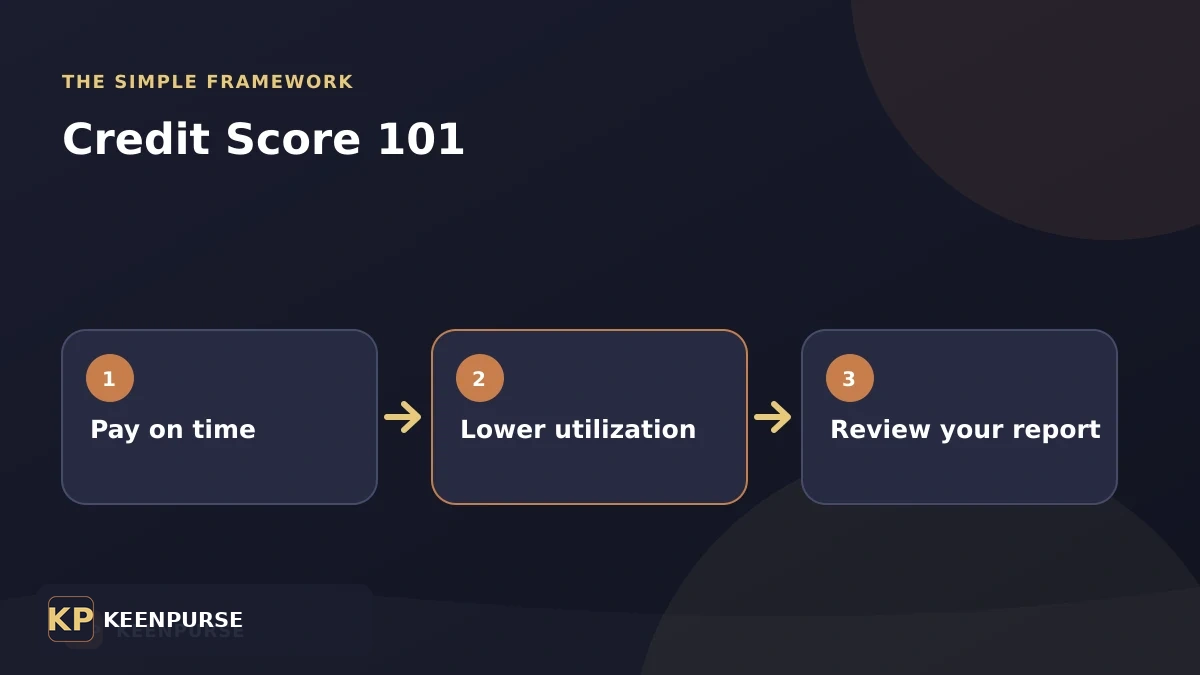
- Pull all three credit reports from AnnualCreditReport.com. Review each one for errors — wrong accounts, incorrect late payments, outdated addresses. File a dispute for every error you find. This takes 30–45 minutes and can yield the fastest score improvement if errors exist.
- Set up automatic payments on every credit account. Even a single late payment can drop your score 60–100 points. Configure autopay for at least the minimum due on every card and loan. Payment history is 35% of your score — protect it absolutely.
- Pay down balances to below 30% utilization, ideally below 10%. Start with the card closest to its limit. If you can’t pay everything down immediately, request a credit limit increase — a higher limit automatically lowers your utilization ratio without spending less.
What Hurts Your Score (And What Doesn’t)
| Action | Impact on Score | How Long It Lasts |
|---|---|---|
| 30-day late payment | −60 to −100 points | 7 years (fades after 2) |
| Maxed-out credit card | −30 to −50 points | Immediate, reversible |
| Hard inquiry | −3 to −5 points | 12 months (score impact) |
| Collection account | −80 to −150 points | 7 years [VERIFY] |
| Checking your own score | 0 (soft inquiry) | No impact |
| Closing an old card | −10 to −30 points | Indirect, via utilization & age |
Notice that checking your own score has zero impact. This is a soft inquiry — only hard inquiries (from applications) affect your score. Check your score as often as you want.
Also, think twice before closing old cards. Even if you don’t use them, they contribute to your total credit limit (lowering utilization) and account age (15% of your score). Closing a 10-year-old card could hurt more than keeping it open with a $0 balance.
Put this into practice
Focus on the credit-score actions you control
Credit improvement is usually about steady habits: pay on time, keep revolving balances manageable, and check your reports for errors. Do not pay a company to do what you can do yourself for free.
- Set autopay for at least the minimum due on every open account.
- Check all three credit reports and make a note of any unfamiliar account or late payment.
- Choose one balance-reduction target and track it until the statement closes.
For official consumer information, check AnnualCreditReport.com before making a financial decision.
Frequently asked questions
Can paying off a card change my score?
A lower reported balance may help the utilization part of many scoring models, but scores use several factors and can move for more than one reason.
Should I close an old credit card?
Do not close it just to chase a score change. Consider the annual fee, your ability to manage the account, and how closing it would affect your available credit.