
Personal Finance

Personal finance guides for budgeting, debt, credit, and everyday money decisions, written for beginners in plain English.

Branded 3D eating-out budget plan with restaurant setting, takeaway, grocery bag, calendar and calculator

How to Save Money on Eating Out Without Giving It Up Completely

TL;DR

Saving money on eating out does not have to mean declaring restaurants, takeout, takeaways, fast food, and delivery off-limits. Start by treating food away from home as one category you define consistently. Review a recent stretch of spending, choose a monthly amount that fits your own budget, decide which occasions matter most, and check in before the category quietly expands.

Key Takeaways

  • Define “eating out” before trying to reduce it, then count the same kinds of purchases each time.
  • Use a reader-chosen category budget rather than a universal dining allowance or percentage.
  • Decide ahead of time which occasions you want the category to cover, including takeout, takeaways, delivery, and fast food if they apply to you.
  • Build a few realistic swaps into your routine instead of relying on a strict rule you will abandon.
  • Review the category after changes in schedule, income, household needs, or habits; one unplanned purchase does not erase the plan.

Define the Category Before Trying to Cut It

The phrase “eating out” can hide a surprisingly wide range of spending. For one reader, it means restaurant meals only. For another, it includes coffee bought on the way to work, fast food, takeout or takeaways, delivery charges, and meal-delivery services. Neither definition is automatically right. The useful part is choosing one and applying it the same way from one review period to the next.

Start with your transaction history, receipts, or notes from a recent period. Put each food-away-from-home purchase in one place. If a purchase does not fit neatly, choose a rule and use it in future reviews.

CategoryInclude it in an eating-out budget?Planning note
Restaurant mealUsually, if it fits your definitionRecord the full occasion, not just the main meal.
Coffee or snack bought away from homeYour choiceInclude it consistently if it is part of the habit you want to see.
Fast foodUsually, if it fits your definitionKeep it visible rather than folding it into groceries.
Takeout or takeawaysUsuallyUse the same category whether you collect it or bring it home.
Delivery fees, tips, or order chargesWhere applicableDecide whether these are part of the meal occasion and review the total.
Meal-delivery serviceYour choiceKeep it separate if that makes your decisions clearer.
GroceriesNo, unless your own system says otherwiseGroceries are a different food-at-home category.
Branded 3D food-budget framework with restaurant, coffee, takeaway and grocery categories
Define food away from home consistently so the category shows a useful pattern.

A clear boundary helps the budget show a useful pattern. For grocery-specific tactics, use a separate grocery category.

Build a Reader-Entered Eating-Out Budget

A category budget is a decision tool, not a verdict on what you should spend. Begin with an amount you choose after looking at your overall obligations, priorities, and recent spending. Then decide how many occasions you want that amount to cover before the next check-in. The number of occasions might include restaurant visits, takeout nights, or quick stops that you have chosen to count.

Fill in your own figures; leave a cell blank until you have enough information to make a choice.

Reader-chosen monthly amountPlanned occasionsEstimated per-occasion amountCheck-in date
Your amountYour number of occasionsMonthly amount ÷ planned occasions (illustrative arithmetic only, not a recommendation)Your chosen date
Your revised amount, if neededYour revised numberRevised amount ÷ revised occasions (illustrative arithmetic only, not a recommendation)Your next check-in
Branded 3D restaurant-occasion plan with calendar, grocery bag, calculator and checklist
Choose the occasions that matter and review the category before an unplanned order.

The estimate is not a spending instruction. If the occasions you value do not fit the category, change the occasions, the category amount, the type of occasion, or another part of the wider budget.

If you use a broader framework, the zero-based budgeting guide can help you see where dining out sits among other discretionary choices. It should not be read as a prescribed eating-out allocation.

Choose Repeatable Swaps, Not a Perfect Rule

Rather than announcing that you will never eat out, pick one or two situations where you want a different routine. The swap should fit your schedule, preferences, and household.

For example, you might reserve restaurant occasions for plans you care about and make fewer spontaneous stops. You could choose collection or pickup rather than delivery when that option is available and works for you, while checking the actual order total first. Or you might designate some evenings for food prepared at home without turning that choice into meal-prep or nutrition guidance.

Write the swap in practical language: “When I am deciding at the end of a workday, I will check the category balance before ordering.” At the next check-in, keep what worked and replace what did not.

Plan for Takeout, Delivery, and Fast Food

These purchases may draw from the same food-away-from-home budget. “Takeout” is common in US usage, while “takeaways” is common in UK usage; either can describe food ordered to eat away from the venue.

Term or purchase typeCategory question to askBefore-you-buy check
Takeout / takeawayDoes this count as an eating-out occasion in my system?Check the planned occasions remaining.
DeliveryWill I count the food and all applicable order charges together?Look at the full total before confirming.
Fast foodIs this a planned convenience choice or an unplanned routine?Check the category balance and your next planned occasion.
Restaurant mealIs this one of the occasions I chose in advance?Decide whether it fits the category before ordering.

The point is not to assume that any one format costs less. Availability, charges, terms, and totals can vary by provider and location. Avoid building a plan around a promotional offer, loyalty programme, subscription, or coupon unless you have read the current terms and can evaluate it for your own situation.

If Eating Out Has Become a Habit You Want to Change

A recurring food purchase can reflect time pressure, a commute, a social routine, or preference. Naming the trigger can help you choose a small experiment.

Observe for one review period: when do you most often buy food away from home, and what happens immediately before? Then choose one reader-defined experiment, such as planning a convenience occasion or checking the category before buying. There is no promised savings result.

If you want a short, structured pause from optional spending, a short, structured spending pause may be a companion resource. A pause can reveal patterns; it does not replace a category plan that works after the pause ends.

Link the Food Budget Together

Keep the categories distinct: groceries cover food bought for home use, and eating out covers your selected food-away-from-home definition. A no-spend period can be a temporary reset; a wider budget can show trade-offs.

For a broader pre-purchase reflection framework, see the zero-based budgeting guide. For an approved meal-prep or grocery refresh, use a separate grocery review when a canonical page is available.

Frequently Asked Questions

How can I save money when eating out?

Define what counts, review a recent period, choose a category amount and number of occasions, then use a repeatable pre-purchase check. This is a planning method, not a promise of savings.

How much should I budget for eating out each month?

There is no universal monthly amount in this guide. Use your own cash flow, obligations, priorities, and category history, then revise the amount or planned occasions when circumstances change.

Is takeout the same as dining out for budgeting?

It can be, if you decide to include it in your food-away-from-home category. The important step is consistency: record takeout or takeaways, delivery, and restaurant meals according to the definition you selected. Keep groceries separate if that makes the pattern easier to understand.

How can I stop spending so much on fast food?

Notice when fast-food purchases happen and test one small alternative that fits your routine. You might plan convenience occasions or check your category before buying. Do not expect a guaranteed result.

What is the difference between groceries and eating-out spending?

Groceries generally cover food bought for home use, while eating-out spending covers the food-away-from-home purchases you define, such as restaurant meals, takeout, takeaways, fast food, or delivery. Separate categories make it easier to review each pattern without assuming they require the same solution.

Sources and further reading

Editorial review: KeenPurse Editorial Team reviewed this guide on August 28, 2026. Rules, prices, eligibility, product terms, and local services can change; follow the dated primary sources and verify details that apply to you.

⚠️ This article is for educational information only and does not constitute personalized financial, investment, legal, or tax advice. Verify current local information before acting; see KeenPurse’s disclaimer.

How to Save Money on Eating Out Without Giving It Up Completely Read More »

Branded 3D retirement contribution plan with calendar, calculator, savings vessel and growing plant

How to Save for Retirement: A Beginner’s Contribution Plan

Saving for retirement starts with a repeatable decision: set aside an amount you can keep contributing on a regular cadence, then use the workplace or individual arrangement that applies under current local rules. That is different from predicting a retirement outcome or naming one “right” amount. A workable plan has a sustainable contribution, a schedule that fits how you are paid, and current plan information.

TL;DR

The practical answer to how to save for retirement is to turn an intention into a recurring budget line, not to chase a universal percentage or a retirement-number forecast. Pick a reader-chosen contribution cadence, record it, and revisit it when income or circumstances change. Then identify the workplace plan or individual arrangement that applies locally before acting on plan, tax, eligibility, or account details.

Key Takeaways

  • Start with a contribution amount you can repeat; a smaller sustainable habit can be easier to review than an ambitious plan that breaks after one pay cycle.
  • Choose a cadence that matches your pay pattern or income rhythm, then place the contribution in your budget before discretionary spending decisions.
  • Keep the saving question separate from the account question, the investment question, and the retirement-number question.
  • Use your own plan documents and current official guidance for account, tax, eligibility, employer, pension, and contribution-rule details.
  • Review the plan after a meaningful change rather than treating the first choice as permanent.

Separate the three retirement questions before you make a plan

Retirement planning gets confusing when several valid questions become one. “How do I save?” concerns contributing regularly. “Where can I save?” concerns the available plan or account. “How much will I need?” is a target-number question; “What should I invest in?” is an investment question.

This article stays with the first question. A generic rule cannot answer every account, tax, investment, or retirement-date decision. The relevant arrangement and local rules vary by reader and must be checked from current documentation.

QuestionThis article helps withCompanion topic
How do I save or contribute regularly?Choosing a reader-entered amount, cadence, and review routineThis contribution plan
Which account or workplace plan exists?Identifying the documents and questions to verifythe Roth IRA and retirement-account explainer
How much do I need to retire?Recognising that this needs separate personal analysisA separate, personalized retirement-target analysis
What should I invest in?Keeping investment choices outside this article’s scopethe beginner investing guide
Branded 3D retirement framework separating contribution, account, investment and target decisions
Keep the contribution habit, account choice, investment choice and retirement target as separate decisions.

Start with a contribution you can keep up

A contribution plan is a cash-flow plan first. Look at when money arrives, the bills already due, and periods when income is less predictable. Choose an amount and timing you can revisit rather than a number borrowed from somebody else’s circumstances.

Some readers prefer a fixed monthly entry; others use a pay-period entry or a schedule that follows variable income. Neither cadence guarantees an outcome; it gives the habit a place in the budget. If a contribution strains essential obligations or immediate cash needs, reassess the plan.

Before setting the first entry, gather:

  • your usual pay or income cadence;
  • current workplace-plan, benefits, or pension documentation, if one exists;
  • immediate cash needs and an emergency-fund priority;
  • debt payments or other cash-flow pressure that affect what is sustainable;
  • the current local rules and plan terms that could affect the arrangement you are considering.

For a contribution-habit introduction, see the beginner investing guide. For budget-category context, see the zero-based budgeting guide; it is not a retirement-contribution prescription.

Use a reader-entered retirement contribution worksheet

The worksheet is deliberately blank. Enter the contribution you chose, the number of times you expect to make it, and the arithmetic total. It is a record, not a recommendation, growth estimate, or retirement-date calculation.

Reader-entered contribution per periodNumber of periods in a yearIllustrative annual totalNotes to review
____________contribution per period × number of periodsDoes this cadence match income timing?
____________contribution per period × number of periodsWould a change in bills require an adjustment?
____________contribution per period × number of periodsWhich plan or account terms need verification?
Branded 3D retirement review with calendar, documents, calculator and adjustment symbol
Review the plan after changes in income, employment, documents or goals.

If you choose a monthly cadence, multiply the amount by 12 to record a calendar-year contribution total. That is arithmetic only, not a recommendation, projection, or statement about what you should save. With irregular income, record each contribution and compare the record with your plan at a later check-in.

Keep the worksheet where you will see it. The tool matters less than being able to compare the plan with what happened. For a separate scheduled-money routine, see a separate saving-ahead category. That article covers scheduling mechanics, not retirement accounts or targets.

If you are self-employed or have no workplace plan

A self-employed reader, freelancer, side-hustler, or employee without a workplace arrangement may need to identify an individual retirement arrangement or another locally applicable option. The planning task is still familiar: decide what can be set aside, choose a cadence, and keep a record.

Account availability, eligibility, limits, tax treatment, withdrawal rules, penalties, and administration can be jurisdiction- and arrangement-specific. Check a current primary authority and plan documentation. For U.S.-specific rules, use current IRS retirement-plan or IRA guidance; for workplace terms, use plan material or current U.S. Department of Labor/Employee Benefits Security Administration material. For non-U.S. arrangements, use the applicable national tax or pension authority.

With variable income, some readers separate a planned contribution from money needed for near-term obligations. That is a record-keeping choice, not an account, tax, or investment recommendation.

Starting later is still a planning decision

Starting in your 40s, 50s, or later can make retirement saving feel urgent. Avoid any promise that one tactic will “catch you up.” No article can determine the contribution, retirement date, account choice, or investment approach that fits your circumstances.

Take inventory: list existing arrangements, locate current documents, note a contribution pattern you can sustain, and identify questions for qualified personal help. Clear records and realistic reviews are especially useful when personal tax, legal, pension, employment, or investment considerations are involved.

Review rather than set-and-forget

A contribution plan should be stable enough to follow and flexible to revisit. A review may confirm the cadence, record, and current plan information still fit.

TriggerWhat to reviewWho or what can verify it
Income changeWhether the current contribution still fits cash flowYour budget record and current income information
Job changeWhether a different workplace arrangement appliesCurrent employer benefits material or plan document
Plan-document updateTerms that could affect participation or contributionsOfficial plan notice or administrator documentation
Change in country or tax residenceWhether different local rules may applyApplicable national tax or pension authority
Personal-goal changeWhether you need individual planning supportA qualified professional appropriate to your circumstances

Put a future review date beside the worksheet so an old assumption does not quietly become the plan.

Frequently Asked Questions

How do I start saving for retirement?

Choose a reader-entered contribution you can repeat, select an income-fitting cadence, and record it in your budget. Then identify the applicable arrangement and verify current terms before acting.

How much should I save for retirement each month?

There is no universal monthly amount in this guide. Start with an amount that fits current cash flow and review it when circumstances change. Personal advice may be useful when income, existing savings, retirement timing, taxes, or plan rules enter the decision.

Can I save for retirement if I am self-employed?

You may need an individual arrangement or locally applicable alternative. Keep records and verify availability, eligibility, limits, tax treatment, and other terms from current official guidance before account-specific decisions.

What if I do not have a 401(k) or workplace pension?

Treat a missing workplace arrangement as an information task, not a reason to guess. Identify local individual options and verify current rules. This article does not compare accounts; review the Roth IRA and retirement-account explainer.

Is it too late to start saving for retirement at 50?

Make a present-tense planning decision: inventory what exists, set a sustainable next contribution, and get qualified guidance where appropriate. This article cannot say what amount, account, or outcome is right at any age.

Sources and related reading

Editorial review: KeenPurse Editorial Team reviewed this guide on August 28, 2026. Rules, prices, eligibility, product terms, and local services can change; follow the dated primary sources and verify details that apply to you.

⚠️ This article is for educational information only and does not constitute personalized financial, investment, legal, or tax advice. Verify current local information before acting; see KeenPurse’s disclaimer.

How to Save for Retirement: A Beginner’s Contribution Plan Read More »

Branded 3D Roth IRA guide with account folders, secure box, investment tiles and calendar

What Is a Roth IRA? A Beginner’s Guide to Retirement Accounts

TL;DR

A Roth IRA is a United States retirement-account arrangement. It is not an investment by itself; it is an account with rules about contributions, tax treatment, and withdrawals. The investments held inside it are a separate decision. A Traditional IRA and a workplace 401(k) are also retirement-account or plan categories, but their rules are not interchangeable. Current eligibility, contribution, tax, withdrawal, and employer-plan terms are all questions that require official or plan-specific documentation.

Key Takeaways

  • A retirement account is a legal and administrative container; an investment is something that may be held inside it.
  • A Roth IRA is a US arrangement, so readers outside the US should not assume the name or rules apply locally.
  • Roth IRA, Traditional IRA, and workplace 401(k) arrangements have distinct rule sets; none is automatically “best” for every reader.
  • An employer match is a feature some workplace plans may offer under their own terms, not a universal retirement benefit.
  • Before acting, gather current official rules and your own workplace-plan documents rather than relying on an old article, a social-media clip, or a generic contribution rule.

Start with the vocabulary

Retirement terminology becomes easier once the layers are separated. A retirement goal is the purpose. A retirement account or workplace plan records contributions and applies rules. Investments are assets that may sit inside it. “Open a Roth IRA” does not answer which provider, investments, contribution amount, or tax approach fits a particular person; those questions depend on verified facts.

TermPlain-English meaningWhat this article does not decide for you
Retirement goalA long-term financial purpose, often connected with later-life income or spending.Your target date, desired lifestyle, or savings target.
Retirement accountAn account arrangement governed by rules that can affect contributions and withdrawals.Whether the arrangement suits your circumstances.
Workplace planA retirement plan connected to an employer; a 401(k) is a US example.Whether to join, what to contribute, or how your employer’s plan works.
ContributionMoney placed into an account or plan, subject to applicable rules.A contribution amount or schedule.
InvestmentAn asset held within an account, such as a fund or other security.Which investment to buy or sell.
Employer matchAn employer contribution that some workplace plans may provide under plan-specific terms.Whether you are eligible or what action to take.
Branded 3D Roth IRA framework separating account folders from investment tiles
Separate the retirement-account container from the investments held inside it.

A useful next read is What Is Investing for Beginners?, which covers the account-versus-investment boundary without turning this article into a product-selection guide.

What makes a Roth IRA different at a high level?

At a high level, Roth IRA contributions are not tax-deductible, while qualified distributions are tax-free when IRS requirements are met. A Roth IRA is an account, not an investment, and this tax description is not a shortcut for deciding whether one suits a particular person.

Eligibility, contribution limits, income-related conditions, timing, and withdrawal treatment are official-rule questions that can change or depend on a reader’s circumstances. Use current IRS guidance, not a dated blog post, beside any US Roth IRA decision. Unlike a workplace plan, an IRA is generally an individual arrangement rather than an employer-administered benefit.

Roth IRA vs. Traditional IRA vs. workplace 401(k)

A comparison should identify the question each category raises rather than declare a winner. The labels below are US-oriented. International readers should check their own official tax or pension authority; a foreign account is not automatically a Roth IRA equivalent.

Account or plan classWho commonly offers itHigh-level tax/rule questionWhat to verify
Roth IRAA financial institution administering an individual US retirement account.How current Roth contribution and qualified-withdrawal rules apply.IRS rules, eligibility, limits, timing, withdrawal conditions, and provider terms.
Traditional IRAA financial institution administering an individual US retirement account.How current contribution and tax-treatment rules apply.IRS rules, eligibility, limits, deduction treatment where relevant, and provider terms.
Workplace 401(k)An employer-sponsored US workplace plan.What the employer’s plan permits and how its current rules operate.Plan summary, enrollment materials, contribution options, fees, vesting, and distribution terms.
Employer matchSome employers within a workplace-plan design.Whether the plan includes a match and under what conditions.The employer’s current plan document and benefits contact.
Branded 3D retirement-account due-diligence checklist with documents, calendar and calculator
Check current official rules and plan documents before choosing a next step.

The table is a map, not a ranking. Account names alone cannot resolve a reader’s cash needs, tax circumstances, employment situation, or investment preference. Start with current documentation, not a universal internet answer.

For a broader first-step sequence, see What Is Investing for Beginners?. It can help readers place retirement-account vocabulary within beginner investing without making a contribution prescription.

How an employer match fits in

An employer match is not another investment. Under plan-specific terms, some employers may add money in connection with employee participation or contributions. Find the current plan description, enrollment materials, or benefits contact. Ask which contributions count, when employer contributions are made, and whether conditions apply. Those are fact-finding questions, not instructions to contribute a particular amount.

Questions to answer before choosing a next step

A short preparation list can prevent an account label from doing too much work. Fill it out before comparing providers, investments, or contribution ideas:

Question to documentWhy it belongs in your notesWhere to verify it
Where are you resident for tax and retirement-plan purposes?Names and rules can be jurisdiction-specific.Relevant official tax or pension authority.
Is there a workplace retirement plan?It may have its own enrollment process and documents.Employer benefits materials or plan administrator.
What documents describe the plan?Summaries may explain plan-specific terms.Current employer plan documents.
What current contribution rules apply?Annual limits and eligibility are not timeless facts.Dated official source.
Are near-term bills and cash reserves covered?A retirement label does not remove short-term financial needs.Your own budget and, if needed, a qualified professional.
What needs professional clarification?Tax, legal, and personal financial questions can be individual.An appropriately qualified professional.

This is not a recommendation engine. Readers building a cash reserve can also review the emergency-fund sizing guide for context; that link is not a direction to delay, start, or change retirement contributions.

Common beginner mistakes to avoid

Do not treat an account as though it automatically selects investments. Do not assume a limit, tax outcome, or employer-match formula from an undated post, or assume a broker or employer plan is available to everyone. Separate vocabulary from action: collect current documents and identify unanswered questions before relying on a generic comparison chart.

Frequently Asked Questions

What is a Roth IRA in simple terms?

A Roth IRA is a US individual retirement-account arrangement with rules about contributions, tax treatment, and withdrawals. It is not itself an investment, and the label does not determine a person’s provider, investments, eligibility, or tax result. Check the current IRS guidance before relying on any rule.

Is a Roth IRA the same as a 401(k)?

No. A Roth IRA is an individual US retirement-account arrangement, while a 401(k) is commonly a workplace-plan category in the US. Their administration and rules can differ. A reader should use current IRS material and their own employer’s plan documentation rather than assume the terms transfer between them.

What is the difference between a Roth IRA and a Traditional IRA?

They are distinct US IRA categories with different current rule and tax-treatment questions. A simple comparison cannot establish which is preferable for an individual. Verify current IRS guidance and consider qualified tax or financial help for a situation-specific question.

How does an employer match work?

Some workplace plans may include an employer contribution tied to employee participation or contributions under defined plan terms. The formula, eligibility, timing, and vesting conditions are plan-specific. The authoritative source is the current employer plan document or benefits contact, not a general example online.

Can readers outside the US use a Roth IRA?

A Roth IRA is a US retirement-account term. Readers outside the US should not assume they can use one or that local accounts have equivalent rules. Consult the relevant national tax or pension authority and, where needed, a qualified local professional.

Sources and related reading

Editorial review: KeenPurse Editorial Team reviewed this guide on August 28, 2026. Rules, prices, eligibility, product terms, and local services can change; follow the dated primary sources and verify details that apply to you.

⚠️ This article is for educational information only and does not constitute personalized financial, investment, legal, or tax advice. Verify current local information before acting; see KeenPurse’s disclaimer.

What Is a Roth IRA? A Beginner’s Guide to Retirement Accounts Read More »

Branded 3D dental-care budget plan with tooth model, estimate, calendar and savings envelope

How to Save Money on Dental Care Without Cutting Corners

TL;DR

Dental care can be hard to budget for because the bill depends on the work proposed, the practice, location, timing, and any coverage or local support available to you. The practical way to reduce surprises is not to make treatment decisions from a price list: it is to get a clear estimate, compare the qualified options you are actually offered, ask how payment and follow-up work, and make a plan for an expected cost. None of those steps guarantees a lower bill, and money planning should never replace professional dental care.

Key Takeaways

  • Ask for an itemised written estimate before agreeing to non-emergency work, then check what is included and what could change.
  • Compare like with like: the scope of work, timing, follow-up, and payment terms matter alongside the total shown.
  • Ask a dental practice which options are clinically appropriate for your situation; a lower price by itself is not a treatment recommendation.
  • If you do not have coverage, verify local access options directly. Availability, eligibility, fees, and benefits vary by place and program.
  • Put an expected dental expense into a simple reserve plan. For an urgent, unexpected expense, consider the boundary between that bill and your wider emergency-fund decision.

Map the type of dental cost before trying to reduce it

The first useful question is not “What should this cost?” Online averages can be old, incomplete, and irrelevant to the treatment, location, or clinical circumstances in front of you. Instead, identify the cost class and the information you need to understand it.

Cost classQuestions to askMoney-planning boundary
Routine or preventive careWhat services are proposed, what is included, and when is payment due?Plan for recurring visits only after confirming the practice’s current terms.
Restorative dental workWhat work does the estimate cover, and what follow-up is included?Do not compare totals unless the proposed scope is comparable.
Dental crowns or dental implantsWhat stages, materials, visits, and follow-up are included?Do not treat a generic online price as a personal estimate.
Extraction or wisdom-teeth careIs there an urgent-care or follow-up element to clarify with the practice?Seek appropriate professional guidance; this article cannot assess urgency.
Orthodontics or bracesWhat is the expected timetable, payment timing, and review schedule?A planned goal can be tracked as a separate dental-cost reserve.
Dental care without insuranceWhich local access routes are currently available to me?Verify eligibility, fees, and appointment availability with the named organisation.
Branded 3D comparison of two dental estimates with tooth model, calendar and calculator
Compare the same treatment scope, timing, follow-up and payment terms.

Get an estimate you can understand

A written, itemised estimate gives you something more useful than a single number: a record of the proposed work and the terms you need to clarify. Ask the practice whether the estimate identifies the services or stages included, the expected timing, and any items that may change after further assessment. If you use dental coverage, ask the coverage provider what its current document says about your plan rather than relying on a label such as “covered” or “partially covered”.

Use this short checklist when you receive an estimate:

  1. What work, visits, materials, and follow-up does this figure include?
  2. Which parts could change, and who would explain a change before it is billed?
  3. When is each payment expected?
  4. Are there clinically appropriate options the practice can explain, including differences in timing or scope?
  5. If I have coverage, which current plan document should I use to verify my responsibility?

If you want a broader script for discussing a bill, use a general bill-discussion checklist for the general negotiation framework. Keep this article’s dental conversation focused on the estimate and the care offered.

Compare options without comparing apples to oranges

If you have more than one qualified option to consider, build a comparison that makes differences visible. The lowest headline figure may omit a visit, a stage of work, follow-up, or a different payment schedule. Likewise, a longer timetable can change how much you need to set aside each month without making one option universally better.

Compare thisRecord it as statedWhy it matters
Scope of the estimateServices, stages, and materials listedA total is meaningful only when the underlying work is clear.
TimingDates, sequence of visits, and payment datesTiming affects cash flow and reserve planning.
Follow-upWhat follow-up is included or separately estimatedIt prevents an incomplete comparison.
Payment termsDeposit, instalments, deadlines, and conditionsTerms are practice-specific and should be confirmed directly.
Coverage informationCurrent plan-document wordingCoverage language and responsibility can be account-specific.
Branded 3D dental-care reserve plan with appointment calendar, folder and checklist
Plan expected costs without treating a budget as a substitute for professional care.

Ask each practice or coverage provider to explain its own information. Do not use this table to choose a destination, product, or provider. If care is urgent or safety-related, discuss it with an appropriate professional rather than treating a cheaper option as automatically suitable.

If you do not have dental coverage

Lower-cost routes vary by location and availability. In the US, the National Institute of Dental and Craniofacial Research suggests asking dental schools about clinics and contacting state or local health departments about reduced-cost programs. In England, the NHS service finder lists dental practices, but patients still need to ask a practice whether it is accepting NHS appointments. Confirm services, eligibility, fees, documents, and appointment availability directly. Read the current terms of any dental savings plan before treating it as insurance or assuming a discount.

Plan for expected dental costs

A reserve works best when it is attached to a specific future question, not a vague fear of a large bill. If you expect to ask about braces, a crown, or another planned need, create a line in your budget after you have information from the practice. You can use a separate saving-ahead category for the mechanics of separating a planned expense from everyday spending.

Here is a reader-entered planning sheet. It contains no assumed price, date, or monthly saving amount.

Expected needDate to ask about itEstimate received?Amount set asideNext question
Example: braces discussion___Yes / No___What does the written estimate include?
Example: routine visit___Yes / No___When is payment due?
Your planned dental cost___Yes / No______

A sudden dental expense can raise a different question: whether it belongs in an emergency-fund decision, a payment discussion, or both. the emergency-fund sizing guide covers the broader cash-reserve context. the zero-based budgeting guide can provide household-budget context only if its canonical URL is confirmed at drafting.

What not to do to save money

Do not skip necessary professional care because an article made the bill feel intimidating. Do not use universal price averages as a quote, assume coverage or program eligibility, or select a clinic, product, or destination from this guide. Do not compare estimates describing different work as though the lower total settles the decision.

Frequently Asked Questions

Can you negotiate dental costs?

You can ask a practice to explain the estimate, payment timing, and options it can discuss. It is not required to change a price or offer an arrangement, so do not budget around an unconfirmed outcome.

How can I save money on dental work?

Make the proposed work clear, then compare qualified options on the same scope, timing, follow-up, and terms. Verify access-program or coverage details directly. A lower number alone is not evidence an option is appropriate.

What if I need dental care without insurance?

Check an official local health-service or health-department directory where available, then contact the named organisation to verify services, eligibility, fees, and appointments.

How should I budget for braces or other planned care?

Ask for a written estimate and payment timing, then track the goal separately from routine spending. a separate saving-ahead category explains the saving structure.

Why do dental estimates vary?

Estimates can reflect different services, stages, materials, timing, follow-up, location, and coverage terms. Ask what each estimate includes before comparing it.

Sources and further reading

Editorial review: KeenPurse Editorial Team reviewed this guide on August 28, 2026. Rules, prices, eligibility, product terms, and local services can change; follow the dated primary sources and verify details that apply to you.

⚠️ This article is for educational information only and does not constitute personalized financial, investment, legal, or tax advice. Verify current local information before acting; see KeenPurse’s disclaimer.

How to Save Money on Dental Care Without Cutting Corners Read More »

Branded 3D gift budget plan with calendar, wrapped gifts, calculator and savings envelope

How to Save Money on Gifts Without Making Giving Feel Cheap

TL;DR

How to save money on gifts begins before shopping: choose a personal total, list the occasions it must cover, and set limits you can support. This is not a universal etiquette rule or a verdict on any relationship. It is a way to make discretionary spending visible before a busy season or surprise invitation takes over.

Gift cards can be part of the plan, but they are stored-value products, not guaranteed discounts. Check exact issuer or merchant terms, keep purchase information, and use official channels to verify a balance.

Key Takeaways

  • Decide on one total gift budget before you divide it across events.
  • List holidays, birthdays, weddings, baby showers, and smaller exchanges in the same place.
  • Define “enough” from your own obligations and relationship context; there is no universal gift amount.
  • Keep a gift-card balance separate from any claim that a card or promotion saves money.
  • Revisit the plan when circumstances or invitations change instead of quietly extending the total.

Build a gift-cost map before shopping

A gift-cost map is one list of occasions that may draw from the same money. Add expected holidays, birthdays, weddings, baby showers, and smaller exchanges. Leave an unplanned line; the goal is visibility, not perfect prediction. Limits are reader-defined, not etiquette rules. A note, shared activity, group contribution, or simpler exchange may suit some relationships, but none has a guaranteed value or works everywhere.

OccasionRecipient groupYour spending limitTimingNotes
Holiday seasonHousehold, friends, or colleaguesReader-enteredPlan before the seasonList exchange expectations
BirthdayFamily or friendReader-enteredAdd when date is knownConsider a simple plan
WeddingCouple or group giftReader-enteredCheck invitation detailsAvoid assuming an etiquette amount
Baby showerParent(s) or group giftReader-enteredAdd to calendarNote a group arrangement if relevant
Teacher or host giftTeacher, host, or organizerReader-enteredBefore eventConfirm whether an exchange is expected
Unplanned occasionReader-definedReader-enteredReview when it arisesAdjust the plan or choose an alternative
Branded 3D gift-planning framework with calendar, occasion cards, presents and budget envelope
Map every expected occasion against one realistic total before shopping.

Decide what “enough” means in your own budget

A workable answer starts with money committed to household needs, debt payments, care responsibilities, and saving goals. It also depends on the relationship and whether an exchange is expected.

Use a sequence rather than a rule. Choose a total your current budget can carry. List known occasions. Assign provisional limits, beginning with events that matter most to you. If the list will not fit, revise before shopping: simplify, coordinate with others, choose a non-purchase gesture, or communicate expectations early.

For an illustrative example, a planner with six occasions could give more of a self-selected total to two close-family events, join group gifts for two others, and choose a card or shared activity for another. The point is visibility before checkout. If income or obligations change, revise the ceiling. For context, see the zero-based budgeting guide.

Plan holiday and occasion gifts early

Early planning is not a promise of a deal. Keep dates, recipient groups, exchange deadlines, and delivery timing in one calendar view. It can reveal clusters of holidays, birthdays, travel, school events, or hosting costs.

Keep the decision about gifts separate from the mechanics of saving ahead. If a known future occasion needs money reserved gradually, use a separate saving-ahead category for that framework. This article addresses what your gift plan includes, not a prescribed transfer amount or schedule.

Before buying, check the recipient line, remaining total, group arrangement, and next event. Record the decision immediately. For an unplanned occasion, pause: ask whether a gift is expected and whether the expense fits without displacing essentials. A short spending pause offers a wider reset concept.

Understand gift cards before you buy or use them

A gift card is stored value with a particular issuer or merchant; it is not itself proof that you saved money. Paying with a card, receiving one, and seeing a promotion are different from reducing a gift’s cost.

Before buying, read the exact terms presented for the specific card and retain the receipt or confirmation. Before using a card, verify its balance through the issuer’s official process. Terms, access methods, redemption limits, and availability can vary by issuer, product, and location. Do not rely on a general article or third-party listing for details about the card in hand.

Treat unexpected requests to pay by gift card, unfamiliar balance-check links, and pressure to act immediately as reasons to stop. The U.S. Federal Trade Commission warns that a caller or message demanding payment by gift card is a scam. Use the contact information printed on the card or the issuer’s official website—not a link in an unsolicited message—to check a balance or report a problem.

Gift-card questionWhat to checkWhy it mattersWhere to verify it
What value is on the card?Official issuer balance processUsable balance may differ from expectationIssuer’s official website or phone number shown on the card
Where can it be used?Issuer or merchant termsRedemption may be limited by the specific cardCurrent issuer or merchant terms
What proof should be retained?Purchase receipt or confirmationHelps the purchaser track the transactionIssuer guidance and purchase record
Is an offer or request legitimate?Official contact route and fraud guidanceAvoids reliance on unsolicited messagesFTC gift-card scam guidance
Branded 3D gift-card check with receipt, calendar, secure envelope and checklist
Keep the receipt and use the issuer’s official channel to check a gift card.

Use a gift budget tracker and a reset routine

A tracker can be a note, spreadsheet, or paper list. Update it when you decide. Keep planned and actual amounts separate; combining them hides whether an occasion is open. Enter a gift-card balance only after checking the official issuer process.

Gift/occasionPlanned amountActual amountGift card balanceNext step
Reader-entered occasionReader-enteredReader-entered after purchaseReader-entered, if verifiedConfirm, buy, wrap, or remove
Reader-entered occasionReader-enteredReader-entered after purchaseReader-entered, if verifiedCheck group-gift status
Unplanned invitationReader-enteredReader-entered after decisionNot applicable or reader-enteredRebalance or choose an alternative

Choose a repeat review point each month or before a busy event period. Look for additions, purchases not yet recorded, and lines that need revision. A regular monthly review offers a broader monthly review routine. For a parallel recurring-category example, see the zero-based budgeting guide.

Avoid the last-minute traps

Last-minute spending is often a visibility problem: the date arrived before the budget decision did. Check the next few weeks before shopping.

Do not treat a countdown, “limited” offer, or gift-card request as proof. Pause, compare it with the remaining total, and verify terms or safety concerns through an official source.

Frequently Asked Questions

How can I save money on gifts without using a universal spending rule?

Choose a total that fits your obligations, list known occasions, and set reader-defined limits. If the list is too large, simplify the plan before shopping through group arrangements, simple exchanges, or other relationship-appropriate alternatives. No universal amount accounts for every budget or relationship.

How much should I spend on a Christmas, wedding, or baby-shower gift?

There is no reliable universal amount. Consider cash flow, existing commitments, relationship context, and whether a group gift or exchange expectation exists. Set a personal limit you can maintain without treating it as an etiquette standard.

Are gift cards a way to save money?

They are stored value, not a guaranteed discount. A card can be part of a plan if it suits the recipient, but check the exact issuer or merchant terms and balance through official channels first.

How do I budget for gifts throughout the year?

Keep one list of planned occasions, dates, and self-chosen limits, then review it regularly. For known future costs, use a separate saving-ahead category for the saving-ahead framework.

What should I check before buying or using a gift card?

Check exact issuer or merchant terms, the official balance process, and your purchase record. Be cautious with unsolicited requests involving gift cards, and consult current official consumer-fraud guidance when needed.

Sources and further reading

Editorial review: KeenPurse Editorial Team reviewed this guide on August 28, 2026. Rules, prices, eligibility, product terms, and local services can change; follow the dated primary sources and verify details that apply to you.

⚠️ This article is for educational information only and does not constitute personalized financial, investment, legal, or tax advice. Verify current local information before acting; see KeenPurse’s disclaimer.

How to Save Money on Gifts Without Making Giving Feel Cheap Read More »

Pet care budget notebook, food container, and emergency savings jar

How to Save Money on Pets Without Cutting Necessary Care

TL;DR

How to save money on pets is a planning exercise: separate food, care, prescriptions, insurance, supplies, grooming, and boarding costs; then reduce waste and last-minute buying.

Use receipts and dates. For diet and prescriptions, ask a licensed veterinarian before changing a prescribed diet, medication, or necessary care.

Key Takeaways

  • Categorize pet spending before cutting it. A single “pet” line conceals the recurring and irregular costs that need different plans.
  • Check food and supply waste, storage, duplicate purchases, and impulse add-ons before changing anything essential.
  • Ask a veterinary practice for clarity about care, timing, and estimates where offered; do not postpone, ration, or alter necessary care.
  • Compare current insurance policy terms instead of assuming insurance saves money; exclusions, caps, deductibles, and availability vary [VERIFY: insurer/policy/market].
  • Calendar expected irregular costs and use a planned-expense buffer for known bills.

Map the costs before trying to reduce them

For one billing cycle, collect receipts, invoices, bank transactions, and renewal notices. Give each item a category: recurring, planned irregular, or unexpected. The first draft need not be perfect; it shows what the household is buying.

Cost categoryWhat belongs hereReader-controlled questionBoundary
FoodRegular food purchases and treatsAm I buying a suitable amount and avoiding waste or duplicates?Do not change a prescription or medically necessary diet without veterinary guidance [VERIFY: veterinary/medical guidance].
Routine/urgent veterinary careCheckups, treatment, diagnostics, and urgent visitsDo I have records and a way to distinguish planned from unexpected bills?Necessary care is not a budget-cutting target.
PrescriptionsMedication and prescribed itemsDo I know the refill timing and instructions?Do not ration, substitute, or alter medication from this article.
InsurancePremiums, renewals, and policy documentsHave I read the current terms for my own pet and location?Terms vary [VERIFY: insurer/policy/market].
SuppliesLitter, bedding, toys, carriers, and equipmentWhich items are repeat purchases and which are occasional replacements?Do not compromise safety needs.
GroomingAt-home supplies or professional servicesCan I put likely timing on the calendar?Care needs differ [VERIFY: veterinary/medical guidance].
Boarding/careSitting, boarding, walking, or other careCan I identify travel or care needs early?Services and availability need local verification [VERIFY: organization/program/location].
KeenPurse editorial illustration: how to save money on pets — pet food and supplies budget

Make food and supplies decisions around the pet’s actual needs

Food and supplies are visible recurring purchases, so they are a sensible category to audit. Start with waste rather than a search for a universal bargain. Is food expiring because the package is too large for the household’s pace? Are unopened supplies already stored at home? Are two people buying the same item because there is no shared list?

Record the item, package size, purchase date, and likely next purchase date. When comparing packages, compare unit information only among products that are appropriate for the same purpose. A larger package is not necessarily a better value if it creates waste, strains storage, or does not suit the pet’s actual needs.

Keep ordinary needs separate from extras. For example, a household could list regular food and litter as planned recurring purchases, while a new toy or seasonal accessory goes on an optional-supplies line. This is an illustrative organization method, not a judgment about whether extras are worthwhile. It simply makes a trade-off visible before checkout.

Prescription food and medically necessary diets should not be treated like a general retail comparison. Discuss any change with a qualified veterinary professional [VERIFY: veterinary/medical guidance]. Retailer offers and product details can change, so verify them directly before acting [VERIFY: retailer/product].

Reduce surprises in veterinary and prescription costs

Veterinary and prescription spending needs a different process from household shopping. The useful money step is preparation: keep visit notes, invoices, prescription details, and refill dates in one place. A clear record can help you understand what happened at a prior visit, what follow-up was discussed, and which questions to bring to the practice.

Before a planned appointment, write down your questions. Where a practice offers the information, ask it to explain the purpose and expected timing of recommended services and whether it can provide an estimate or payment information. Practice procedures differ, so this is a prompt for a conversation, not a promise that every option will be available [VERIFY: veterinary/medical guidance].

For medication, record the treating professional’s refill instructions and dates. Do not skip doses, ration medication, substitute products, or delay necessary care to reach a budget target. If a bill is difficult to manage, ask the relevant practice what information it can provide. Any assistance program, low-cost-care service, charity, eligibility rule, or local resource must be checked directly before reliance [VERIFY: organization/program/location].

This recordkeeping also separates two planning jobs. Known follow-ups may be irregular but expected, while urgent care can remain uncertain. Putting them in the same budget bucket hides that difference.

Treat pet insurance as a comparison decision, not a savings promise

Whether pet insurance is worth it has no universal answer. It depends on the pet, household budget, risk tolerance, local market, and the particular policy. A policy should not be presented as a guaranteed way to lower pet expenses.

Compare the policy documents you can verify. Look for eligibility, exclusions, waiting periods, reimbursement approach, benefit caps, deductibles, premiums, claims, renewal, and cancellation language. These terms can vary by insurer, policy version, pet, and location [VERIFY: insurer/policy/market]. Ask the provider to explain unclear wording, then store the policy with the pet budget.

Build a pet budget and a planned-expense buffer

A pet budget connects dates with actual spending. Put recurring categories in the monthly plan, then add known irregular items when they become visible. The aim is not to forecast every emergency; it is to create a place for an expected expense before it arrives.

Copy this table into a notes app or spreadsheet and fill it with your own records.

Monthly/irregular categoryYour expected amountDue/renewal dateActual amountNext action
FoodCheck supply before the next shop
Routine careAdd planned visit or follow-up date
Prescription/refillConfirm instructions with the treating professional [VERIFY: veterinary/medical guidance]
InsuranceRead current policy terms [VERIFY: insurer/policy/market]
SuppliesUse existing inventory first
GroomingCalendar likely timing
Boarding/careIdentify upcoming needs
KeenPurse editorial illustration: how to save money on pets — vet care costs and insurance

For known future pet expenses, a sinking-fund approach can make a bill less abrupt: [INTERNAL LINK: /how-to-create-a-sinking-fund/ — planning for known pet expenses]. For the urgent-cost boundary, see [INTERNAL LINK: /how-to-build-an-emergency-fund-in-90-days/ — urgent-cost emergency boundary]. These related tools do not replace necessary care.

A household category review may also help: [INTERNAL LINK: /the-50-30-20-budget-rule/ — household category allocation]. The same “plan recurring needs first” habit applies to food spending: [INTERNAL LINK: /save-money-on-groceries/ — parallel recurring-food category].

What not to cut

Necessary veterinary care, prescribed treatment, and safety needs are not saving hacks. This article cannot determine what a particular pet needs. For a choice affecting health, treatment, medication, diet, grooming, or safety, use qualified veterinary guidance [VERIFY: veterinary/medical guidance]. For policy or service claims, read the current terms directly [VERIFY: insurer/policy/market].

Pet-care work is an income topic, not a solution to immediate care needs: [INTERNAL LINK: /side-hustles-for-introverts/ — pet care as earning-side boundary].

Frequently Asked Questions

How can I save money on pet food without changing my pet’s necessary diet?

Review purchase timing, storage, duplicate buying, and waste first. Compare unit information only among suitable products, and keep extras separate from regular needs. Do not change a prescription or medically necessary diet without qualified veterinary guidance [VERIFY: veterinary/medical guidance].

How can I plan for vet bills without delaying needed care?

Keep visit and invoice records, calendar known follow-ups, and ask the veterinary practice for clarity on estimates or options where offered. A budget can organize expected expenses, but it should not be used to postpone or decline necessary care.

Is pet insurance worth it if I am trying to lower pet expenses?

It is a comparison decision, not a guaranteed savings tool. Review current exclusions, waiting periods, caps, deductibles, premiums, and availability against your pet and budget [VERIFY: insurer/policy/market].

How much should I budget for pet care?

Use your own records rather than a generic figure. Start with food, care, prescriptions, insurance, supplies, grooming, and boarding/care, then record due dates and actual amounts in the blank tracker.

Where can I look for help with pet care costs?

Ask the relevant veterinary practice what information it can provide. Before relying on any charity, assistance program, or low-cost-care service, verify the organization, location, eligibility, and current availability directly [VERIFY: organization/program/location].

Sources and further reading

  • [SOURCE PLACEHOLDER: American Veterinary Medical Association, pet-owner resources — verify relevant current care/medical boundary page before publication [VERIFY].]
  • [SOURCE PLACEHOLDER: ASPCA pet-care resources — verify any assistance/care page and organization eligibility before publication [VERIFY].]
  • [SOURCE PLACEHOLDER: Consumer Financial Protection Bureau, budgeting resources — verify current budgeting guidance before publication [VERIFY].]
⚠️ This article is for educational information only and does not constitute personalized financial, investment, legal, or tax advice. Verify current local information before acting; see KeenPurse’s disclaimer.

Keep cost-cutting separate from care decisions

A lower monthly bill is useful only if your pet’s necessary food, medication, and care remain appropriate. Before changing a diet or treatment plan, ask the veterinary practice that knows your pet whether there is a safe alternative, a different quantity, or a timing option to discuss. If care is urgent, contact a veterinary professional rather than delaying it to compare prices.

For practical food and storage checks, the U.S. Food and Drug Administration explains that pet-food questions specific to an animal should go to that animal’s veterinarian. Its guidance also covers label information and safe storage.

Editorial note: This guide is general money education, not veterinary or insurance advice. Prices, assistance programs, product terms, and available care vary by location and by pet.

How to Save Money on Pets Without Cutting Necessary Care Read More »

Zero Based Budgeting: Run It in 4 Steps (and Where It Fits in Your Routine)

TL;DR

Written by KeenPurse Editorial Team · Published August 20, 2026

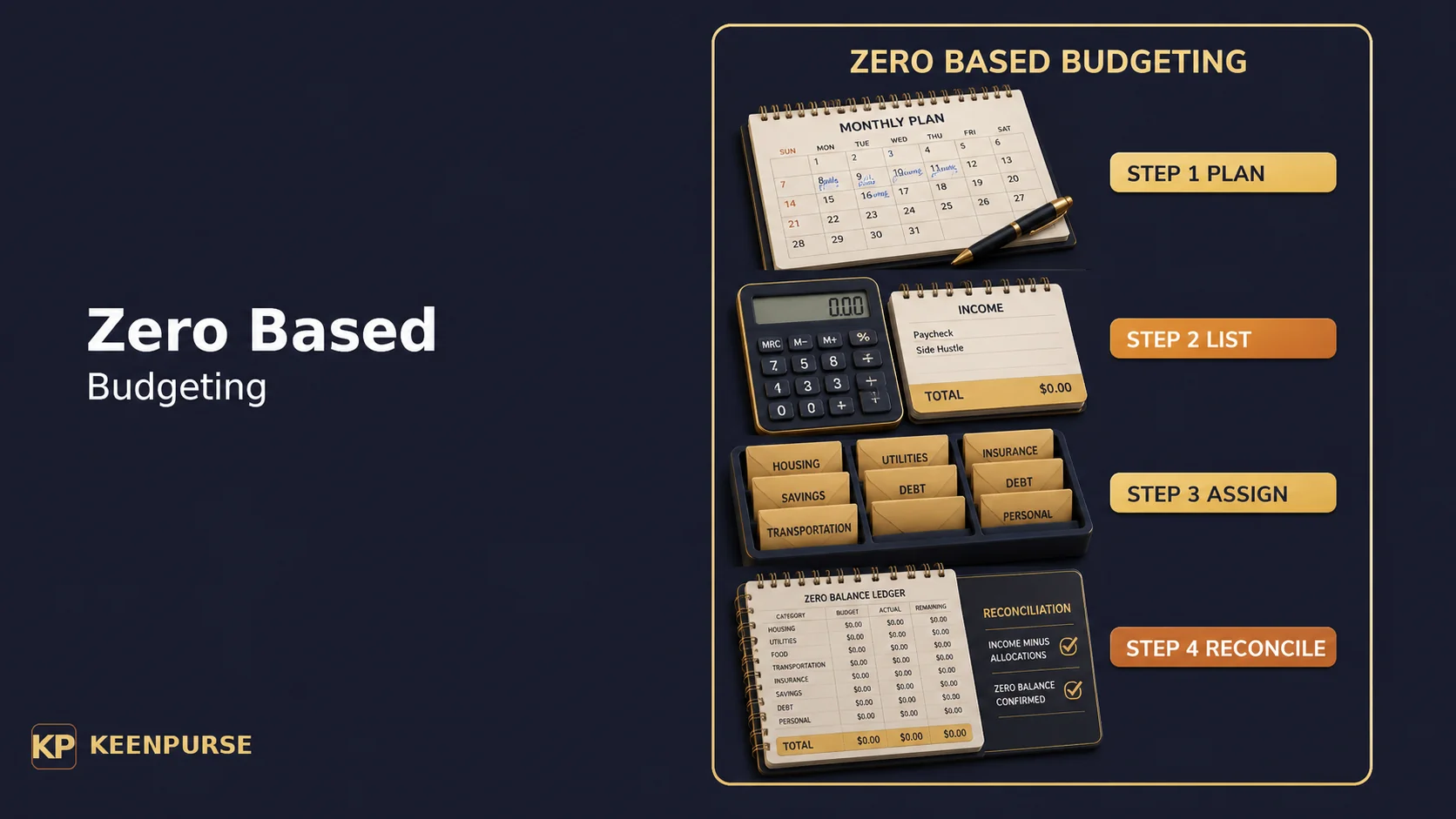
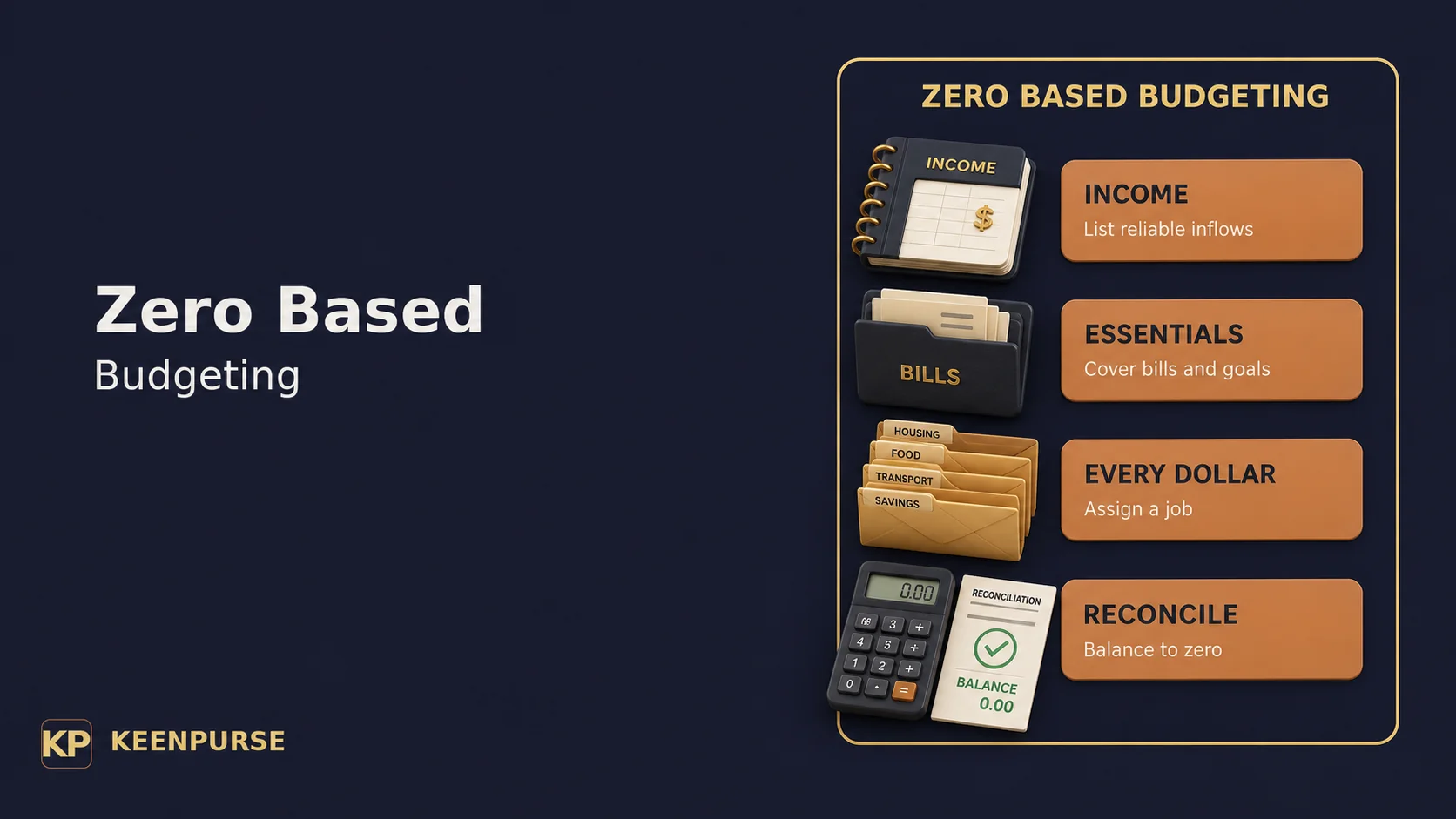
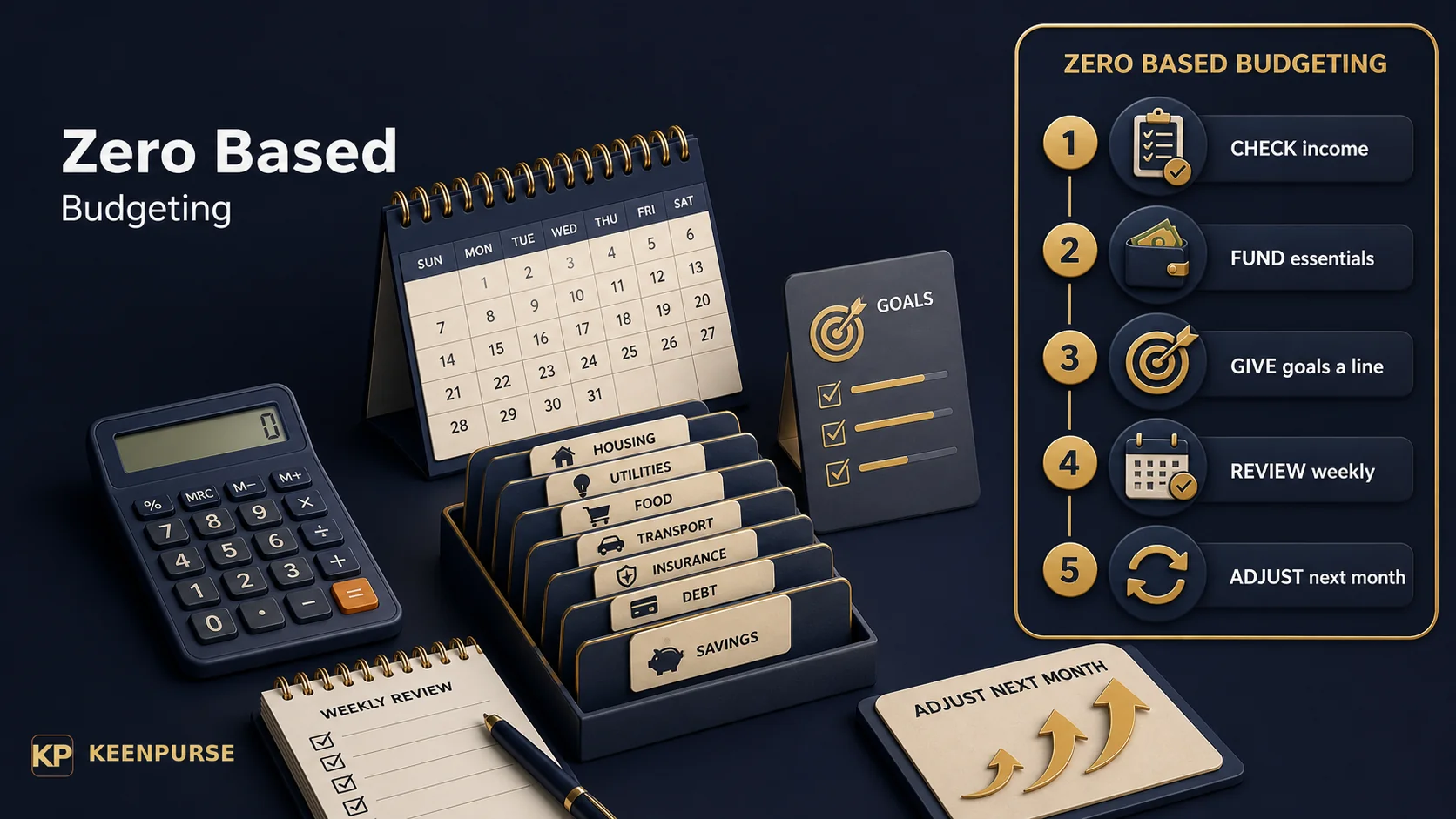
Zero based budgeting is a method, not a magic number: instead of starting from last month’s leftovers or a round percentage, you give every dollar of expected income a specific job each period. The usual four steps are to list your income, name every expense, assign each dollar a purpose, and reconcile the result to zero.

The goal of the zero based budgeting method is that income minus expenses, savings, and debt payments equals zero on paper — a plan, not a promise.

It works alongside common rules such as the 50/30/20 rule, and it can run in a spreadsheet or an app. It is a way to decide where money goes, not a guarantee that you will save a particular amount.

Key Takeaways

  • Zero based budgeting builds a plan from scratch each period: every dollar of expected income is assigned a purpose, so income minus planned categories equals zero.
  • The “zero” is on paper. Planning to zero does not mean spending everything; savings, sinking funds, and debt payments are legitimate jobs a dollar can hold.
  • The method handles irregular income, smaller categories, or a spreadsheet or an app — but every step still requires your own numbers.
  • It is a budgeting method, not a promise of savings, and it does not automatically outperform other approaches such as the 50/30/20 rule for every household.
  • Regular reconciliation keeps it honest: money you planned, spent, or moved should be adjusted in the next review so the plan reflects reality.
  • No guide can promise an average amount saved, a guaranteed surplus, or a universal category list; those depend on your own income, costs, and choices.

Start with a direct answer

The practical answer is that zero based budgeting is a planning method: each budgeting period, you start at a zero baseline and assign every expected dollar of income to a category until the plan balances at zero.

The usual shorthand is “give every dollar a job.” The four core steps are to list your income, name all of your expenses, assign every dollar a purpose, and reconcile the result back to zero. The method forces a conscious decision about each dollar rather than letting the plan fill in from a default.

A common mental block is that “zero” sounds like “spend until nothing is left.” It does not mean that. A zero based budget balances because categories such as savings, an emergency or sinking fund, and debt payments are jobs too.

The target is a plan that accounts for every dollar, not one that spends every dollar; treat “give every dollar a job” as a memorable method label, not a universal law. Public bodies describe a budget as a written plan of what comes in, what goes out, and what you plan each period ([consumer.gov], [FCAC]).

How zero based budgeting differs from the 50/30/20 rule

The zero based budgeting method is not a rival to the popular 50/30/20 rule so much as a different starting point.

The 50/30/20 rule begins with broad categories — roughly needs, wants, and savings — while zero based budgeting begins with your actual list of income and expenses and balances them to zero. One gives you a proportional frame; the other gives you an item-by-item assignment.

Criterion Zero based budgeting 50/30/20 rule Note
Starting point Your actual income and expense list, built from scratch each period Broad category percentages applied to income Different baseline, different effort
What balances Income minus all categories equals zero Income is split into three broad buckets Zero is a target; 50/30/20 is a proportion
Granularity of categories As many lines as you choose, down to individual expenses Three large categories in the classic version Zero-based can be more detailed
Handling of savings and debt Explicitly assigned jobs within the plan Usually folded into the savings/wants structure Both can hold savings as a line
Best fit Readers who want every dollar named and tracked Readers who want a simple proportional frame See the 50/30/20 budget rule for the proportional approach
zero based budgeting : how it works

The two can even be combined: some readers use 50/30/20 to check the overall shape of a budget and zero based budgeting to fill in the item-level detail. There is no single “best” approach; the choice is about which baseline you can maintain.

Run it in 4 steps

Here is the core checklist table for the zero based budgeting method. Each row becomes its own section below, because the value of the method is in the detail of each step rather than in the slogan.

Step What you do What it produces Common pitfall to avoid
1. List your income Write down every expected source and approximate amount for the period A realistic income figure, not an optimistic one Forgetting side income, variable pay, or taxes taken first
2. Name all your expenses List fixed costs, variable costs, and irregular or occasional costs A complete picture of where money needs to go Missing quarterly, annual, or non-monthly items
3. Assign every dollar a job Give each category a planned amount until the list uses up your income A plan that assigns, not spends, every dollar Leaving a gap, or assigning a “miscellaneous” bucket that never gets reviewed
4. Reconcile to zero Compare the plan with actual money in and out, and adjust A balanced plan that reflects reality Skipping the check so the plan drifts from what happened
zero based budgeting : review checklist

Step 1: List your income

Start by writing down every dollar you expect to come in during the budgeting period. For most people that is one or two paychecks, but be honest about the full picture: side income, variable pay, tips, irregular work, or money that arrives less often than the period you are planning.

If part of your pay is taxed or deducted before it reaches you, plan with the amount you actually receive, not the pre-deduction figure. Listing all incoming sources is the first step in official budgeting guidance ([consumer.gov]).

Two caveats make this step reliable. First, use the amount you realistically expect, not the highest amount you might earn. Second, if your income is irregular, plan over a month, a quarter, or a longer rolling window rather than a single fixed period — the method adapts, but only if the income you list is a number you can stand behind.

Step 2: Name all your expenses

Next, write down every expense and group them so nothing hides.

A useful split is: fixed costs you can predict (rent or mortgage, utilities, insurance, debt minimums), variable costs that move with use (groceries, transport, household supplies), and irregular or occasional costs that do not land every period but still have to be planned for (annual subscriptions, car maintenance, gifts, insurance renewals).

Categorizing expenses by type is a step financial-education agencies build into their own budgeting guidance.

The risk in this step is omission. A quarterly or annual bill can be entirely absent from a monthly list, which is exactly where a zero based budget breaks. If you do not have a clear figure, use a reasonable estimate and mark it for review, then correct it in reconciliation.

This is also where a sinking fund earns its place: an irregular cost can be planned as a small, regular contribution into a named fund rather than a surprise in the month it lands.

Step 3: Assign every dollar a job

Now the actual “give every dollar a job” step. Work down your expense list and give each category a planned amount for the period until every dollar of expected income has a named destination — including the productive jobs, such as an emergency or sinking fund, savings, and debt payments beyond the minimum.

Giving savings a named line in the plan is a step official guidance itself recommends ([consumer.gov]).

If your expenses add up to less than your income, the extra dollars still need a job: put them on a savings or sinking-fund line rather than leaving them unassigned.

If they add up to more than your income, you have a shortfall to address (the FAQ covers this) rather than a working plan. The discipline of this step is that nothing is left unnamed: prefer a named line even when the amount is small.

Step 4: Reconcile to zero

Finally, compare the plan with what actually happened. Did a category come in under or over plan? Move money between lines, add missed items, and adjust your income figure if it changed, so the plan balances at zero again.

Comparing what you planned with what you spent and feeding that into the next month’s plan is exactly how official budgeting guides tell you to close the loop ([consumer.gov]). Reconciliation is what turns a one-time list into a recurring method, and it is usually where the real learning happens.

Reconciliation also feeds the wider routine: the monthly money reset checklist gives you a place to slot this check alongside your other account reviews, so it becomes a rhythm rather than an occasional chore.

A method, not a guarantee of savings

It is worth saying plainly: zero based budgeting is a method, not a guarantee. A balanced plan does not promise that you will meet a savings goal, avoid a surprise cost, or build wealth by a certain date. The method improves your visibility and your conscious choices, but outcomes still depend on your income, your unavoidable costs, and real life.

For that reason, this article makes no promise about an average amount saved or that zero based budgeting automatically beats other methods. A surprise bill, a change in income, or a higher-than-planned category can happen to any plan. A method describes how you decide; it does not guarantee the result.

What zero based budgeting is What it is not
A way to consciously assign each dollar a purpose each period A promise of a specific amount saved
A framework that adapts to your own numbers A universal category list or a one-size-fits-all rule
A tool that works in a spreadsheet or an app An investment, tax, or legal recommendation
A method that improves with regular reconciliation A set of percentages or rates you should assume hold everywhere

Tooling: a spreadsheet is enough, an app can help

You do not need any particular product to run a zero based budget. Many people build a simple spreadsheet with income on top, a category list below, and a final line that sums to zero; others use a pen-and-paper sheet.

The method lives in the assignment and reconciliation steps, not in the tool. Some public agencies publish free budgeting planners, so no paid software is required.

If you prefer a digital tool, a budgeting app can automate some tracking, but no app removes the need for your own numbers, and apps differ in price, platform, and approach.

This article does not rank or endorse a specific app and makes no claim about current prices or features. If you want a comparison of tracking tools rather than this method guide, see our comparison of budgeting apps.

Put zero based budgeting inside your wider money routine

A zero based budget is most useful when it sits inside a broader set of habits rather than floating on its own. Reconciliation connects naturally with a regular review moment like the monthly money reset checklist.

A no-spend week budget reset can help you see which spending lines you actually depend on. Because the method names every dollar, it also pairs well with a sinking fund for irregular costs and with living below your means.

None of those links claims one method is better than another; they are adjacent tools that can reinforce the same habit of intentional money decisions.

Frequently Asked Questions

Is zero based budgeting the same as the 50/30/20 rule?

No, they are different starting points. The 50/30/20 rule splits income into broad proportional categories, while zero based budgeting assigns each dollar a specific job from your actual income and expense list and balances to zero. They can be combined; the proportional approach is in the 50/30/20 budget rule.

Does zero based budgeting work with irregular income?

It can, but you have to adapt the period. With variable or contract income, plan over a longer rolling window, use a conservative income figure, and be ready to adjust at reconciliation.

Official budgeting guidance recognizes that not everyone is paid monthly and suggests estimating a monthly figure from a longer record ([consumer.gov]). Irregular income makes the income-listing step harder, not impossible.

What if my expenses exceed my income?

Then you have a shortfall to address, not a working plan: either reduce planned expenses, add income, or both. Official guidance describes the same signal — when spending is more than income, look for things in the budget you can change ([consumer.gov]).

A zero based budget that does not balance is telling you something about the gap rather than solving it by itself.

Are spreadsheets or apps required?

No. A spreadsheet, a printed sheet, or a note can be enough, and this article does not require or endorse any specific product. Apps can automate tracking, but they still need your own figures, and their suitability, price, and platform vary. Compare tools separately if you want to choose one: our comparison of budgeting apps.

Does zero based budgeting guarantee that I will save money?

No. It is a method for deciding where money goes, not a promise of a particular amount saved. Outcomes depend on your income, your unavoidable costs, and what actually happens. Treat any “average amount saved” figure as a claim to inspect rather than a result you can count on.

How often should I update a zero based budget?

As often as your own reality changes and you are willing to reconcile. A common rhythm is monthly, feeding reconciliation into a regular monthly money reset checklist; official guidance frames a budget as something you use and revisit every month ([consumer.gov]). If your income or costs change more often, update more frequently.

Sources and further reading

  • consumer.gov (U.S. Federal Trade Commission, consumer education), “Making a Budget.” https://consumer.gov/your-money/making-budget. Accessed 2026-08-20; page last updated August 2024. Jurisdiction: United States. Supports: a budget is a written plan of income against spending; listing income and expenses first; checking the balance is more than zero; estimating a monthly figure for irregular pay; planning and reconciling monthly; giving leftover money a savings line.
  • Financial Consumer Agency of Canada (FCAC), “Making a budget.” https://www.canada.ca/en/financial-consumer-agency/services/make-budget.html. Accessed 2026-08-20. Jurisdiction: Canada. Supports: a budget is a plan that balances income with savings and expenses; categorizing expenses (needs and wants, plus categories such as food, housing, and insurance); using a free budgeting planner tool with your own figures.

These sources are cited for the statements above only; local prices, category rules, and outcomes vary.

⚠️ Educational information only. Full disclaimer.

Zero Based Budgeting: Run It in 4 Steps (and Where It Fits in Your Routine) Read More »

How to Cut Subscriptions: A Category-by-Category Audit of Recurring Charges

TL;DR

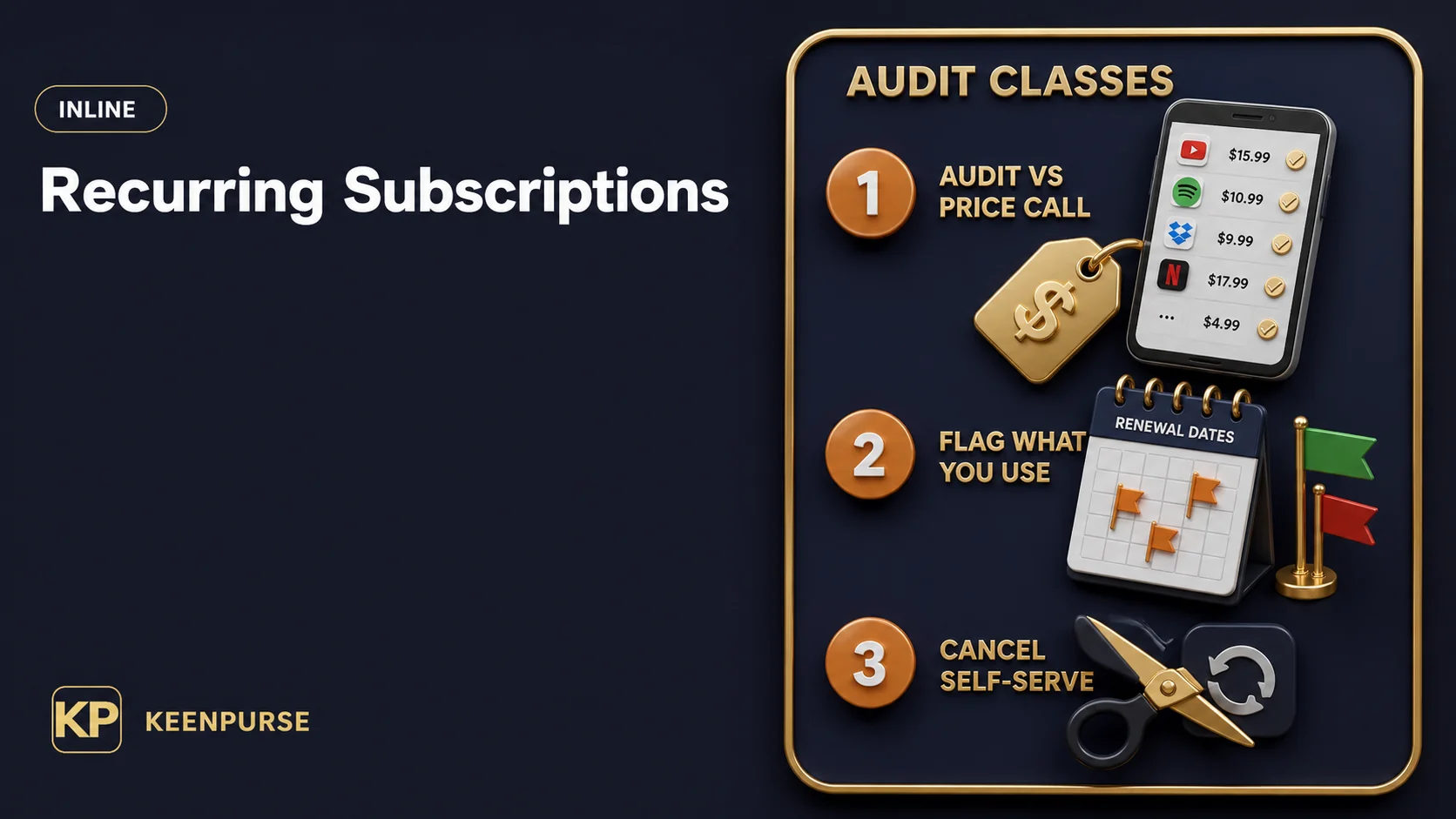
If you want to know how to cut subscriptions, treat it as an audit, not a call to a provider: find the recurring charges, flag what you no longer use, cancel from your own account settings, and set a review rhythm.

No step in this article promises a dollar amount or a guaranteed refund; the value is in the review itself. Most of the work happens on your own accounts, at your own pace, before any provider conversation is even necessary.

Key Takeaways

  • A subscription cut is a review of your own accounts first; calling a phone, internet, or insurance provider to ask for a lower bill is a separate, price-focused skill covered elsewhere.
  • Audit by charge class — streaming, apps and software, memberships, duplicate or forgotten renewals, free-trial rollovers, and annual renewals — so nothing hides in the pile.
  • Cancel through the account settings of the service you are actually using; be wary of third-party cancellation services and “cancel for you” apps.
  • Watch the small print around free trials and annual renewals: a trial that rolls into a paid plan, or an annual renewal that auto-turns, can be easier to miss than a monthly charge.
  • Set a monthly review moment so the audit becomes a habit rather than a one-time purge, and link it into the rest of your money routine.
  • No guide can promise a specific savings figure or a guaranteed cancellation or refund outcome; availability, billing, and refund rules vary by service and by market .

Start with a direct answer

The practical answer is to treat the task as an audit: list the subscriptions, sort them by charge class, mark which ones you still use, and turn off the ones you do not from your own account settings.

You rarely need to call anyone to find out what you pay or to stop most subscriptions; your own accounts, statements, and profile pages hold the detail you need. How to cut subscriptions starts with a list, not a single trick. How to cut subscriptions is a review you repeat, not a project you finish once.

A recurring charge is any charge that repeats on a schedule you agreed to — a monthly stream, a software renewal, a gym membership, or an annual plan. The exact wording, billing cadence, and cancellation path differ by service, platform, country, and payment method .

That is why the method here is a checklist you run on your own accounts rather than a one-size-fits-all number. Knowing what counts as a recurring charge is the base of how to cut subscriptions.

The subscription audit vs. calling a provider

A subscription audit and a provider price call are two different skills, and confusing them can blur both.

What it is What it asks Where it happens Boundary
Subscription audit Which recurring charges do I still want? Your own accounts, statements, and profile pages This article
Negotiating a lower bill Can I ask a phone, internet, or insurance provider to lower an existing service price? A price conversation with a provider how to negotiate lower bills
How to cut subscriptions: audit vs price call

This article covers the audit and the self-serve cancellation of subscriptions. Negotiating phone, internet, or insurance bills is a different topic with its own steps, and it is covered in how to negotiate lower bills.

The boundary matters: an audit does not require a phone call, and a price negotiation does not require you to cancel anything. Keep them separate, and keep the audit in control of your own accounts. Keeping the audit separate from the price call is what makes how to cut subscriptions repeatable.

Audit checklist by recurring-charge class

The fastest way to get overwhelmed is to page through every subscription at once without a system. Grouping charges into classes makes the review repeatable.

This table is a starting grid: where to look, what to review, and how to cancel — always through self-serve account settings, never through a third-party cancellation service or “negotiate my bills” app. A class list is the engine of how to cut subscriptions done calmly.

Recurring-charge class Where to look What to review How to cancel (self-serve settings)
Streaming Streaming app or account settings; payment history Which plans you hold, who in the household uses them, duplicates across providers Cancel from the account or profile settings of the service
Apps and software App-store subscription page; software account or billing section Which apps bill monthly vs. annually; unused licenses; upgrades you did not ask for Turn off auto-renew or cancel from the account/app-store subscription settings ([Google Play])
Gym and memberships Gym or club member portal; contract or membership page Pause vs. cancel rules; notice periods; annual contracts Use the member portal or the club’s official channel per its own terms
Forgotten and duplicate renewals Bank or card statements; a payment app’s automatic-charge list Repeat charges you no longer recognize; two tools doing the same job Cancel at each service’s own account settings; do not report a legit charge as fraud
Free-trial rollovers The trial confirmation email; the billing or plans page When the trial ends; payment method on file; renewal setting Turn off auto-renew before the trial ends in the account settings, if offered
Annual renewals Renewal reminder emails; account settings with a renewal date Renewal date; whether auto-renew is on; whether you used it last cycle Disable auto-renew in account settings before the renewal date; check the notice-period rules
How to cut subscriptions: monthly audit checklist

The columns are deliberately general: where to look, what to review, and how to cancel can vary by service, platform, and market. Fill in the blanks with your own accounts rather than assuming a universal rule.

Streaming: the first easy pass

Streaming is usually the most visible class because the charges are familiar and frequent. Start by listing every streaming account you hold — video, music, anything with a monthly or annual plan.

For each, note which plans you have, who uses them, and whether more than one service does effectively the same job. Streaming is usually the easiest class in how to cut subscriptions to start with.

Look for details that hide between plans: a higher tier you upgraded to once and never used, a second profile that still bills, a guest membership you added, or a bundle that re-priced silently.

None of this is a claim about any specific price — the point is to see the shape of what you hold. Hidden upgrades are exactly what how to cut subscriptions surfaces.

To cut anything, use the account settings of that service. Most streaming services let you change plans, pause, or cancel from your own profile page, and the self-serve path is documented in the service’s own help pages . If the setting is not obvious, the service’s official help or terms page is the right place to look — not a third-party tool that claims to cancel for you.

The FTC’s negative option rule explains how auto-renewals must be presented where it applies.

Apps and software: the category that multiplies quietly

App and software subscriptions are easy to forget because they are small, spread across app stores, browsers, and individual companies, and often billed in different places. A phone might bill one tool, a computer another, and a web app a third. App stores are a good place to begin how to cut subscriptions you forgot you had.

The review here is about duplicates and disuse: a design tool you bought for one project, a productivity app you stopped opening, a license on a device you no longer use, or two apps draining the same budget.

Check the subscription settings inside each app store and each software account; most services list active subscriptions and give you an auto-renew toggle or cancel path there ([Google Play]). Duplicates and disuse are the two easiest wins in how to cut subscriptions.

Two cautions apply. Cancel each service at its own official account settings, not through an aggregator that asks for your credentials. And billing arrangements differ: some apps charge through an app store, others bill direct, so the cancellation path is not always the same ([Google Play]). Avoiding aggregators is a caution that belongs in how to cut subscriptions.

Gym and memberships: read the contract before you jump

Gym and membership subscriptions behave differently from streaming because they often involve a contract, notice period, or pause option rather than a simple monthly toggle. A membership you use occasionally may offer a freeze; one you no longer use may still require a specific cancellation step. Contracts make gyms the trickiest part of how to cut subscriptions.

Start with the member portal or the paper or digital agreement you signed; note the renewal cadence, notice requirements, and whether pausing is available in your location. Then decide whether to pause, downgrade, or end the membership, and complete the step the club’s own terms describe.

Do not assume a gym cancels the same way a streaming service does. Availability of pause, downgrade, or online cancellation can vary by location, by club, and by contract type. If self-serve cancellation is not offered, the official club channel is the appropriate place to ask — again, not a third-party cancellation service.

Forgotten and duplicate renewals: find the repeat you no longer recognize

Some of the most useful finds are charges you no longer even recognize as a subscription: an old app renewal, a legacy plan, a service you signed up for years ago that still bills quietly.

Your bank or card statement, and the automatic-charge list inside a payment account, are the clearest places to look. The forgotten renewals are where how to cut subscriptions pays off most. The forgotten renewal is a classic target in how to cut subscriptions.

When you see a repeat charge you do not remember, the discipline is to check it before acting. Confirm the merchant name, the service it corresponds to, and whether you actually opened the account. If it is a real subscription you no longer want, cancel at that service’s own account settings.

If it is genuinely a charge you did not authorize — distinct from a forgotten subscription you did authorize — your card or bank’s official dispute process exists for that case; it is not a step to use on a charge you simply forgot. Duplicates also live here: two tools doing the same job, an old plan overlapping a new one, or an unused trial that became a paid plan.

Free-trial rollovers: catch the trial before it turns

A free-trial rollover happens when a trial period ends and the service begins charging on the payment method you provided. It is one of the most common ways a small monthly charge sneaks into a statement, which is why negative-option billing is a focus of consumer-protection rulemaking .

The audit point is timing: know when the trial ends, what happens at the end, and whether the account is set to auto-renew. The trial confirmation email usually states the end date and the renewal behavior, and the billing or plans page in the account may let you switch off auto-renew.

If you want the service after the trial, keep it; if you do not, the reliable move is to turn off the renewal before the end date in the account settings — not to rely on a reminder you were supposed to receive. Trial timing is one of the subtle parts of how to cut subscriptions. Trial timing sits at the heart of how to cut subscriptions safely.

Annual renewals: the biggest single line items

Annual subscriptions renew less often but land as one larger charge, which makes them easy to miss and easy to regret. A software license, club membership, or yearly service that renews automatically slips past a monthly review because it appears only once a year — the kind of recurring billing consumer-protection rules target .

For each annual renewal, note the renewal date and whether auto-renew is on, and decide whether you actually used the service over the last cycle. If you want to stop it, the account settings usually allow you to disable auto-renew in advance; some services require you to act before a certain notice date, and that timing can vary.

Because the charge is larger and less frequent, an annual item deserves an explicit line in your audit rather than a glance. Annual renewals are part of how to cut subscriptions that is easy to let slide. Decision discipline belongs in how to cut subscriptions every cycle.

Add the audit to your monthly reset

The most valuable habit is a rhythm, not a purge. Schedule a subscription review into a regular money moment so it becomes a standing check instead of an occasional panic charge hunt.

The monthly money reset checklist provides a place to slot the subscription review beside the rest of your account checks. A rhythm, not a purge, is how to cut subscriptions that lasts.

This article sits inside a broader saving-money toolkit. Where water fits your subscription or household-cost picture, the review of recurring water charges follows its own logic in how to save money on water — a subscription-style renewal is not the same as a metered or billed household utility, so keep the two separate.

And if the audit surfaces a phone, internet, or insurance bill you want to lower rather than cancel, that is the sibling skill in how to negotiate lower bills, not a subscription-cancellation step.

The monthly rhythm also keeps you honest about usage: set a reminder, spend ten minutes on the charge classes, and update the list when plans change. A review that happens every month is more useful than a perfect one that never repeats. A standing review is how to cut subscriptions that sticks.

Be cautious with “cut your bills by $800 a month” claims

> Myth boundary: A savings headline in a suggestion stream is not a promise that the result is likely, available, or appropriate for your accounts. No article here claims a specific saving. A savings headline is not a saving; how to cut subscriptions is about your own list.

A universal savings figure skips the facts that make a review meaningful: which services you hold, what you use, your billing cadence, and each platform’s cancellation and refund rules. It can also push readers to cancel things they want, or to trust a service that promises to “cancel your subscriptions for you.” A more reliable standard is modest and specific: list the charges, flag the ones you no longer want, and turn them off from your own account settings.

Whether that saves a little or a lot is a fact of your own accounts, not a claim any guide can make. Your own data turns how to cut subscriptions into a grounded habit.

Frequently Asked Questions

How do I find every subscription I am paying for?

Start with your bank and card statements and your payment account’s automatic-charge list, then check the subscription pages inside each app store and each service’s account settings ([Google Play]).

Group the results by charge class so nothing is missed. Your statements and auto-pay lists are the raw material in how to cut subscriptions. Statements are where how to cut subscriptions usually starts.

Can I cancel a subscription without calling anyone?

In many cases, yes: most services offer a self-serve cancellation or auto-renew setting in the account or profile page . The exact path varies by service, platform, and market, so check the service’s own help or terms page.

Are third-party “cancel my subscriptions” services safe to use?

This article recommends canceling from your own account settings and treating third-party cancellation tools cautiously, because they are not a substitute for the service’s own controls. Credentials and account access should stay with you. Your own account settings are the safe path in how to cut subscriptions.

What happens if I cancel right before a renewal date?

That can vary by service and by market, including notice periods and whether a current period still runs. Check the service’s own cancellation and refund rules before relying on a specific timing outcome.

Can a guide promise how much I will save by cutting subscriptions?

No. Savings depend on which charges you hold, what you use, and your own billing arrangements. Treat an “average savings” figure as a claim to inspect rather than a result you can count on. Confirming each platform rule is part of how to cut subscriptions done properly.

Do subscription rules work the same in every country?

No. Availability, billing cadence, cancellation, and refund rules differ by platform and by market . Confirm the relevant rule with the service’s official terms or help page for your location. Confirming each rule completes how to cut subscriptions without guesses.

Sources and further reading

  • FTC — Negative Option Rule (US federal consumer-protection regulator; rule page, updated 2024; Federal Register notice dated 2026-03-13; accessed 2026-08-19): supports the recurring-payment / free-trial-rollover / auto-renewal “negative option” class claims and the statement that subscription billing and cancellation rules are set per jurisdiction. https://www.ftc.gov/legal-library/browse/rules/negative-option-rule
  • Apple Support — “If you want to cancel a subscription from Apple” (published 2026-07-30; accessed 2026-08-19): supports that subscriptions billed through Apple can be canceled from your own Apple account/device settings. https://support.apple.com/en-us/HT202039
  • Google Play Help — “Cancel, pause, or change a subscription on Google Play” (accessed 2026-08-19): supports that Android app subscriptions can be canceled or paused in your own Google Play account settings. https://support.google.com/googleplay/answer/7018481
  • Spotify Support — “How to cancel Premium plans” (accessed 2026-08-19): supports that a streaming subscription can be canceled from your own account settings. https://support.spotify.com/us/article/cancel-premium/
  • how to negotiate lower bills — boundary article for provider price conversations.
  • monthly money reset checklist — a regular review moment.
  • how to save money on water — where a water-related recurring review is in scope.
⚠️ Educational information only. Full disclaimer.

How to Cut Subscriptions: A Category-by-Category Audit of Recurring Charges Read More »

How to Build Credit for Beginners: 5 Entry Paths and the Myths to Ignore

TL;DR

How to build credit for beginners means establishing a credit record from no history or a very thin one — not repairing or improving an existing score.

The main paths are a secured credit card, a credit-builder loan or account, being added as an authorized user, and no-card routes where a cell phone, utility, or rent record is reported. Every path depends on the bureaus and the market you are in, so none comes with a guaranteed timeline or outcome .

Key Takeaways

  • Building credit from scratch is about creating a first record; improving an existing score is a separate job with its own methods .
  • A person with no or very little history is sometimes called “credit invisible” or a “thin file” — a real and common starting point .
  • The common entry paths are a secured card, a credit-builder loan or account, an authorized-user addition, and no-credit-card routes like cell-phone, utility, or rent reporting .
  • Reporting and scoring mechanics vary by credit bureau and by country, so no rule is universal ; and no lender or bureau can honestly promise a score outcome, a timeline, or an approval.
  • The reliable habit is simple and durable: make what you do report, keep payments current and on time, and keep balances low relative to limits where a limit exists .
  • Building a first record feeds into a larger routine like the 50/30/20 budget rule and a broader understanding of how credit cards work.

What does it mean to build credit from scratch?

“Building credit from scratch” and “improving a credit score” are two different problems, and confusing them is where a lot of bad advice starts. How to build credit for beginners is not the same as improving a score you already have.

Building from scratch describes a person with no meaningful credit history — sometimes called a “thin file” or “credit invisible” — who needs a first record that lenders and bureaus can see . Credit bureaus create a report when you first borrow or apply for credit, so with little borrowing there is often little to report .

Improving describes someone who already has a record and wants a higher score or cleaner report — a repair-and-optimization job built on lowering utilization, disputing errors, and lengthening payment history .

Task Building from scratch Improving an existing score
Starting point No or thin history; little for a bureau to report An existing file with at least some history
Core job Create a first credit record Raise or clean up an existing record
Typical first tools Secured card, credit-builder account, authorized user, no-card reporting Utilization, payment history, error disputes, age of accounts
Boundary Covered in *this* article See how to improve your credit score by 100 points — the sibling article; this piece does not re-teach improving
How to build credit for beginners: establishing vs improving

If your goal is to lift a score you already have, the sibling article is where that is covered. How to build credit for beginners is best treated as a needs question, not a products quiz.

Before any of it, remember the country caveat: credit bureaus, scoring models, and what counts as a reportable account differ across markets like the US, UK, and Canada, and bureaus use different, undisclosed formulas . A path that is standard in one market may not exist, or may work differently, in another.

That is why every entry path below carries the same boundary: it depends on the bureaus and jurisdiction you are in. How to build credit for beginners always starts by checking what counts as a reportable account where you live. How to build credit for beginners always starts by checking what counts as a reportable account where you live.

Overview table of entry paths

The table shows the main ways a beginner can start a credit record. The last column is honest: none of these guarantees a score movement, an approval, or a fixed time.

Entry path What it is What it needs Typical reporting Not-a-promise boundary
Secured credit card A card backed by a refundable deposit that acts as the credit limit A deposit and a qualifying application Issuer reports the account to one or more bureaus No guaranteed approval, limit, rate, or score change
Credit-builder loan or account A small loan or savings vehicle designed to report repayment activity Ability to make the scheduled payments; terms vary by provider Payments reported as they are made, if the provider reports No promised score gain; terms and approval vary by provider and market
Authorized user Being added to someone else’s card account An existing cardholder willing to add you The account may appear on your file, depending on the issuer and bureau Not universal; depends on the cardholder, issuer, and bureau rules
No-credit-card paths Rent, utility, or cell-phone payment reported to a bureau A lease or bill in your name and a reporting service or arrangement May be reported through specialized bureaus or programs Availability and effect vary by provider, market, and bureau
Student or at-18 entry Products and accounts aimed at first-time borrowers Age, student status, or a qualifying application Varies by product and provider No guarantee of approval or of any particular starting score
How to build credit for beginners: review prompts

Path 1: The secured credit card

A secured credit card is often the first suggestion for someone with no history, and it is easy to see why. The card is “secured” because you put down a refundable deposit that typically sets the size of your credit limit.

The issuer reports the account to credit bureaus, which is what lets a reasonable payment history become part of your record .

Because the deposit reduces the lender’s risk, a secured card is often more accessible to a first-time borrower than an unsecured line of credit — though approval is never guaranteed.

A secured card is a common starting point in how to build credit for beginners, but it is still a real approval. A secured card is a common starting point in how to build credit for beginners, but it is still a real approval.

Many banks and credit unions offer secured cards, with a credit line that starts small equal to the deposit you put in an account . Your deposit is held while the account is open and may be refunded as you show you can pay on time (some issuers also raise your limit).

Deposit amounts, qualification rules, and graduation terms vary by issuer and market. The deposit mechanics matter, which is part of how to build credit for beginners that is easy to misread.

The habit that matters is simple: use the card for purchases you can already afford, and pay the statement balance on time and in full where you can. Carrying a balance to “build credit” is a myth — you do not need to pay interest to build a track record .

Keep reported balances low relative to your limit, because using close to your limit can hurt a score in some models . The CFPB’s guide to rebuilding your credit explains why on-time history matters.

This article name-checks products like Chime, Capital One, or Discover without comparing deposit amounts, APRs, or fees, which change and vary by applicant. If a secured card is right for you, compare current, dated issuer material in your own market.

This is why how to build credit for beginners emphasizes behavior over product claims. This is why how to build credit for beginners emphasizes behavior over product claims.

Path 2: A credit-builder loan or account

A credit-builder loan is a small loan designed less for spending money and more for building a payment record. In a common version, the money you “borrow” is held for you in a locked account while you make payments; once the term is complete, the balance is released to you.

The point is that as you make on-time payments, the account is meant to generate a payment record — but only if the provider actually reports it, and to which bureaus. Fees and interest are real, so how to build credit for beginners keeps costs on the table.

Credit-builder loans are not a free score hack. You pay fees or interest in many cases, and terms, deposit structure, and whether the activity is reported all vary by provider. Treat them as a deliberate, small tool, not a guarantee of any score change. Costs and reporting matter, so how to build credit for beginners keeps fees and terms visible.

The boundary is the same as everywhere: a product being named is not a promise that it will report the way you hope, is available in your market, or produces a fixed outcome. Read the provider’s terms and confirm which bureaus (if any) it reports to before you commit.

Path 3: Being added as an authorized user

An authorized user is someone given permission to use another person’s credit card account without being the primary account holder. The appeal is that the account may be added to your file, giving you the benefit of the primary holder’s payment history for as long as you are on the account.

Being an authorized user is just one route in how to build credit for beginners, with real conditions. Being an authorized user is just one route in how to build credit for beginners, with real conditions.

The “may” is doing heavy lifting, and it should. Whether being an authorized user builds your record depends on things not in your control: the issuer’s reporting practices, the bureaus and their rules, and whether the primary holder keeps the account in good standing.

A responsible primary holder with low balances and on-time payments is very different from one who is late or maxed out — and in some scenarios you are also exposed to the account’s behavior.

No one can guarantee that adding you as an authorized user will raise your score or change your file in any particular way. If you pursue it, do it with a cardholder you trust and do not assume the effect is automatic. Confirm what a path actually reports, a core discipline in how to build credit for beginners.

Path 4: No-credit-card paths (cell phone, utility, and rent reporting)

You do not always need a card to start a record. Some companies and services report recurring payments like rent, utilities, or cell-phone bills to credit bureaus — sometimes to the traditional bureaus, sometimes to specialized rental-data bureaus used by landlords and lenders.

The CFPB notes that payments like monthly rent or cell phone are often not automatically captured by credit reporting companies, but can be recorded — including by opting into a self-reporting service . Not every provider reports, which is the core uncertainty in how to build credit for beginners.

The catch is that “some do” does not mean “yours does.” Whether a cell-phone or utility account is reported depends on the provider, the market, and often on an opt-in program or a third-party reporting service. Rent reporting in particular often requires a service that collects and forwards your payment data, set up by you or your landlord.

Availability and impact are genuinely local, and fees and conditions may apply — do your homework before enrolling . Whether a provider reports is the decisive variable in how to build credit for beginners.

Because reporting is not automatic, ask not “does paying rent build credit?” but “does my specific rent, utility, or phone account get reported anywhere?” Verify the answer with the provider directly — it determines whether this path does anything for your record at all.

Asking the right question is the reliable method in how to build credit for beginners. Asking the right question is the reliable method in how to build credit for beginners.

Path 5: Student and at-18 entry

For people just reaching adulthood or enrolled in school, some lenders market first products at a beginner audience: student credit cards, small secured cards, or accounts with a low starting limit.

“At-18” and “student” are audience labels, not guarantees — you can turn 18 (or the local age of majority) and still be declined. Since everyday bills like rent are not reported until an arrangement is made, being young with few credit accounts usually means a thin file until something reports .

The same rules apply here as to every path: understand what the product reports, keep payments current, and do not chase a headline score. A student or first card can be a fine starting point, but its terms vary by issuer and market. First products exist, but how to build credit for beginners still depends on what actually reports.

What does NOT build credit (and myths)

Not everything a lender can see — or that a marketing message suggests — helps you build a record. A few common myths are worth naming so you do not fall for them: Spotting myths early keeps how to build credit for beginners honest. Spotting myths early keeps how to build credit for beginners honest.

  • Checking your own credit does not build it, and pulling your own report does not hurt it. A self-check is not a credit application; AnnualCreditReport.com states that checking your reports there will not affect your credit scores .
  • Paying rent, utilities, or a phone bill does not automatically build credit. As covered above, it only helps if a provider or service actually reports the payment. Absent that, a regular bill is just a bill .
  • Carrying a balance does not build credit faster. Interest does not buy a better record. What matters is the reported payment behavior, and you can build a history while paying in full .
  • Paying off collections or closing old accounts “cleans” your file universally. The effect of closing an account or resolving a collection varies by market, bureau, and scoring model — do not treat a one-line rule as universal.
  • “Boost your score by N points” headlines are a claim to inspect, not a result anyone can promise. Rebuilding takes time and has no shortcuts or secrets .

Notice the pattern: the reliable facts are about behavior (pay on time, keep balances low, report what can be reported), while the unreliable ones are all promises — points, timelines, guaranteed approvals.

Next step: improving a score you already have

Once you have a first record and some history, the job changes from building to improving — lowering utilization, keeping a long on-time payment history, disputing actual errors, and avoiding new hard inquiries unless you need them . The sibling article covers it in depth: how to improve your credit score by 100 points.

The mechanics of a card are explained in how do credit cards work, and a budget routine that keeps payments manageable lives in the 50/30/20 budget rule. Once you have a record, how to build credit for beginners becomes maintenance and reporting accuracy. Once you have a record, how to build credit for beginners becomes maintenance and reporting accuracy.

Frequently Asked Questions

What is the fastest way to build credit as a beginner?

There is no honest fastest way, because speed depends on your market, the bureaus, and which products actually report for you. Pick a path that reports to the bureaus you care about and keep payments current.

There is no fastest path in how to build credit for beginners, only a consistent one. There is no fastest path in how to build credit for beginners, only a consistent one.

Do I need a credit card to build credit from nothing?

No. Credit-builder loans or accounts, being an authorized user, and rent/utility/phone reporting can all create a first record where available . Whether any works for you depends on reporting availability in your market. No tool replaces the fundamentals in how to build credit for beginners.

Is a secured credit card always approved?

No. A secured card reduces lender risk because of the deposit, but you still go through a qualification review, and approval is never guaranteed. On-time history is the reliable foundation in how to build credit for beginners.

Does being an authorized user always help my credit?

Not automatically. It depends on whether the issuer reports the account, the bureau rules, and how the primary holder manages the account. There is no universal authorized-user guarantee. Automatic reporting does not mean guaranteed, anywhere in how to build credit for beginners. Automatic reporting does not mean guaranteed, anywhere in how to build credit for beginners.

Does a credit-builder loan guarantee a better score?

No. It can create a payment record if the provider reports it, but the score effect, the fees, and the reporting all vary. Read the terms before you commit.

Can anyone promise a specific score increase from building credit?

No. Rebuilding takes time with no shortcuts or secrets, and outcomes depend on your file, your market, and the scoring models in play — none of which a guide can know .

Treat any promised number as a claim to question. Patience is the honest conclusion of how to build credit for beginners. Patience is the honest conclusion of how to build credit for beginners.

Sources and further reading

  • CFPB — “How to rebuild your credit” (US, government). Consumer Financial Protection Bureau, accessed 2026-08-19. consumerfinance.gov/consumer-tools/credit-reports-and-scores/how-to-rebuild-your-credit/. Supports: rebuilding takes time with no shortcuts or secrets; credit scores rest on paying bills on time over time; a secured card (deposit equal to the limit) can help establish a credit record and the deposit may be refunded as you pay on time; using close to your limit can hurt a score; checking reports and disputing errors.
  • CFPB — “Who are the Credit Invisible?” (US, government blog). Consumer Financial Protection Bureau, 2015 (report cited on the page), accessed 2026-08-19. consumerfinance.gov/about-us/blog/who-are-credit-invisible/. Supports: roughly 26 million US adults (about one in ten) are “credit invisible” with no traditional bureau history; rent and cell-phone payments are not automatically captured by credit reporting companies but can be recorded, including via self-reporting services with fees and conditions.
  • AnnualCreditReport.com (US, government-authorized). The three major US credit reporting companies’ central source for the free reports you are entitled to under federal law; checking your reports there does not affect your credit scores. Accessed 2026-08-19. annualcreditreport.com.
  • FCAC — “Credit report and score basics” (Canada, statutory consumer agency). Financial Consumer Agency of Canada, accessed 2026-08-19. canada.ca/en/financial-consumer-agency/services/credit-reports-score/credit-report-score-basics.html. Supports: credit bureaus create a report when you first borrow or apply for credit; lenders send account information to bureaus; bureaus and lenders use different, undisclosed scoring formulas — i.e. credit mechanics and scoring vary by market.
⚠️ Educational information only. Full disclaimer.

How to Build Credit for Beginners: 5 Entry Paths and the Myths to Ignore Read More »

Life Insurance for Beginners: 3 Simple Policy Types to Understand

TL;DR

Life insurance is a protection contract: a policyholder pays premiums to an insurer and, if the policy is in force and its terms are met, it can provide a death benefit to named beneficiaries, US). Terminology, rights, and contract conditions vary by policy and jurisdiction, so class-level descriptions below are not a substitute for a specific contract.

For beginners, the useful starting point is not a premium chart or a “best” product list. It is a needs conversation: who would be financially affected by your death, what obligations could remain, and for how long? Term, whole, and universal life are broad policy classes—not interchangeable savings products or universal answers.

Life insurance for beginners is best approached as a needs conversation, not a products quiz.

Key Takeaways

  • A life policy involves an insurer, a policyholder, an insured person where relevant, premiums, beneficiaries, and a death benefit under the contract’s terms. A state regulator describes it as a contract between a policyholder and an insurer that promises to pay the policyholder’s beneficiaries when the insured dies ([WA-OIC], US).
  • Term life insurance is commonly described as a temporary-coverage class; whole and universal life are commonly described as permanent-policy classes. Product wording and availability require verification against the specific policy and jurisdiction.
  • Cash value is a policy feature in certain permanent-policy classes, not the same thing as an ordinary savings account, [WA-CV]).
  • Existing employer group life coverage can be one planning input, but eligibility, amount, portability, beneficiaries, and terms depend on the specific plan; record the plan documents rather than assuming coverage.
  • A no-dependents situation is still a prompt for review, not an automatic yes-or-no answer about coverage.

How life insurance works

At its simplest, life insurance for beginners is easier to understand as a contract than as a financial scorecard. One party applies for and owns a policy in many arrangements; an insurer is the contract counterparty; another person may be the insured. The policy names one or more beneficiaries. The policyholder pays premiums according to the policy’s terms. If the insured person dies while the policy is in force, the contract may provide a death benefit to the named beneficiary or beneficiaries, subject to those terms, [WA-OIC]).

That sequence leaves several details deliberately unanswered. Arrangements differ by policy and jurisdiction. This article also does not address claims timing, tax, inheritance, probate, estate treatment, loans, or payout guarantees.

That is why life insurance for beginners rests on the actual policy document.

A quick distinction avoids a common mix-up: life insurance is not deposit insurance. Deposit-insurance protection concerns eligible deposits at covered institutions, not a life policy’s death-benefit arrangement. Build cash reserves separately from insurance decisions with the emergency-fund guide.

Term vs. whole vs. universal life insurance

The labels below are class-level descriptions from insurance regulators, not a substitute for policy documents. Insurers can use different features, names, conditions, and disclosures across countries and products, and class descriptions vary by jurisdiction.

Life insurance for beginners centers on policy classes, not provider promises.

Policy class Broad duration or structure Cash-value feature Question to explore Source and verification boundary
Term life insurance A policy purchased for a defined period (a term); benefits are payable to named beneficiaries if the insured dies during that term. Do not assume a cash-value feature from the class name; term insurance generally does not build cash values. Is the protection need tied to a limited period? Read the policy’s exact term, renewal, conversion, and end-of-term wording.
Whole life insurance Whole, universal, and variable life are types of cash-value (permanent-coverage) policies; whole life “provides coverage for your entire life” ([WA-CV]). Commonly associated with cash value, subject to policy terms, [WA-CV]). What protection and policy features are actually being compared? Do not infer dividends, loans, surrender value, or performance without the specific contract.
Universal life insurance A permanent, flexible-premium class described by a regulator as “flexible premium adjustable life insurance” ([WA-CV]). May include cash-value features under policy terms. Which terms control funding, coverage, and changes? Verify all premium-flexibility, cost, lapse, loan, and benefit provisions in writing.
Life insurance for beginners: who gets paid

“Permanent” does not mean “simple,” and “cash value” does not mean “savings account.” An ordinary savings account and an insurance policy can have different purposes, protections, access rules, charges, and legal treatment, [WA-CV]). Comparing a feature label without reading the contract can conceal more than it reveals.

A useful beginner habit is to separate the class name from the specific policy promise. A class name can help you ask better questions, but it cannot tell you the benefit amount, the conditions that apply, the cost over time, or what happens after a missed payment; those are contract questions. A comparison that does not identify the version of the policy, jurisdiction, and date of the document is incomplete.

Separating the class name from the policy promise is a core life insurance for beginners skill.

For example, a reader who hears that a policy offers “flexibility” or cash value should ask what the current contract says, which features are guarantees rather than illustrations, and which consequences require tax or legal review.

This is not an argument for or against any policy class, but a way to avoid placing unrelated products on a single scorecard. A policy may be protection, a savings account accessible cash, and an investment account a long-term vehicle—having money does not make them substitutes.

For a clean next step, write down the policy class being discussed, then ask for the current policy document and the disclosure that explains the feature in plain language. A reader should be able to point to the exact wording rather than rely on a sales shorthand or a social-media comparison. Keep copies of the materials used for the comparison, including the date received.

Writing down the class and the document is a clean life insurance for beginners next step.

Class descriptions differ by country; a UK reader should confirm wording against current guidance and the ombudsman.

What to consider before deciding whether coverage applies

A coverage amount cannot be responsibly produced from a salary multiple, an age rule, or a generic calculator in an educational article. Personal obligations, household arrangements, country rules, existing resources, and policy terms can all change the analysis.

A responsible life insurance for beginners note skips the salary-multiple short-cut.

Instead, use a short inventory. It helps turn a vague question—”How much life insurance do I need?”—into facts a qualified professional or policy document can address.

An inventory turns life insurance for beginners from vague into fact-based.

Planning prompt What to write down Why it matters Boundary
People who depend on you Income, unpaid care, shared household work, or other contributions they rely on It identifies who could face a financial gap It does not decide that coverage is suitable.
Shared debts or obligations Which obligations exist, whose name is on them, and what the agreement says Responsibility may not match an informal assumption Legal liability and estate treatment require jurisdiction-specific verification.
Existing employer coverage Plan name, beneficiary form, stated amount, and current plan documents It prevents treating a workplace benefit as a blank space Eligibility, portability, and terms must be verified with the plan.
Time period The period during which another person could be affected It separates a temporary need from a permanent one It is not a recommendation for a policy class.
No dependents Any final expenses, shared commitments, or people who could be affected It makes the question more specific than “I have no children” It does not create a coverage prescription.
Life insurance for beginners: coverage checklist

An illustrative example: Jordan shares rent with a partner, contributes to household bills, and has an employer plan. Jordan’s worksheet would record the actual lease and plan documents, who could be affected, and the period those commitments exist. It would not convert those facts into a universal dollar target. This is an illustration, not a typical household or coverage calculation.

The worksheet can also expose information that is missing. Perhaps a beneficiary designation has not been reviewed, an employer benefit is mentioned only in a pay portal, or a shared obligation is understood informally but not documented. None of those gaps tells Jordan what to buy. They do show why a decision should not rest on a headline number from a generic online article. Beneficiary processes and workplace-plan administration vary by provider and jurisdiction, so confirm each with the relevant document.

Keep the notes factual. Write “lease ends on this date” rather than “my partner would owe this amount,” unless the agreement supports that conclusion. Write “employer plan listed in benefits portal” rather than “coverage continues if I leave,” unless current plan materials say so. This prevents a planning list from becoming a string of untested assumptions.

The same approach applies when a household has assets or savings. A balance in an account does not, by itself, answer who owns it, whether it is accessible, or which obligation it can serve. Record it as one item for later review.

Finally, revisit the worksheet when a household event changes the underlying facts: a new shared obligation, a change in caregiving, a change in work benefits, or a move to another jurisdiction. Revisit does not mean change a policy; it means confirm that the facts and documents used in the discussion are still current.

Is life insurance worth it? Keep the question needs-based

“Is life insurance worth it?” can sound like a product-ranking question. For a beginner, it is more useful as a protection question: would another person face a financial problem if your income, care, or contribution stopped? If so, what is the documented problem, who bears it, and how long could it last?

Life insurance for beginners is more a protection question than a product ranking.

The answer can differ for people with dependents, shared obligations, employer benefits, or no dependents, and it changes as a household changes. A regulator’s guidance notes that each individual’s situation is different, so suitability depends on personal circumstances, product terms, and jurisdiction. A broad article should not declare that everyone should purchase a particular class, amount, or term.

Avoid framing whole life or universal life as a return contest with investing, or repeating “buy term and invest the difference” as a universal rule. Insurance protection and investing can raise different questions. The index funds vs. ETFs guide is a separate beginner guide to fund structures, not an insurance recommendation, and dollar-cost averaging is a separate contribution-method explainer, not a policy comparison.

Budget and planning boundaries

A premium is a recurring policy cost under the contract’s terms, not a reason to skip the rest of a household plan. If you are mapping known bills, a sinking-fund system can make irregular planned expenses visible without turning insurance into an investment category.

A premium is a real cost, so life insurance for beginners should see it plainly.

If a household is reviewing insurance costs already on its budget, use the dedicated bills guide for its separate scope; it does not explain life-policy classes. Do not assume frequency, grace periods, cancellation consequences, or price changes; those are policy-specific and must come from the contract.

The 50/30/20 budget rule can also be a broad budgeting lens, but it cannot determine whether a policy fits your needs. A household goal such as a home purchase is a planning context, not an insurance input.

A practical document check

Before making a comparison, collect the information that exists rather than trying to remember it. That can include the current policy summary or contract, a beneficiary record where available, an employer-plan document, and notes on obligations that others could inherit or need to manage. Documents and their legal effect vary by provider and jurisdiction, so treat each item as a question for the relevant document.

Then write questions in plain language. “Who is covered?” “Who is named?” “What must be paid, and under which terms?” “What changes when this policy reaches a stated date?” “Which statement is written in the contract, and which is only an explanation?” These questions do not require a reader to choose a policy. They make it easier to recognize when a statement is too broad to rely on.

If a document conflicts with a verbal explanation, the conflict is a reason to seek clarification from the insurer or a qualified professional before acting. This is especially important when a reader is considering changing a beneficiary, cancelling coverage, relying on employer benefits, or comparing a policy feature with another financial product. The article cannot interpret a reader’s documents or state which action is appropriate; an insurance ombudsman can help with a dispute about an existing policy in the relevant jurisdiction.

International terminology and exclusions

In the UK and some other contexts, readers may encounter the phrase life assurance. Whether a label is used alongside or instead of life insurance, and what features attach to it, depends on local regulation, policy design, and consumer protections—so it should not be assumed from the label alone. For UK readers, insurance complaints and disputes are handled by the Financial Ombudsman Service, the statutory ombudsman.

This guide intentionally omits tax treatment, inheritance, estate, probate, claims processes, exclusions, conversion, renewal, surrender values, loans, dividends, and insurer comparisons. Each needs a relevant, dated source and jurisdictional context,.

Frequently Asked Questions

What is life insurance and how does it work?

It is a protection contract in which premiums are paid to an insurer and a death benefit may be payable to named beneficiaries if the policy is in force and its terms are met, [WA-OIC]). Roles, conditions, and beneficiary rights are contract- and jurisdiction-specific.

What is the difference between term and whole life insurance?

At a broad level, term life is commonly described as temporary coverage for a defined term, while whole life is commonly described as a permanent-policy class with a cash-value feature, [WA-CV]). Exact features, duration, renewal, and costs depend on the policy.

Life insurance for beginners ends where the policy terms and the local rules begin.

Is life insurance worth it if nobody depends on me?

No dependents does not create a universal answer. Use it as a prompt to document shared commitments, people affected by your contribution, existing arrangements, and the relevant time period. A personal suitability decision needs facts beyond this article.

How much life insurance do I need?

This article does not provide a coverage amount, salary multiple, or calculator result. Start by documenting people affected, obligations, existing workplace coverage, and time periods, then verify relevant policy and professional guidance for your situation.

Is life assurance the same as life insurance?

“Life assurance” is a term readers may encounter, especially in UK contexts. Its precise use and the policy features attached to it must be checked against local regulation and the actual contract, because terminology and consumer protections are not uniform.

Is cash value the same as a savings account?

No. Cash value is a policy feature that operates under insurance-contract terms; a savings account is a different financial product. Do not assume access, value, protections, tax treatment, or outcomes are alike, [WA-CV]).

Sources

  • National Association of Insurance Commissioners, “Life Insurance & Annuities” consumer resource (US). Accessed 16 August 2026. https://content.naic.org/consumer/life-insurance.htm — Supports: policies pay money to named beneficiaries; the two basic classes are term and permanent insurance; whole/universal/variable are cash-value policies; cash value lets owners access money while living; individual situations differ.
  • [WA-OIC] Washington State Office of the Insurance Commissioner, “Life insurance” (US state regulator). Accessed 16 August 2026. https://www.insurance.wa.gov/insurance-resources/life-insurance — Supports: “Life insurance is a contract between a policyholder and an insurer. It promises to pay the policyholder’s beneficiaries a sum of money when they die.”
  • [WA-CV] Washington State Office of the Insurance Commissioner, “Types of cash value life insurance” (US state regulator). Accessed 16 August 2026. https://www.insurance.wa.gov/insurance-resources/life-insurance/types-cash-value-life-insurance — Supports: whole life “provides coverage for your entire life”; universal life is a flexible-premium permanent class; cash value and variable life are permanent classes.
  • Financial Ombudsman Service, insurance complaints guidance (UK statutory ombudsman). Accessed 16 August 2026. https://www.financial-ombudsman.org.uk/consumers/complaints-can-help/insurance — Supports: the UK ombudsman handles consumer complaints about a range of insurance products, and that insurance terms and consumer protections are jurisdiction-specific.
⚠️ Educational information only. Full disclaimer.

Life Insurance for Beginners: 3 Simple Policy Types to Understand Read More »