
Most people overpay for phone, internet, and insurance without realizing it. The companies count on you not picking up the phone. But here’s the thing: a 20-minute call can save you hundreds per year — and the process is simpler than you think.
Key Takeaways:
- Phone bills: ask for retention or switch to an MVNO to save $20–$40/month
- Internet: negotiate based on competitor pricing or downgrade your speed tier
- Insurance: shop quotes annually — loyalty rarely pays in this industry
- Every bill is negotiable — the key is knowing what to say and when to say it
Why Your Bills Are Higher Than They Should Be
Service providers use a pricing model designed to maximize what existing customers pay. New customers get promotional rates; existing customers get gradual increases they barely notice. A $89/month internet plan you signed up for two years ago might now cost $112 — a $23 increase that quietly appeared across three billing cycles.
Over a year, that’s $276 you didn’t budget for. Across phone, internet, and insurance combined, the average household could be overpaying by $500–$1,000 annually without any change in service quality.
How to Negotiate Your Phone Bill
Phone bills are the easiest to reduce because the market is competitive and carriers don’t want to lose you. Start by looking at your last three bills — identify any fees, add-ons, or rate increases you don’t recognize.
Option 1: Call Retention
Call your carrier and say: “I’ve been a customer for X years and I’m considering switching to [competitor] because their plan is $Y cheaper. Can you match that or offer something better?”
Retention departments have authority to offer credits, waive fees, or move you to a lower-rate plan. Example: if you’re paying $75/month and a competitor offers $50/month for similar data, you could save $300/year with a single call.
Option 2: Switch to an MVNO
Mobile Virtual Network Operators (MVNOs) lease tower space from major carriers and resell it cheaper. They use the same networks — you just pay less.
| MVNO | Network | Starting Price | Best For |
|---|---|---|---|
| Mint Mobile | T-Mobile | $15/mo | Light data users |
| Visible | Verizon | $25/mo | Unlimited everything |
| US Mobile | Verizon/T-Mobile | $10/mo | Customizable plans |
Switching from a $75/month major carrier plan to a $25/month MVNO plan saves $600/year. You keep the same coverage area — you’re just not paying for brand overhead.
How to Negotiate Your Internet Bill
Internet providers rely on inertia. They know most customers won’t comparison-shop every year. But you should, because promotional rates expire and speed tiers change.
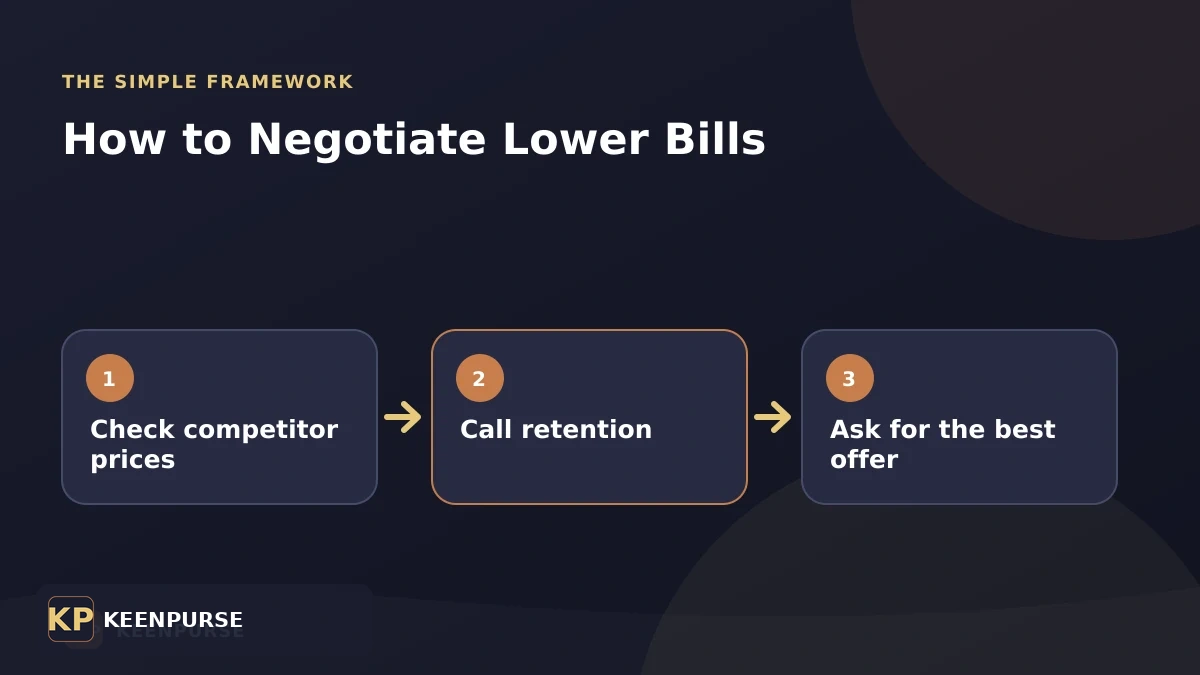
Step 1: Check Competitor Pricing
Look up what other ISPs charge in your area for similar speeds. Write down the provider name, speed, and price. You’ll use this as leverage.
Step 2: Call and Ask for the Loyalty or Retention Department
Say: “I found [competitor] offering [speed] for $X/month. I’d prefer to stay, but I can’t justify paying $Y more. What can you do?” If the first rep can’t help, ask to be transferred to someone who can adjust pricing.
Step 3: Downgrade If You Don’t Need the Speed
Most households don’t need gigabit internet. If you’re streaming, browsing, and video calling, 100–300 Mbps is plenty. Dropping from a $90/month gigabit plan to a $50/month 300 Mbps plan saves $480/year with zero noticeable difference for typical usage.
Quick math: if you’re paying for 1,000 Mbps but only use 50 Mbps during peak hours, you’re paying for 95% capacity you never touch.
How to Lower Your Insurance Premiums

Insurance is the bill most people set and forget. But rates creep up annually, and shopping around consistently beats loyalty. A [VERIFY: industry study data] suggests drivers who switch insurers save an average of 17% on premiums.
Auto Insurance
Get quotes from at least three providers every renewal cycle. Use the same coverage limits for each quote so you’re comparing apples to apples. If your current premium is $1,400/year and a competitor offers $1,100 for identical coverage, that’s $300/year back in your pocket.
Also ask about discounts: multi-car, safe driver, low mileage, defensive driving course, or bundling with home/renters insurance. Each can shave 5–15% off your premium.
Home/Renters Insurance
Renters insurance typically costs $15–$30/month — but many people skip it, assuming it’s expensive. Home insurance varies more widely. In both cases, raising your deductible from $500 to $1,000 can reduce your premium by 10–25% [VERIFY: specific percentage range]. On a $1,200/year home policy, that’s $120–$300 saved annually.
The Negotiation Script That Works
Whether you’re calling about phone, internet, or insurance, the same framework applies:
- Be polite but firm. Reps help people who are respectful. Don’t threaten — just state your position.
- Have your numbers ready. Know your current rate, the competitor’s rate, and how long you’ve been a customer.
- Ask for retention or cancellation. These trigger transfers to departments with more pricing authority.
- Be willing to walk. If they won’t budge, switch. The threat of losing you is your strongest leverage.
- Call back if needed. Different reps have different flexibility. A second call often gets a better result.
Action Steps You Can Take Today
- Pull your last three bills for phone, internet, and insurance. Note the monthly cost and any recent increases.
- Research competitor prices for each service in your area. Write them down — you’ll need specifics during the call.
- Schedule three calls this week: one per provider. Block 20 minutes each. Start with the bill that’s most recently increased.
- Set a calendar reminder to review these bills every 12 months. Rates change — your vigilance should too.
A household paying $75/month for phone, $90/month for internet, and $120/month for auto insurance could save $40–$80/month across all three with a few calls. That’s $480–$960 per year — real money for a few hours of effort.
Put this into practice
Negotiate from a script, not from frustration
A lower bill usually starts with proof that you have options. Compare alternatives, call at a quiet time, and ask directly for the retention or loyalty team.
- Write down your current price, contract end date, and the competing offer you can name.
- Call with one clear goal: a lower rate, a fee removal, or a better plan.
- If the answer is no, ask when your promotional rate ends and set a reminder to shop again.
For official consumer information, check FCC consumer resources before making a financial decision.
Frequently asked questions
Will calling retention always lower my bill?
No. It gives you a chance to ask for available plans or credits, but the result depends on your provider, location, account history, and competing offers.
Should I switch providers immediately?
Compare the full cost first, including equipment, taxes, contract terms, and any early termination fee. A lower advertised price is not always the cheaper option.