Most people think freelance writing requires a journalism degree, a massive portfolio, and years of experience before earning a single dollar. That’s wrong. In 2026, businesses need content more than ever — blogs, newsletters, landing pages, product descriptions — and they’re willing to pay writers who can deliver clear, useful copy on deadline. If you can write a decent email, you can write a decent blog post. And if you can write a decent blog post, you can get paid for it. Here’s how to go from zero to your first paying client in 30 days.
TL;DR: Pick a niche, write 3 sample articles, create a simple portfolio, pitch on 3 platforms, and land your first client within a month. Initial rates: $0.05–$0.10/word. Realistic first-month income: $200–$600 with consistent effort.
What Skills Do You Actually Need to Start Freelance Writing?
You need solid grammar, the ability to research topics quickly, and discipline to meet deadlines. That’s it. No degree required, no certification needed. The best freelance writers aren’t necessarily the most talented — they’re the most reliable.
Here’s what matters in practice: Can you take a brief, understand the target audience, and deliver a clean draft on time? Clients care about reliability more than Pulitzer-level prose. A writer who delivers good-enough copy on deadline will get rehired. A brilliant writer who ghost’s clients won’t.
Example: Say a client wants a 1,000-word blog post about budgeting apps. You need to: research the top 5 apps, compare features, write a clear intro, structure the comparison, and deliver within 3 days. At $0.08/word, that’s $80 for roughly 2–3 hours of work — about $27–$40/hour.
How Do You Pick a Profitable Writing Niche?
Generalist writers compete on price. Specialist writers compete on value. The same 1,000-word article pays $50 in the lifestyle niche and $300 in fintech or B2B SaaS. Pick a niche where you have some background or genuine interest, and clients will pay more for your domain knowledge.
Highest-Paying Freelance Writing Niches in 2026
| Niche | Avg. Rate per Word | Why It Pays Well |
|---|---|---|
| B2B SaaS / Tech | $0.15–$0.50 | Complex products need clear explainers |
| Finance / Fintech | $0.15–$0.40 | YMYL topics demand expertise |
| Healthcare / Medical | $0.15–$0.35 | Regulatory compliance requires precision |
| Legal | $0.15–$0.30 | Specialized knowledge, fewer qualified writers |
| Lifestyle / Travel | $0.03–$0.10 | High supply of writers, lower barriers |
Practical tip: If you’ve worked in retail, you understand e-commerce. If you’ve managed a household budget, you understand personal finance. Leverage your lived experience — it’s more valuable than you think.
Where Do You Find Your First Freelance Writing Clients?
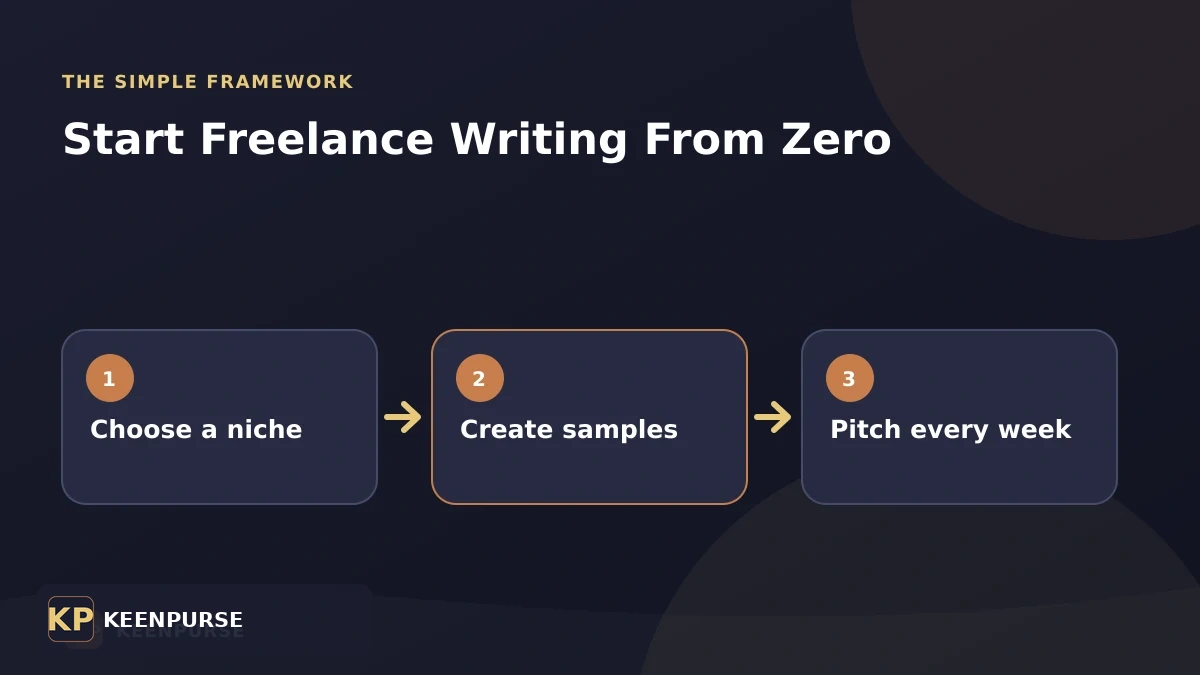
Don’t wait for clients to find you. Go where they’re already looking for writers. Three platforms consistently deliver for beginners: Upwork, Contena, and LinkedIn. Each works differently, and you should use all three simultaneously.
Platform Comparison for New Writers
| Platform | Best For | Fee Structure | Time to First Client |
|---|---|---|---|
| Upwork | Volume, quick start | 10% platform fee [VERIFY: current fee] | 1–2 weeks |
| Contenta / Contena | Curated, higher-paying | Subscription model | 2–4 weeks |
| Direct outreach, no fees | Free (Premium optional) | 2–6 weeks | |
| ProBlogger Job Board | Blog-specific gigs | Free to apply | 1–3 weeks |
Example: On Upwork, a beginner sending 5 targeted proposals per day (each taking 10 minutes) can expect 1–2 responses within the first week. At a $300 fixed-price project for 4 blog posts, that’s $75 per post — and if the client likes your work, they’ll often offer ongoing work at higher rates.
How Much Can You Realistically Earn in Your First Month?

Your first month won’t make you rich, but it proves the model works. Most beginners who apply themselves consistently earn $200–$600 in their first 30 days. By month 3, with returning clients and raised rates, $1,000–$2,500/month is realistic part-time.
Here’s the math: If you land 2 clients in your first month, each paying $0.08/word for weekly 800-word articles, that’s 2 × 800 × $0.08 = $128/week, or roughly $512/month for about 8–10 hours of weekly work. Not bad for a side hustle you started from zero.
3 Action Steps to Start Today
- Write 3 sample articles in your chosen niche. Pick topics that real businesses would pay for — not personal journal entries. A SaaS comparison, a how-to guide, and a listicle. These become your portfolio. Publish them on Medium or a free WordPress site so you have live links to share.
- Create profiles on Upwork and LinkedIn. Use a professional headshot, write a headline that says what you do (e.g., “Freelance Writer Specializing in Fintech & SaaS”), and link to your 3 samples. Send 5 targeted proposals or connection messages per day.
- Set your starting rate and stick to it. $0.05–$0.10/word is fair for a beginner. Don’t race to the bottom — clients who pay $0.01/word are the worst to work with. After 5 completed projects, raise your rate by 30–50%.
Common Mistakes That Keep Beginners Broke
- Waiting for the “perfect” portfolio. Three decent samples beat zero perfect ones. Start pitching before you feel ready.
- Underpricing to “build experience.” Working for $0.01/word teaches you to value your time poorly. Set a floor rate and don’t go below it.
- Ignoring the follow-up. 70% of freelance deals close on the 2nd or 3rd message. If a prospect doesn’t reply, wait 4 days and follow up once.
- Being a generalist forever. Start broad if needed, but niche down within 60 days. Specialists earn 2–3x more per word.
Put this into practice
Build proof before you chase higher rates
New freelance writers do not need a perfect website. They need clear samples, a focused offer, and a repeatable way to contact potential clients.
- Choose one type of business or publication you can write about credibly.
- Create two useful samples that solve a real problem for that audience.
- Send a small number of tailored pitches each week and track replies, follow-ups, and wins.
For official consumer information, check IRS self-employed tax center before making a financial decision.
Frequently asked questions
Do I need a degree to become a freelance writer?
No. Clients usually care more about whether you understand their audience and can produce a useful sample. A focused portfolio is more persuasive than a generic credential.
How should a beginner price work?
Start with a rate that reflects the time required, the revision scope, and the value of the assignment. Track your effective hourly rate so you can raise prices as you gain speed.