TL;DR: Pricing freelance work starts with the result, scope, time, and costs—not a random hourly number. Use a minimum viable rate as a private floor, quote clear packages or fixed projects when the scope is clear, and protect every agreement with written deliverables and revision limits.
Key Takeaways
- Your rate has to cover unpaid admin time, taxes where applicable, tools, and time between projects—not only client-facing hours.
- A fixed project price is easier to understand when the deliverables and revision limits are defined.
- Hourly billing can be useful for uncertain or open-ended work, but it needs an estimate and a cap.
- A simple discovery process prevents underpricing: ask what success looks like, what is included, and when it is needed.
- Raise prices by changing the scope, proof, or process—not by making claims you cannot support.
Why Freelance Pricing Feels Hard at First
New freelancers often price from discomfort: they pick a number that feels easy to say, then discover the project took twice as long as expected. The real challenge is not confidence alone. It is that a client sees one deliverable while you carry discovery calls, revisions, invoicing, software, learning time, and gaps between contracts.
The fix is a repeatable pricing process. You do not need to know the “perfect market rate” to start. You need a clear scope, a sustainable minimum, and a way to explain the value of the work without promising a result you cannot control. This is especially useful if you are turning a skill into a side income; start with the groundwork in our beginner’s guide to freelance writing.
Start With a Private Minimum Rate

A private minimum rate is not necessarily what you quote. It is the number below which a project no longer makes sense for you. Start with the income you need from freelance work, then account for non-billable time and business costs. The illustration below is deliberately simple and not tax guidance.
| Illustrative monthly calculation | Amount |
|---|---|
| Desired monthly freelance income | $2,000 |
| Software, payment fees, and other business costs | $200 |
| Amount to cover before taxes | $2,200 |
| Billable hours you can realistically sell | 40 |
| Private floor: $2,200 ÷ 40 | $55/hour |
Forty billable hours is not the same as forty hours worked. A freelancer might spend 60 hours in a month working, but only 40 are directly paid by clients. The other 20 can include proposals, calls, admin, revisions, and marketing. That is why copying an employee hourly wage is often misleading.
Use the floor to make decisions, not to recite a formula
If a fixed-price project is likely to take six focused hours and your private floor is $55, the project needs to be worth more than $330 before you consider complexity, rush work, or usage rights. You may quote $450 because the deliverables create more value or because you have included a revision round. The floor tells you when a quote is too low; the scope helps you set the actual price.
Pick the Right Pricing Model for the Work
| Model | Best when | Main advantage | Watch out for |
|---|---|---|---|
| Hourly | The scope is changing or ongoing | You are paid for time used | Client anxiety about an open-ended total |
| Fixed project | Deliverables and boundaries are clear | Client knows the investment upfront | Scope creep without a written change process |
| Retainer | There is repeatable monthly work | Predictable income and capacity | Vague “as needed” expectations |
| Package | You solve a repeatable problem | Easy to compare and sell | Forcing a custom job into the wrong package |
For a first small project, a fixed price is often easiest for both sides—provided the scope is concrete. For example, “three 800-word blog posts, one revision round each, supplied outline, delivery by a specific date” is a scope. “Help with content” is not.
Turn a Vague Request Into a Priceable Scope
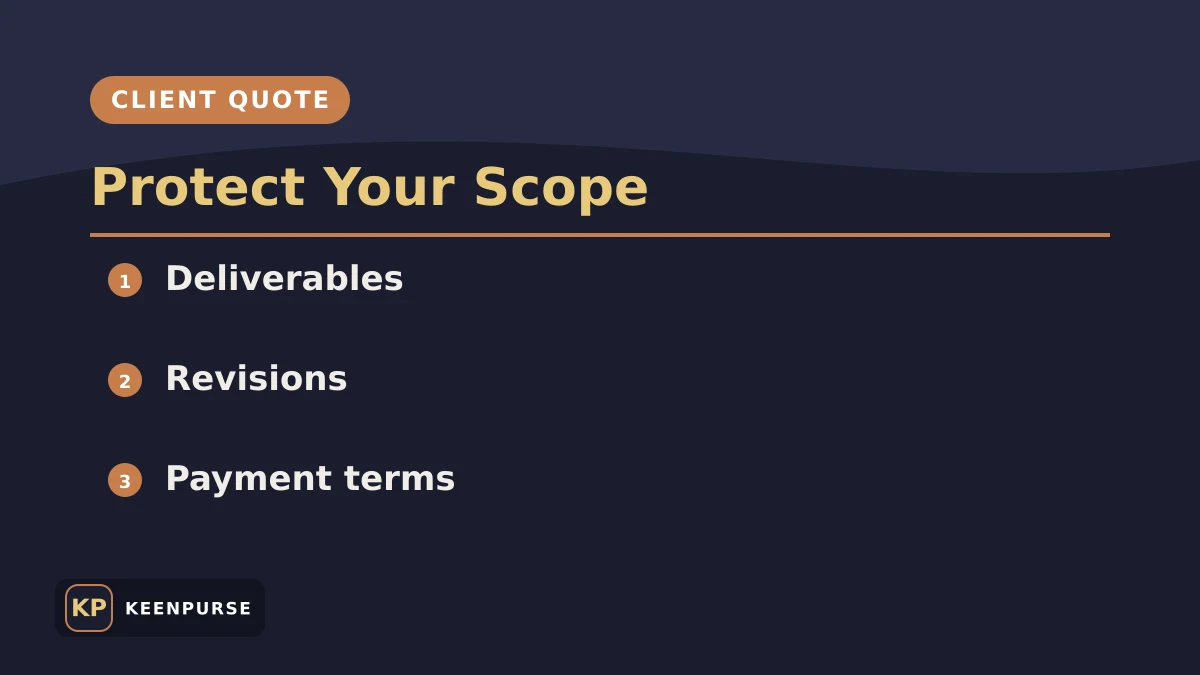
Before naming a price, ask questions that change the workload. This is not bureaucracy; it prevents you from selling something different from what the client expects.
- What outcome is the client trying to achieve?
- What exactly will be delivered, in what format, and by when?
- Who supplies source material, brand guidelines, access, and approvals?
- How many decision-makers will review the work?
- How many revision rounds are included?
- What is explicitly outside the agreement?
A useful rule: if you cannot summarize the deliverable in two sentences, do not quote a fixed price yet. Offer a paid discovery session, a smaller phase one, or an hourly estimate with a not-to-exceed cap instead.
Build Three Simple Packages
Packages give clients a choice without turning every inquiry into a custom negotiation. The packages below are an example structure, not recommended market pricing. Adjust the deliverables and amounts to your skill, niche, and evidence of past work.
| Package | Illustrative deliverables | Boundary |
|---|---|---|
| Starter | $300: one defined deliverable, one revision | No strategy call; client provides all inputs |
| Core | $650: two related deliverables, one planning call, two revisions | Delivery schedule set at kickoff |
| Partner | $1,200: monthly recurring deliverables and reporting check-in | Minimum term and response-time expectations in writing |
The point is not to make the highest tier look inflated. Each option should solve a different version of the client’s problem. If a prospect needs something outside the menu, create a custom scope rather than quietly adding unpaid work to the closest package.
Quote the Project With a Clear, Calm Script
You do not need a long defense of your price. State what is included, the investment, the timeline, and the next step. Here is a reusable starting point:
“Based on the goal and deliverables we discussed, the project fee is $650. That includes the planning call, the two agreed deliverables, and up to two rounds of revisions. I can deliver the first draft by [date]. If that works, I will send the scope and invoice for the deposit.”
Avoid promising revenue, rankings, viral reach, or other outcomes you do not fully control. A strong proposal explains the work and the decision process; it does not turn uncertain results into guarantees.
Protect Your Time: Deposits, Revisions, and Change Requests
Pricing only works when the agreement matches it. Put the core terms in writing before you start. For many project types, a deposit or upfront milestone payment can reduce the risk of doing substantial work without payment. The legal and tax treatment varies by jurisdiction, so use a qualified local professional for documents and compliance questions.
| Term | What to state clearly |
|---|---|
| Payment schedule | Deposit or milestone amount, invoice due date, and payment method |
| Revisions | How many rounds are included and what counts as a new request |
| Timeline | Client feedback deadlines and how late feedback affects delivery |
| Change requests | How additional work is estimated and approved before beginning |
| Usage and files | What the client receives after final payment |
A revision means improving the agreed deliverable. A revision does not mean adding new pages, changing the target audience, or replacing the original brief. Naming that difference early makes the client relationship easier, not harsher.
A 30-Day Pricing Experiment for New Freelancers
- Week 1: List three services you can deliver confidently. Write a one-sentence outcome and a concrete deliverable for each.
- Week 2: Calculate your private hourly floor, then draft one fixed-price package for the simplest service.
- Week 3: Send five targeted outreach messages or proposals. Track questions and objections without changing the price after every conversation.
- Week 4: Review: how long did projects actually take, where did scope expand, and which clients valued the work? Update your package language before changing the number.
If the income from freelancing begins to grow, give it a home in your broader plan. You can use a separate account for irregular business expenses and apply the same planning principle in your emergency fund strategy. For a broader list of income ideas, see side hustles that can fit around a job.
Frequently Asked Questions
Should beginners charge hourly or per project?
Either can work. Hourly pricing is practical when the scope is unclear. Fixed pricing can be easier to sell when deliverables, timeline, and revisions are defined. New freelancers often benefit from tracking hours privately even when they quote a project fee.
How do I raise my freelance rates?
Start by reviewing project profitability and demand. Raise rates for new work, tighten the scope, or add a higher-value package. Explain the current deliverables and process rather than apologizing or claiming that a higher price guarantees a result.
What if a client says the price is too high?
Ask whether the scope or budget is the constraint. You may offer a smaller version of the project, a later start date, or a different payment schedule. Do not remove essential work without changing the fee.
Do I need a contract for small projects?
Written terms are useful even for small projects. A simple agreement can document deliverables, payment, timeline, revisions, and ownership. For legal advice or local contract requirements, consult a qualified professional.