
TL;DR
Written by KeenPurse Editorial Team · Published August 20, 2026
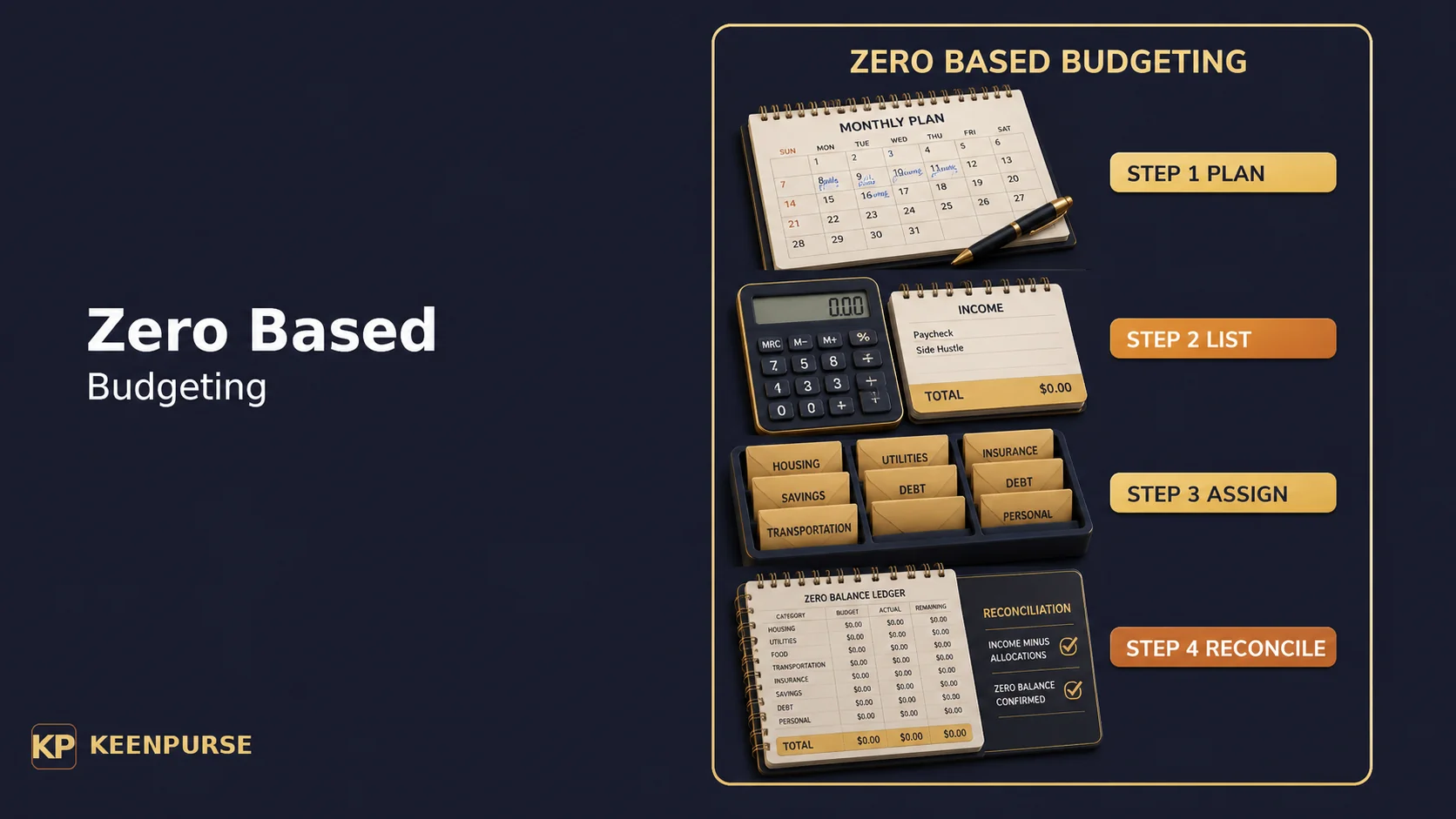
Zero based budgeting is a method, not a magic number: instead of starting from last month’s leftovers or a round percentage, you give every dollar of expected income a specific job each period. The usual four steps are to list your income, name every expense, assign each dollar a purpose, and reconcile the result to zero.
The goal of the zero based budgeting method is that income minus expenses, savings, and debt payments equals zero on paper — a plan, not a promise.
It works alongside common rules such as the 50/30/20 rule, and it can run in a spreadsheet or an app. It is a way to decide where money goes, not a guarantee that you will save a particular amount.
Key Takeaways
- Zero based budgeting builds a plan from scratch each period: every dollar of expected income is assigned a purpose, so income minus planned categories equals zero.
- The “zero” is on paper. Planning to zero does not mean spending everything; savings, sinking funds, and debt payments are legitimate jobs a dollar can hold.
- The method handles irregular income, smaller categories, or a spreadsheet or an app — but every step still requires your own numbers.
- It is a budgeting method, not a promise of savings, and it does not automatically outperform other approaches such as the 50/30/20 rule for every household.
- Regular reconciliation keeps it honest: money you planned, spent, or moved should be adjusted in the next review so the plan reflects reality.
- No guide can promise an average amount saved, a guaranteed surplus, or a universal category list; those depend on your own income, costs, and choices.
Start with a direct answer
The practical answer is that zero based budgeting is a planning method: each budgeting period, you start at a zero baseline and assign every expected dollar of income to a category until the plan balances at zero.
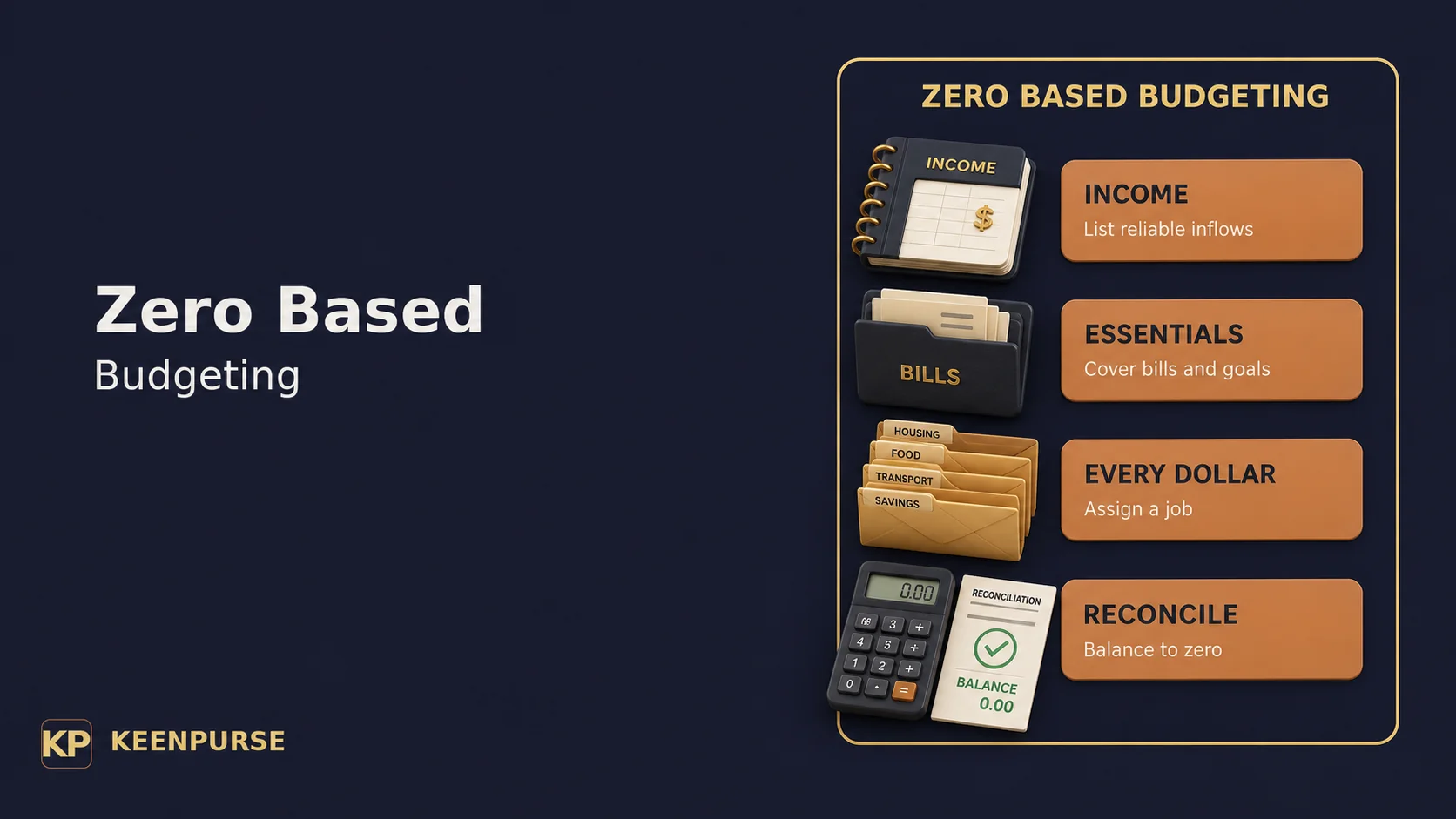
The usual shorthand is “give every dollar a job.” The four core steps are to list your income, name all of your expenses, assign every dollar a purpose, and reconcile the result back to zero. The method forces a conscious decision about each dollar rather than letting the plan fill in from a default.
A common mental block is that “zero” sounds like “spend until nothing is left.” It does not mean that. A zero based budget balances because categories such as savings, an emergency or sinking fund, and debt payments are jobs too.
The target is a plan that accounts for every dollar, not one that spends every dollar; treat “give every dollar a job” as a memorable method label, not a universal law. Public bodies describe a budget as a written plan of what comes in, what goes out, and what you plan each period ([consumer.gov], [FCAC]).
How zero based budgeting differs from the 50/30/20 rule
The zero based budgeting method is not a rival to the popular 50/30/20 rule so much as a different starting point.
The 50/30/20 rule begins with broad categories — roughly needs, wants, and savings — while zero based budgeting begins with your actual list of income and expenses and balances them to zero. One gives you a proportional frame; the other gives you an item-by-item assignment.
| Criterion | Zero based budgeting | 50/30/20 rule | Note |
|---|---|---|---|
| Starting point | Your actual income and expense list, built from scratch each period | Broad category percentages applied to income | Different baseline, different effort |
| What balances | Income minus all categories equals zero | Income is split into three broad buckets | Zero is a target; 50/30/20 is a proportion |
| Granularity of categories | As many lines as you choose, down to individual expenses | Three large categories in the classic version | Zero-based can be more detailed |
| Handling of savings and debt | Explicitly assigned jobs within the plan | Usually folded into the savings/wants structure | Both can hold savings as a line |
| Best fit | Readers who want every dollar named and tracked | Readers who want a simple proportional frame | See the 50/30/20 budget rule for the proportional approach |
The two can even be combined: some readers use 50/30/20 to check the overall shape of a budget and zero based budgeting to fill in the item-level detail. There is no single “best” approach; the choice is about which baseline you can maintain.
Run it in 4 steps
Here is the core checklist table for the zero based budgeting method. Each row becomes its own section below, because the value of the method is in the detail of each step rather than in the slogan.
| Step | What you do | What it produces | Common pitfall to avoid |
|---|---|---|---|
| 1. List your income | Write down every expected source and approximate amount for the period | A realistic income figure, not an optimistic one | Forgetting side income, variable pay, or taxes taken first |
| 2. Name all your expenses | List fixed costs, variable costs, and irregular or occasional costs | A complete picture of where money needs to go | Missing quarterly, annual, or non-monthly items |
| 3. Assign every dollar a job | Give each category a planned amount until the list uses up your income | A plan that assigns, not spends, every dollar | Leaving a gap, or assigning a “miscellaneous” bucket that never gets reviewed |
| 4. Reconcile to zero | Compare the plan with actual money in and out, and adjust | A balanced plan that reflects reality | Skipping the check so the plan drifts from what happened |
Step 1: List your income
Start by writing down every dollar you expect to come in during the budgeting period. For most people that is one or two paychecks, but be honest about the full picture: side income, variable pay, tips, irregular work, or money that arrives less often than the period you are planning.
If part of your pay is taxed or deducted before it reaches you, plan with the amount you actually receive, not the pre-deduction figure. Listing all incoming sources is the first step in official budgeting guidance ([consumer.gov]).
Two caveats make this step reliable. First, use the amount you realistically expect, not the highest amount you might earn. Second, if your income is irregular, plan over a month, a quarter, or a longer rolling window rather than a single fixed period — the method adapts, but only if the income you list is a number you can stand behind.
Step 2: Name all your expenses
Next, write down every expense and group them so nothing hides.
A useful split is: fixed costs you can predict (rent or mortgage, utilities, insurance, debt minimums), variable costs that move with use (groceries, transport, household supplies), and irregular or occasional costs that do not land every period but still have to be planned for (annual subscriptions, car maintenance, gifts, insurance renewals).
Categorizing expenses by type is a step financial-education agencies build into their own budgeting guidance.
The risk in this step is omission. A quarterly or annual bill can be entirely absent from a monthly list, which is exactly where a zero based budget breaks. If you do not have a clear figure, use a reasonable estimate and mark it for review, then correct it in reconciliation.
This is also where a sinking fund earns its place: an irregular cost can be planned as a small, regular contribution into a named fund rather than a surprise in the month it lands.
Step 3: Assign every dollar a job
Now the actual “give every dollar a job” step. Work down your expense list and give each category a planned amount for the period until every dollar of expected income has a named destination — including the productive jobs, such as an emergency or sinking fund, savings, and debt payments beyond the minimum.
Giving savings a named line in the plan is a step official guidance itself recommends ([consumer.gov]).
If your expenses add up to less than your income, the extra dollars still need a job: put them on a savings or sinking-fund line rather than leaving them unassigned.
If they add up to more than your income, you have a shortfall to address (the FAQ covers this) rather than a working plan. The discipline of this step is that nothing is left unnamed: prefer a named line even when the amount is small.
Step 4: Reconcile to zero
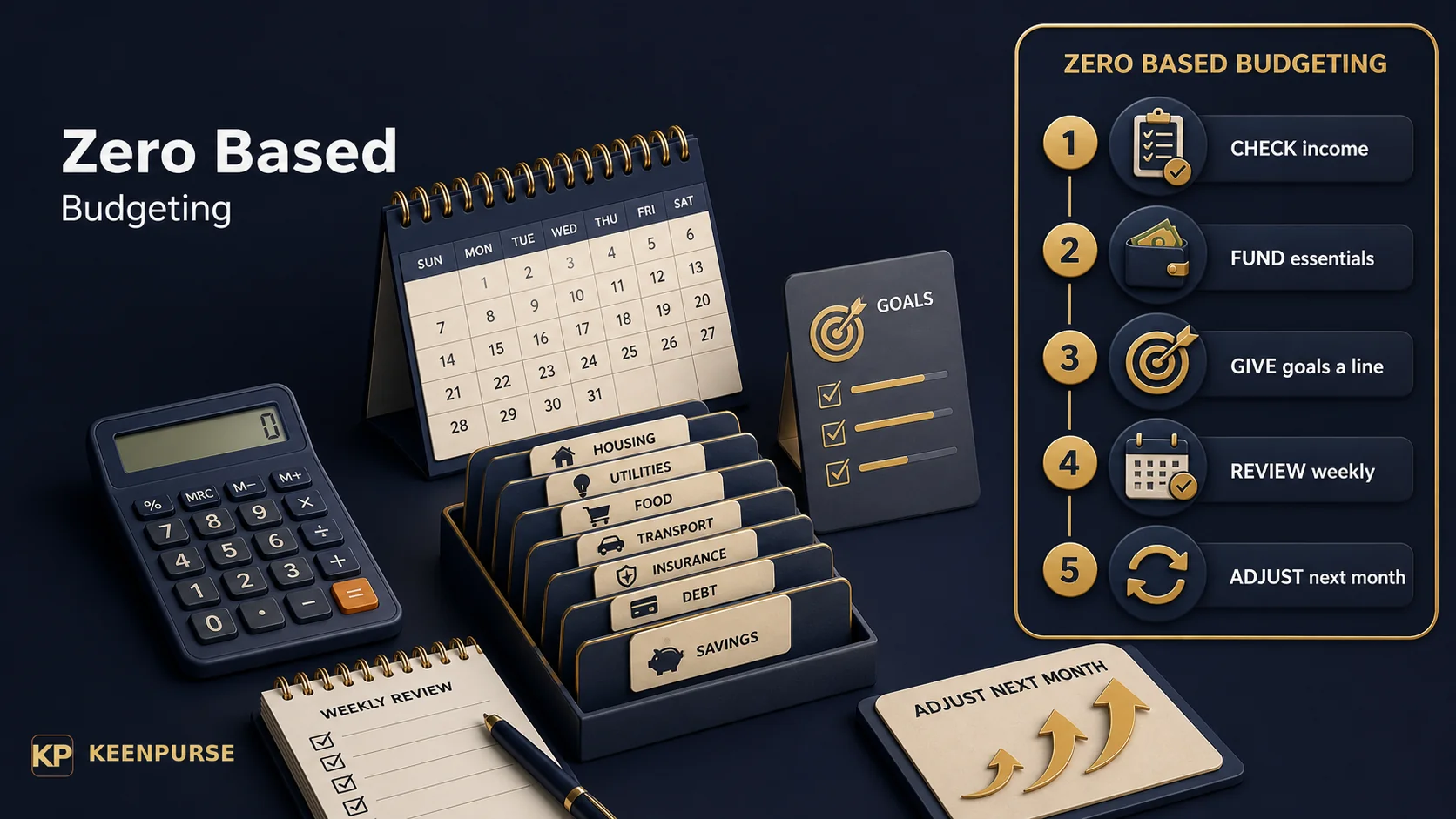
Finally, compare the plan with what actually happened. Did a category come in under or over plan? Move money between lines, add missed items, and adjust your income figure if it changed, so the plan balances at zero again.
Comparing what you planned with what you spent and feeding that into the next month’s plan is exactly how official budgeting guides tell you to close the loop ([consumer.gov]). Reconciliation is what turns a one-time list into a recurring method, and it is usually where the real learning happens.
Reconciliation also feeds the wider routine: the monthly money reset checklist gives you a place to slot this check alongside your other account reviews, so it becomes a rhythm rather than an occasional chore.
A method, not a guarantee of savings
It is worth saying plainly: zero based budgeting is a method, not a guarantee. A balanced plan does not promise that you will meet a savings goal, avoid a surprise cost, or build wealth by a certain date. The method improves your visibility and your conscious choices, but outcomes still depend on your income, your unavoidable costs, and real life.
For that reason, this article makes no promise about an average amount saved or that zero based budgeting automatically beats other methods. A surprise bill, a change in income, or a higher-than-planned category can happen to any plan. A method describes how you decide; it does not guarantee the result.
| What zero based budgeting is | What it is not |
|---|---|
| A way to consciously assign each dollar a purpose each period | A promise of a specific amount saved |
| A framework that adapts to your own numbers | A universal category list or a one-size-fits-all rule |
| A tool that works in a spreadsheet or an app | An investment, tax, or legal recommendation |
| A method that improves with regular reconciliation | A set of percentages or rates you should assume hold everywhere |
Tooling: a spreadsheet is enough, an app can help
You do not need any particular product to run a zero based budget. Many people build a simple spreadsheet with income on top, a category list below, and a final line that sums to zero; others use a pen-and-paper sheet.
The method lives in the assignment and reconciliation steps, not in the tool. Some public agencies publish free budgeting planners, so no paid software is required.
If you prefer a digital tool, a budgeting app can automate some tracking, but no app removes the need for your own numbers, and apps differ in price, platform, and approach.
This article does not rank or endorse a specific app and makes no claim about current prices or features. If you want a comparison of tracking tools rather than this method guide, see our comparison of budgeting apps.
Put zero based budgeting inside your wider money routine
A zero based budget is most useful when it sits inside a broader set of habits rather than floating on its own. Reconciliation connects naturally with a regular review moment like the monthly money reset checklist.
A no-spend week budget reset can help you see which spending lines you actually depend on. Because the method names every dollar, it also pairs well with a sinking fund for irregular costs and with living below your means.
None of those links claims one method is better than another; they are adjacent tools that can reinforce the same habit of intentional money decisions.
Frequently Asked Questions
Is zero based budgeting the same as the 50/30/20 rule?
No, they are different starting points. The 50/30/20 rule splits income into broad proportional categories, while zero based budgeting assigns each dollar a specific job from your actual income and expense list and balances to zero. They can be combined; the proportional approach is in the 50/30/20 budget rule.
Does zero based budgeting work with irregular income?
It can, but you have to adapt the period. With variable or contract income, plan over a longer rolling window, use a conservative income figure, and be ready to adjust at reconciliation.
Official budgeting guidance recognizes that not everyone is paid monthly and suggests estimating a monthly figure from a longer record ([consumer.gov]). Irregular income makes the income-listing step harder, not impossible.
What if my expenses exceed my income?
Then you have a shortfall to address, not a working plan: either reduce planned expenses, add income, or both. Official guidance describes the same signal — when spending is more than income, look for things in the budget you can change ([consumer.gov]).
A zero based budget that does not balance is telling you something about the gap rather than solving it by itself.
Are spreadsheets or apps required?
No. A spreadsheet, a printed sheet, or a note can be enough, and this article does not require or endorse any specific product. Apps can automate tracking, but they still need your own figures, and their suitability, price, and platform vary. Compare tools separately if you want to choose one: our comparison of budgeting apps.
Does zero based budgeting guarantee that I will save money?
No. It is a method for deciding where money goes, not a promise of a particular amount saved. Outcomes depend on your income, your unavoidable costs, and what actually happens. Treat any “average amount saved” figure as a claim to inspect rather than a result you can count on.
How often should I update a zero based budget?
As often as your own reality changes and you are willing to reconcile. A common rhythm is monthly, feeding reconciliation into a regular monthly money reset checklist; official guidance frames a budget as something you use and revisit every month ([consumer.gov]). If your income or costs change more often, update more frequently.
Sources and further reading
- consumer.gov (U.S. Federal Trade Commission, consumer education), “Making a Budget.” https://consumer.gov/your-money/making-budget. Accessed 2026-08-20; page last updated August 2024. Jurisdiction: United States. Supports: a budget is a written plan of income against spending; listing income and expenses first; checking the balance is more than zero; estimating a monthly figure for irregular pay; planning and reconciling monthly; giving leftover money a savings line.
- Financial Consumer Agency of Canada (FCAC), “Making a budget.” https://www.canada.ca/en/financial-consumer-agency/services/make-budget.html. Accessed 2026-08-20. Jurisdiction: Canada. Supports: a budget is a plan that balances income with savings and expenses; categorizing expenses (needs and wants, plus categories such as food, housing, and insurance); using a free budgeting planner tool with your own figures.
These sources are cited for the statements above only; local prices, category rules, and outcomes vary.
- the 50/30/20 budget rule — the proportional budgeting approach for comparison.
- monthly money reset checklist — a regular reconciliation and review moment.
- no-spend week budget reset — a focused consumer experiment that can test which spending lines matter.
- how to create a sinking fund — for planning irregular costs as small, regular contributions.
- how to live below your means — a broader discipline that intentional assignment supports.
- best budgeting apps compared — tool-selection comparison, distinct from this method guide.