
Personal Finance

Personal finance guides for budgeting, debt, credit, and everyday money decisions, written for beginners in plain English.

Shopping basket and price tags illustrating purchasing power

What Is Inflation? A Plain-English Guide to Prices and Purchasing Power

Evidence label: SERP-derived suggestion evidence only; it does not establish volume, demand, trend, difficulty, or targeting.

TL;DR

What is inflation? In plain terms, it is a broad rise in prices over time: the same amount of money may buy fewer goods and services than before, which is a loss of purchasing power. One expensive item is not, by itself, inflation, and inflation is not a reason to assume any savings account, investment, or asset will perform well. Rates and effects vary by place and time, so this guide deliberately quotes no current rate.

Key Takeaways

  • Inflation is a broad price-level change over time, not one isolated price increase.
  • Purchasing power is the practical question: what can the same amount of money buy?
  • An inflation rate is a time- and country-specific statistic that needs its method, date, and geography.
  • Economists name several mechanism classes behind inflation; none automatically explains a specific episode.
  • Savings, bonds, stocks, gold, and crypto each raise different questions; this article names no universal winner or protection.

Inflation is not the same as one price going up

The direct answer to what is inflation is a sustained, broad increase in prices across an economy over time. Broad matters. A café can change the price of one drink because its lease changed, its supplier changed, or it is running a promotion elsewhere. That observation alone does not tell you whether prices are increasing across many categories.

Think of two shopping lists rather than one receipt. If one item costs more while other prices are mixed or unchanged, it is an item-specific change. If a measure designed to track a basket of goods and services shows a broad change over a period, that is the type of evidence used when discussing inflation. The exact basket, weighting, collection method, and published index depend on the country and agency.

This distinction keeps headlines from doing too much work: a higher bill still needs context before it proves economy-wide inflation. A price index is not a universal receipt, and a current number without its date and source is incomplete.

How inflation is measured—and why current rates need context

Public agencies publish price-index statistics, but labels and methods differ. Readers asking what is inflation need the same context before using a number. The table is a reading guide, not a substitute for the original release.

TermEducational roleCountry/time sensitivitySource boundary
Price index or CPI-class statisticA structured measure intended to follow prices for a defined basket over time.Basket, weights, coverage, and methods can vary by agency and country.Read the relevant statistics office’s current methodology and release.
Inflation rateA reported change in a price measure over a stated period.Requires the period, geography, index, and release date.Do not use a figure without its primary release and date.
Purchasing powerWhat a given amount of money can buy in a stated context.Depends on prices, location, timing, and the items considered.Treat broad definitions as educational; avoid personal-cost conclusions.
Nominal and real valuesNominal refers to stated money amounts; “real” comparisons commonly adjust for price changes under a stated method.The adjustment and period matter.Use a dated institutional definition for any technical application.
What is inflation: how inflation is measured
How inflation is measured

A current rate belongs in a dated news report, not an evergreen explainer. Before using one, ask: which index, which country, which period, and was it revised? Those questions stop a precise-looking number from becoming a vague claim.

What can contribute to inflation?

Economists describe several channels that can place upward pressure on broad prices. These are mechanism classes, not a scorecard for diagnosing a particular country, month, or headline; an authoritative, dated source is needed to apply any of them to a real episode.

Mechanism classPlain-language questionWhat it does not establish
Demand-side pressureAre people, businesses, or governments trying to buy more than available goods and services can readily supply?That demand alone caused inflation in a specific place.
Cost-side pressureHave input, transport, energy, labor, or other production costs changed in ways businesses may pass through?That every cost change becomes a broad, lasting price increase.
Money and credit conditionsHow might financial conditions affect spending, borrowing, and demand over time?A simple one-variable explanation for an inflation episode.
ExpectationsCould expectations about future prices influence contracts, pricing, wage discussions, or spending decisions?That expectations can be observed or inferred without evidence.
Supply disruptionHas availability been interrupted by events affecting production, shipping, or inputs?That a temporary shortage equals economy-wide inflation.
KeenPurse illustration: read an inflation statistic safely
Read an inflation statistic safely

The practical takeaway is modest: “what causes inflation?” rarely has one clean answer. Understanding what is inflation also means accepting that causes are rarely simple. A good explainer names possible mechanisms and leaves country-specific attribution to current, sourced analysis.

How inflation can affect savings and spending

Inflation connects to daily money decisions through purchasing power: a balance can show the same nominal number while the mix of goods it can buy changes. That is a concept, not a forecast about one household’s bills or results. Knowing what is inflation helps you read an account disclosure without treating it as a promise.

For savings accounts and certificates of deposit, readers may see inflation mentioned alongside stated interest terms. The useful next step is to separate the account’s disclosed terms from the broader purchasing-power question; neither this article nor a headline can determine the reader’s outcome. Product rates, access rules, deposit protection, taxes, and local treatment require separate, current verification.

The same boundary helps with a grocery budget. A higher category total can prompt a review of what was bought, when, and at what prices, but it does not tell a reader which category to cut or what amount is appropriate. For category planning, see related guide. For an allocation framework, see related guide.

Readers exploring cash reserves can continue with related guide, or compare account concepts through related guide and related guide. Those articles address separate decisions; inflation itself does not dictate the right account or target.

Is inflation good or bad? Asset questions need boundaries

Inflation is not experienced identically by every household or investor. Prices, income timing, debts, holdings, and personal needs differ, and asset outcomes cannot be reduced to a one-word answer.

Asset class or holdingQuestion to investigateWhat this article does not claimRelated KeenPurse link
Savings or depositsWhat are the current terms, access conditions, and relevant protections?That a deposit will preserve purchasing power.related guide
BondsWhat risks and terms apply to the specific bond or fund?That bonds always rise or fall with inflation.related guide
Stocks or diversified fundsWhat risks, costs, time horizon, and diversification details apply?That stocks are an inflation hedge or will deliver a result.related guide
Gold or precious metalsWhat are the ownership, pricing, storage, and risk considerations?That metals guarantee protection.related guide
CryptoWhat volatility, custody, regulatory, and product risks apply?That crypto protects against inflation or is suitable for a reader.related guide

“Protect against inflation” is a question to unpack, not a promise: it may mean preserving access to cash, understanding account terms, or researching an investment risk—each a separate decision. Asking what is inflation before acting on a headline keeps the mechanism separate from the news.

Related terms and international wording

These terms are related but not interchangeable. Definitions and historical applications should be checked against a dated institutional source.

TermBounded contrast
DeflationA broad decline in prices, contrasted with inflation’s broad rise.
StagflationA term often used for a combination involving inflation and weak economic conditions; its use needs context and a source.
HyperinflationAn extreme inflation term with technical and historical context; do not apply it casually to a price complaint.
Stock market / share marketLexical variants for a market topic; neither changes the need for evidence about a particular investment outcome.
Lifestyle inflationSpending drift as income changes; a separate behavioral topic, not the macro price-level mechanism explained here.

Frequently Asked Questions

What is inflation in simple terms?

Inflation is a broad rise in prices over time: the same amount of money can buy less than before. The exact measure and impact depend on country, period, and what is considered.

Is inflation the same as one item becoming more expensive?

No. One price can change for item-specific reasons; inflation is a broader movement in prices measured over time with a defined method and basket. That is why what is inflation is a measurement question, not a receipt question.

What causes inflation?

Economists discuss demand pressure, costs, money and credit conditions, expectations, and supply disruptions. The list does not identify the cause of a specific episode; that needs dated, country-specific evidence.

How does inflation affect savings accounts and purchasing power?

A balance is nominal; purchasing power is what that balance can buy. Account terms and price changes move independently, so no universal conclusion follows from inflation alone. That distinction is the practical side of what is inflation for savers.

Is inflation good or bad?

Effects are not uniform. Households and holdings differ, and this guide predicts no personal costs, asset performance, or best response.

What does it mean to protect against inflation?

It is shorthand for a goal, not a guaranteed product feature or investment outcome. Clarify the goal, timeframe, risks, and current terms before deciding.

Why doesn’t this article list the current inflation rate?

A current rate is a dated, geography-specific statistic tied to a particular index and release; without that context it could mislead, so consult the official statistics release for a current figure. What is inflation as a concept can be explained without today’s figure.

Sources and further reading

⚠️ Educational information only. Full disclaimer.

What Is Inflation? A Plain-English Guide to Prices and Purchasing Power Read More »

How to Make Money Blogging: Four Real Income Categories and a Decision Checklist

TL;DR

A blog is a written content asset: you publish useful work for a defined reader and, if an audience develops, may later consider methods such as advertising, affiliate relationships, sponsorships, or your own offers. That sequence is not a fast-income formula. Revenue, timing, traffic, platform eligibility, and whether blogging is worthwhile for a particular person all remain uncertain .

For how to make money blogging responsibly, the practical first decision is not “Which monetization button should I turn on?” It is whether you want to build an audience-facing asset, sell a service to clients, or make a product. Each route asks for different work and carries different uncertainty.

Key Takeaways

  • Blogging is distinct from freelance writing: a freelancer sells work to a client, while a blogger publishes for readers and may build an audience over time.
  • Display ads, affiliate links, sponsored posts, and your own products or services are different monetization categories—not interchangeable promises of income.
  • Traffic is an input to possible monetization, not proof that a reader will earn anything .
  • A narrow reader problem and consistently useful articles are more concrete starting points than a broad “make money online” topic.
  • Before using a commercial relationship in content, check current platform terms and applicable disclosure rules .

How to make money blogging: the direct answer

The short answer to how to make money blogging is that a publisher may pair useful written content with a suitable monetization method after building an audience. The usual categories are display advertising, affiliate relationships, sponsored content, and offers the publisher owns, such as a template, course, service, or digital product. None of those categories establishes an income level, a timeline, or eligibility .

That distinction matters because how to make money blogging is not solved by treating a blog as simply a folder of posts. It is an attempt to create a useful body of work for readers who have a recurring question or task. A personal-finance blog, for example, might help a beginner compare budgeting systems, organize a savings goal, or understand the language on a bank statement. The reader’s problem comes first; a monetization method, if any, has to fit the content and be disclosed appropriately .

For official platform documentation, review Google AdSense Help and Program Policies. For U.S. disclosure guidance, review the Federal Trade Commission’s endorsements, influencers, and reviews guidance. Legal obligations depend on the relationship and jurisdiction .

Blogging versus freelance writing versus digital products

A side-hustle comparison is clearer when you separate what is being sold while considering how to make money blogging. Freelance writing generally centers on a client assignment. A blog centers on content published for an audience. A digital product centers on a reusable item a customer can choose to buy. A person can work on more than one route, but combining them does not remove the trade-offs.

Route What is being offered Main work Key uncertainty Related KeenPurse reading
Freelance writing A client-facing writing service Finding, scoping, delivering, and revising assignments Client demand, scope, pricing, and payment terms Freelance writing for beginners
Blog / content asset Useful written content for a defined audience Researching, writing, updating, and helping readers discover content Audience development, traffic, monetization eligibility, and outcomes This article
Digital product A reusable item such as a template or download Designing, describing, improving, and supporting the product Demand, platform terms, customer expectations, and sales outcomes How to start an Etsy shop
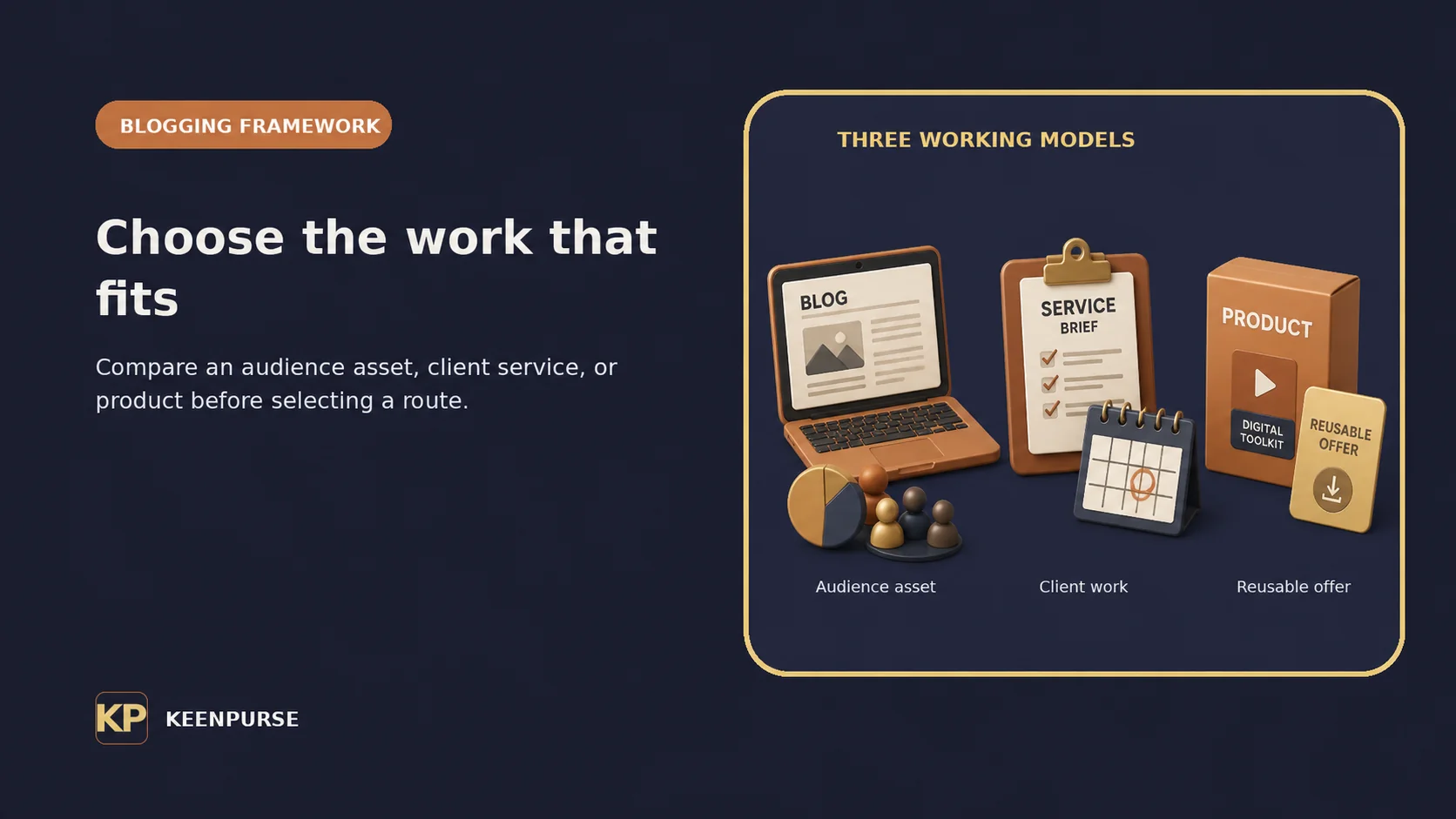
Make money blogging framework: compare blog, service, and product working models
Make money blogging — working models

When comparing how to make money blogging with client work, freelance writing may suit someone who prefers a defined client brief and a direct service relationship. A blog may suit someone willing to keep building a public library of useful answers despite delayed and uncertain feedback. A product route may suit someone who wants to package a repeatable solution. Those are working-style differences, not guarantees that one path will pay more or work better .

If you are comparing client work with an audience asset, start with the mechanics of setting a service price rather than importing a blog-income assumption: How to price freelance services.

How bloggers make money: four categories, four sets of terms

Learning how to make money blogging should not dictate the topic. A reader can usually tell when an article was made to answer a question and when it was made mainly to insert a commercial mention. Treat each category as a relationship with its own current policies, disclosures, payments, and eligibility requirements.

Monetization category What it can involve What to examine before using it What it does not prove
Display advertising Ads displayed alongside content Current program policies, eligibility, ad controls, payment terms, and reader experience That a site will be approved, receive traffic, or earn a particular amount
Affiliate relationships A publisher may receive compensation when a reader takes a qualifying action Merchant terms, link handling, disclosure placement, and local legal requirements That readers will click, buy, or benefit from a product
Sponsored posts Compensation or another material relationship connected to content Contract terms, editorial independence, disclosure requirements, and platform rules That a sponsor will be available or that the post will perform
Own products or services A template, consultation, course, download, or other direct offer Product scope, customer support, payment handling, refunds, taxes, and applicable rules That an offer will sell or solve every reader’s problem
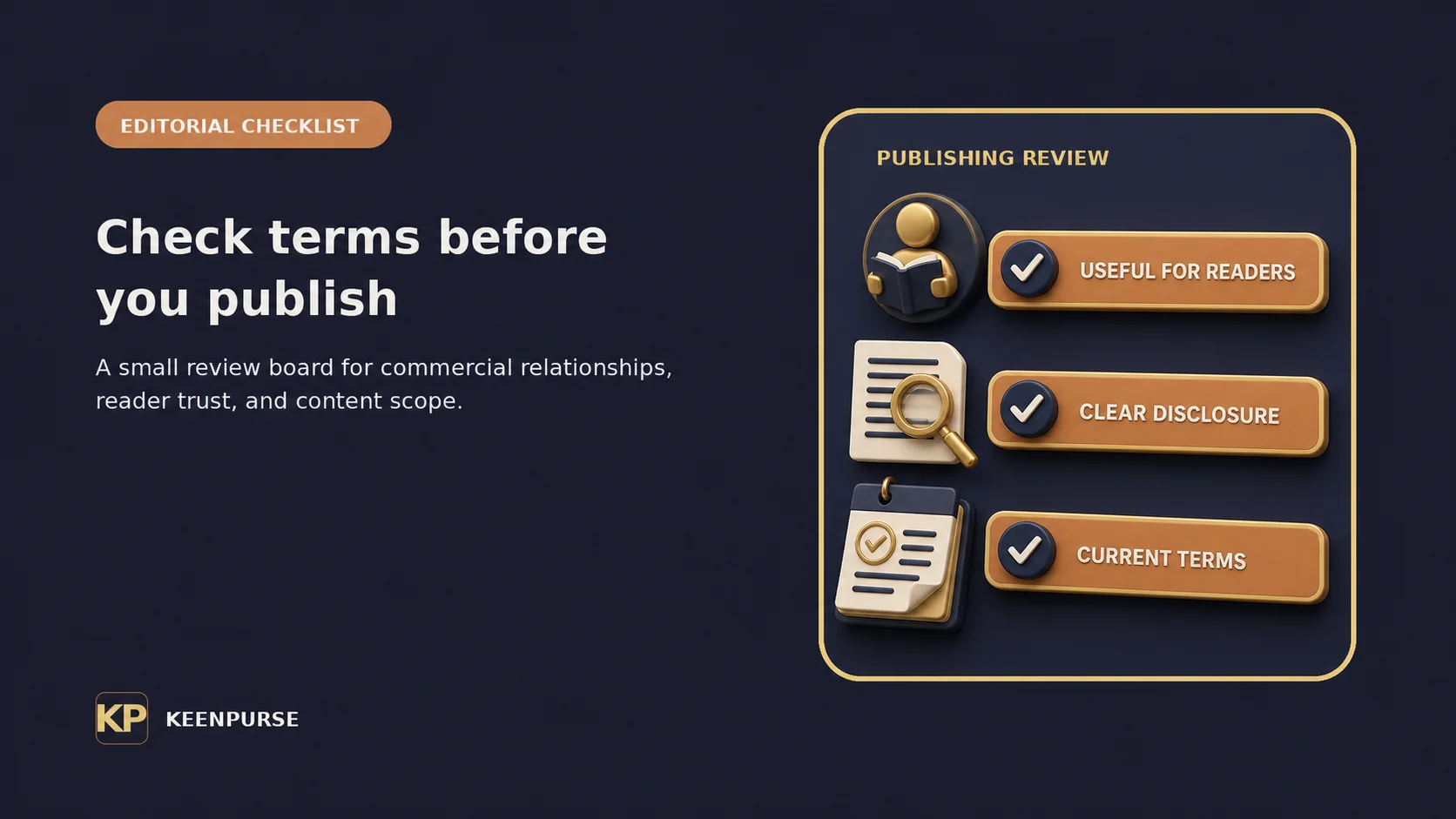
Make money blogging checklist: reader value, clear disclosure, and current terms
Make money blogging — publishing checklist

For how to make money blogging with commercial relationships, a disclosure is not decorative fine print. When a commercial relationship affects content, the publisher should use clear disclosure suited to the relationship and jurisdiction . Do not copy a disclosure from another site and assume it applies. Read the applicable guidance and the agreement for the specific program before publication.

This article does not recommend Google AdSense, any affiliate program, Blogger, WordPress, or a particular marketplace. They are examples of platform categories or names readers may encounter, and their features and terms can change .

Start with a reader and a useful topic

For someone learning how to make money blogging, a workable blog begins with a reader question that is narrow enough to answer repeatedly. “Help first-time freelancers understand a client brief” is more usable than “write about careers.” “Help renters build an emergency-fund routine” is more usable than “cover money.” Narrow does not mean tiny; it means you can explain who the article is for, what decision it supports, and what it will not cover.

For how to make money blogging over time, choose a content format you can maintain without making a schedule promise. One writer might publish a detailed guide after careful research; another might maintain a small collection of short explainers. The important operational question is whether each piece is accurate, readable, and connected to the next useful question. Publishing more often does not itself guarantee discovery, trust, traffic, or income .

Before drafting, make a simple content note with four fields:

  1. Reader: Who is trying to do what?
  2. Problem: What confusion, choice, or task does the article address?
  3. Evidence boundary: Which claims require a current primary-source check?
  4. Next step: What related guide would genuinely help after this one?

That process reduces the temptation to use vague topics or force a product into every post.

Traffic is an input, not a promise

People exploring how to make money blogging should remember that readers may find a blog through search, an email list, referrals, or social platforms. Pinterest and Facebook are possible discovery channels; Google AdSense is an advertising program readers may ask about. None should be treated as a guaranteed distribution engine, a shortcut, or an endorsed strategy here .

Keep the roles separate when considering how to make money blogging. Search can help a reader locate an answer. Email can give a publisher a direct way to share updates with subscribers who chose to receive them . Social posts can point people toward a longer guide. A blog can also be found through a link from another site. Each channel has changing rules, technical choices, and audience behavior that need current official documentation before a specific tactic or claim is published .

For a broader map of side-hustle categories—not a forecast of what will work—see 10 side hustles that actually pay in 2026.

“How much can a blog make?” without turning uncertainty into a promise

When considering how to make money blogging, income anecdotes are tempting because they turn a complicated process into a neat number. They are not a forecast for a reader. They may omit costs, taxes, unpaid labor, timing, audience source, program changes, refunds, or the difference between gross revenue and personal take-home results .

For how to make money blogging without false precision, use a reader-entered worksheet instead of a default earnings estimate:

Input to write down Your assumption Why it stays uncertain
Readers or visits in a chosen period __________ Discovery and audience behavior can change
Monetization method __________ Eligibility, terms, and disclosures vary by program and location
Reader action required __________ Clicks, purchases, inquiries, or other actions are not assured
Costs and time __________ Tools, hosting, contractors, taxes, and personal time differ

In a guide to how to make money blogging, the arithmetic is deliberately unfinished. Supplying a sample traffic figure, rate, conversion percentage, or payout would create false precision. A reader can use their own documented assumptions to see which variables would matter, then test the business and compliance details with current sources . That is more honest than implying an average blogger outcome.

Is blogging worth it in 2026? Use a decision checklist

For a person asking how to make money blogging, “worth it” is a personal judgment, not a universal verdict. In 2026, a reasonable assessment still starts with the same questions: Do you want to write for a defined audience? Can you tolerate uncertain, delayed results? Are you comfortable maintaining accuracy and updating older posts? Would client work or a product better fit your available time?

  • I understand that a blog is an owned-audience project, not passive income.
  • I can name a reader problem I will address without promising results.
  • I have a process for checking claims, links, disclosures, and changing terms .
  • I can separate useful editorial content from commercial relationships.
  • I have considered the opportunity cost against client services or a product route.

If your aim in learning how to make money blogging is actually a reusable product rather than a publication, compare that path through How to start an Etsy shop. If your aim is foundational cash resilience first, read How to build an emergency fund in 90 days.

Hype and boundary checks

People researching how to make money blogging should be wary of phrases such as “free blog,” “AI blog,” or “make money without investment” when they erase labor, tool choices, policy limits, or uncertainty. AI can be a drafting tool, but it does not remove the need to verify facts, make editorial judgments, respect disclosures, or create content readers find useful . “Free” can also be misleading when a project may involve time, optional tools, or changing platform terms .

How to make money blogging is a written-content route, not a promise about a video-first format. YouTube, TikTok, Instagram, and other video-first formats are sibling channels, not a substitute topic for this guide. Likewise, a blog should not be labeled passive income simply because content may remain available after publication. For that category boundary, see Passive income ideas.

Build a small editorial operating system

A blog becomes easier to manage when every article has a defined job, which is central to a thoughtful approach to how to make money blogging. That does not require expensive software or a large team. It means recording the reader question, the claims that need checking, the useful related article, and any commercial relationship that needs a clear disclosure . A simple spreadsheet or document can be enough for this planning work; the tool itself does not guarantee better content or results.

For how to make money blogging with a repeatable process, try a four-column review before an article goes live:

Review question What to record Why it matters
What is the reader trying to decide or do? One plain-language question and the intended audience It keeps the article focused rather than chasing broad keywords.
Which statements can change? Platform terms, laws, prices, product features, statistics, and dates requiring a current source check Current details need a primary source and a publication check.
What commercial relationship exists? Advertising, affiliate, sponsor, or own-offer connection The relationship may require clear disclosure under applicable rules .
What should the reader read next? One relevant internal guide A useful next step is better than a forced link or unrelated promotion.

For how to make money blogging without blurring trust, this operating system also protects the separation between editorial work and marketing. An article can explain a category without recommending a provider. It can describe an affiliate relationship without implying that readers should buy. It can mention a sponsored arrangement only with the disclosures and terms appropriate to the arrangement and jurisdiction . When facts cannot be checked before publication, remove the claim or remove the claim until it can be checked rather than filling the gap with confident-sounding copy.

Older posts deserve the same discipline when you are learning how to make money blogging. A guide that once described a platform feature or disclosure practice may become inaccurate after a policy or legal change . Schedule an occasional review of links, dates, screenshots, product statements, and calls to action. Updating for accuracy is not evidence that a post will rank, gain traffic, or earn revenue; it is basic editorial maintenance .

For a blog that covers personal finance, this is especially important when evaluating how to make money blogging. Educational content should distinguish general explanation from advice tailored to someone’s debt, savings, taxes, investments, or legal situation. If a post needs a current rule or a country-specific answer, cite an authoritative current source and confirm that it applies to the reader’s context .

Frequently Asked Questions

How do bloggers make money?

For how to make money blogging, publishers may consider advertising, affiliate relationships, sponsored posts, or their own products and services after creating useful content for an audience. The applicable terms, disclosure duties, eligibility, traffic, and financial result remain uncertain and should be checked with current sources .

Can beginners make money blogging?

A beginner learning how to make money blogging can start a blog, but starting does not establish monetization, an audience, approval for a program, or income. Begin with a reader problem and useful content, then evaluate any monetization method and its current requirements carefully .

How long does it take to make money from a blog?

For how to make money blogging, there is no reliable universal timeline. Discovery, content quality, reader needs, platform terms, commercial relationships, and many other variables differ. Treat claims about a standard time to income as unverified unless supported for the precise context .

Is blogging worth it compared with freelance writing?

For how to make money blogging, it depends on the work you want to do and the uncertainty you can accept. Freelance writing focuses on client services; blogging focuses on an audience-facing content asset. Neither route guarantees income, and pricing or outcomes should not be assumed .

Do I need ads or affiliate links to monetize a blog?

For how to make money blogging, no single method is universally required. A publisher may consider ads, affiliate relationships, sponsorships, or an offer they own, subject to current terms and appropriate disclosures . The best fit depends on the content, reader, and obligations involved.

Can I start a blog without promising income?

Yes. A responsible approach to how to make money blogging can focus on helping readers understand a topic without presenting revenue as guaranteed. Keep commercial relationships clear, avoid unsupported earnings claims, and direct readers to current primary sources for terms and disclosure requirements.

Sources and further reading

⚠️ Educational information only. Full disclaimer.

How to Make Money Blogging: Four Real Income Categories and a Decision Checklist Read More »

Cash Stuffing for Beginners: What It Is, How to Set It Up, and Its Honest Limits

TL;DR

Cash stuffing is a way to make a spending plan visible: decide an amount for a category, set that cash aside, and track what leaves the envelope during a chosen period. It can be useful as an organizing routine, but it does not create income, erase debt, or guarantee savings. Start with variable spending categories and amounts from your own plan—not a universal formula.

Key Takeaways

  • Cash stuffing, the cash envelope system, and envelope budgeting are three names commonly used for the same allocate-cash method.
  • Start with categories where the amount can vary, such as groceries or personal spending, rather than trying to convert every bill to cash.
  • Put a reader-entered planned amount on each envelope; the label is a recordkeeping tool, not a recommended spending limit.
  • Record each withdrawal from the envelope so “cash on hand” does not become a mystery at the end of the week.
  • A digital or hybrid version can separate category balances without carrying notes and coins; features and protections depend on the tool and provider.

What is cash stuffing?

Cash stuffing means allocating a pre-decided amount of cash to individual spending categories before you spend it. A person might label envelopes “groceries,” “transport,” and “fun,” then place the amount they chose for the period inside each one. When they pay cash from a category, they update the envelope or a tracker.

The point is visibility. Instead of seeing one undifferentiated bundle of cash, you can see which part of the plan was assigned to which job. It is simply one way to organize variable spending; it is not a universal solution. It is simply one way to organize variable spending.

A fictional example: Jordan plans a 14-day period and writes a reader-chosen amount of 80 units of local currency on a grocery envelope. After spending 23 units, Jordan records 57 units remaining. The example shows the subtraction, not a suggested grocery budget or a typical result.

For a general budgeting reference, consult the Consumer Financial Protection Bureau’s budgeting resources. The resource is U.S.-focused; use local guidance where rules or options differ.

Cash stuffing, cash envelope system, and envelope budgeting

The names can make this method sound more complicated than it is. Cash stuffing generally describes the same core sequence: decide, separate, spend, and review. “Digital envelopes” use separate balances or records instead of physical cash, so they are a variation on the allocation idea rather than an entirely different budgeting method.

Name you may see What it usually refers to Practical meaning
Cash stuffing A current, informal label Putting planned cash amounts into categories
Cash envelope system A longstanding label Using labeled envelopes to hold category cash
Envelope budgeting A general method name Assigning money to categories before spending
Digital envelope A hybrid or non-cash variation Tracking separate category balances or pots
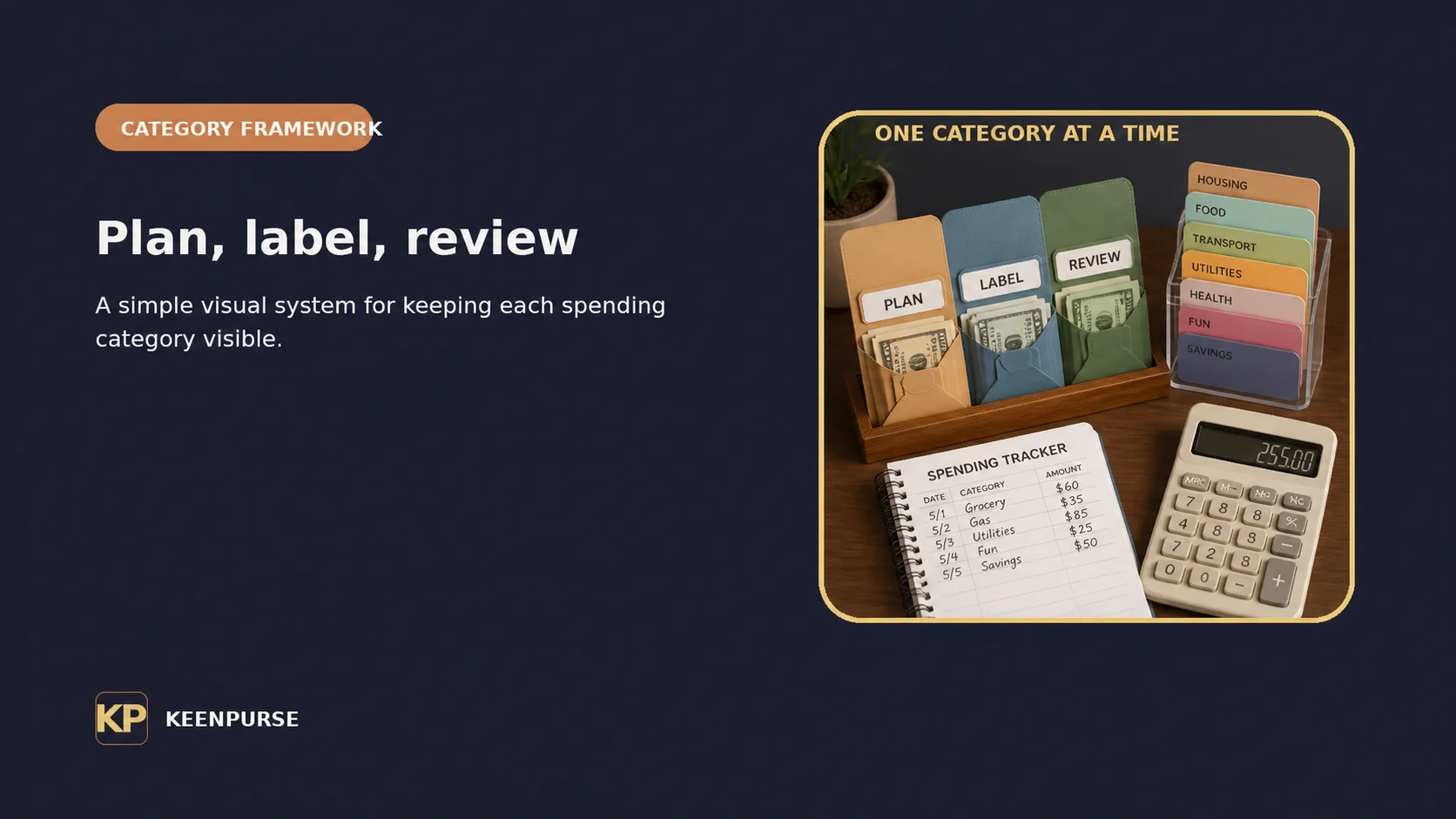
Cash stuffing framework: plan, label, and review category cycle
Cash stuffing — category framework

Avoid treating a binder, wallet, printable, or social-media trend as the method itself. The container is optional; the category plan and review habit do the work.

Choose categories before withdrawing cash

Choose categories first, then decide whether cash stuffing fits them. Variable categories are often easier to observe with envelopes because the amount may change from period to period. Fixed commitments, such as rent or a recurring bill, may call for a different recordkeeping method.

Do not begin with every line in your finances. Pick a small number of categories you can clearly name and track. The amounts belong to your own plan. If you need a framework for dividing overall spending priorities, see the 50/30/20 budget rule; this article does not set or repeat allocation percentages.

Category type Example category Use an envelope? Amount to enter
Variable essential Groceries If cash works for your purchases Your planned amount
Variable essential Local transport If cash is accepted and practical Your planned amount
Flexible Eating out Optional Your planned amount
Flexible Personal spending Optional Your planned amount
Goal-directed A named short-term goal Optional; keep the purpose clear Your chosen transfer or set-aside
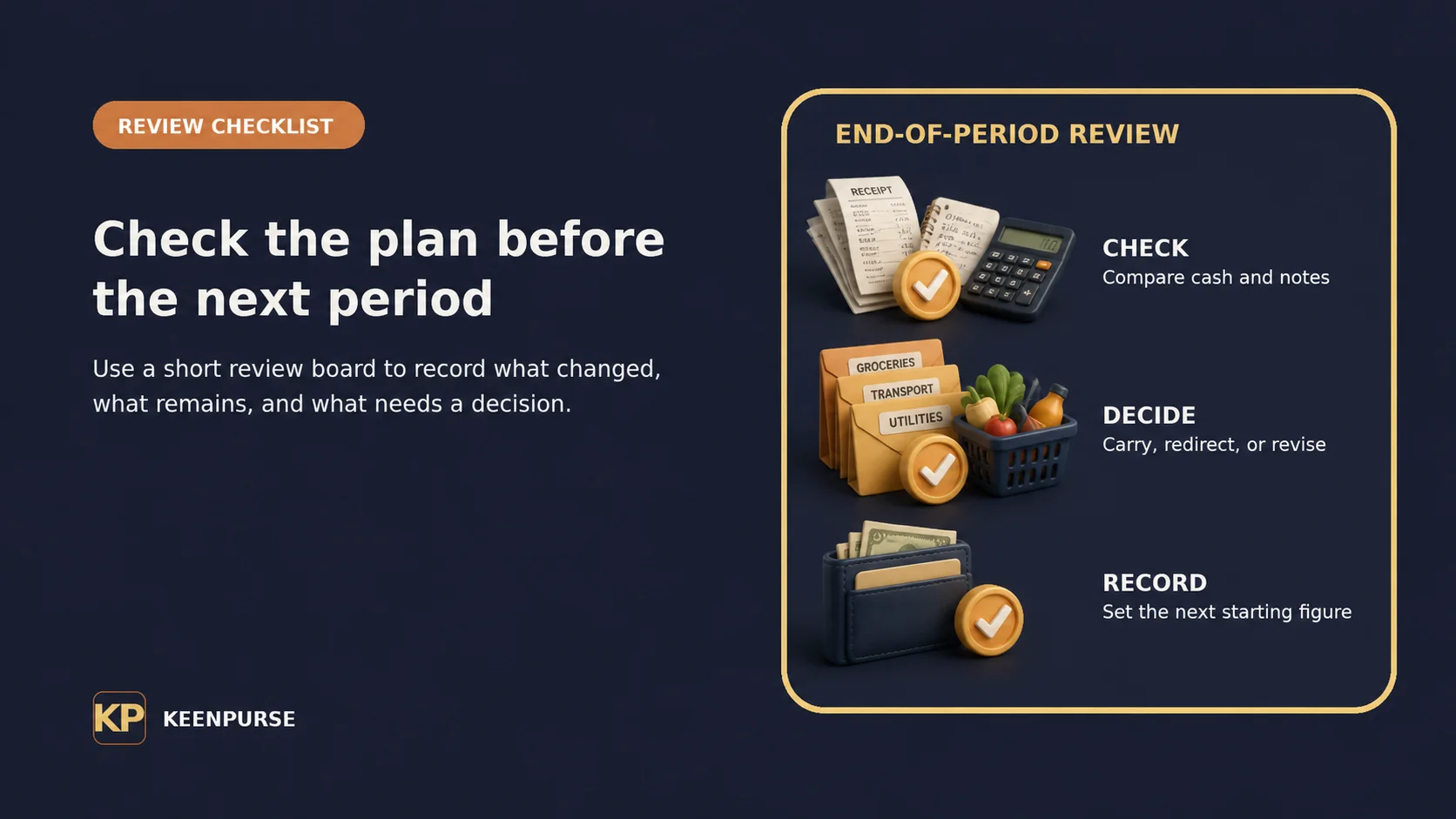
Cash stuffing review checklist: compare cash, decide next steps, and record the new starting figure
Cash stuffing — review checklist

A category should describe a real decision you make. “Miscellaneous” can be useful for small surprises, but a large catch-all category may hide the very choices you wanted to see.

How to set up a cash envelope system

Set up cash stuffing with a short, repeatable sequence:

  1. List the categories you want to track. Use a few variable categories rather than copying someone else’s binder labels.
  2. Choose the period. It could be a week, two weeks, or another interval that matches how you review your spending. The interval is your organizational choice, not a rule.
  3. Write the planned amount for each category. Use figures from your own plan and mark the currency if needed.
  4. Label the envelopes. Include the category, period, and planned amount. A plain envelope, folded paper, or another secure method can work; do not assume a retail product is necessary.
  5. Allocate the cash. Count it once and note the starting amount in the tracker.
  6. Record spending as it happens. Write the amount and subtract it from the category balance. Keep receipts only if they help you reconcile later.
  7. Review before refilling. Compare the plan, spending record, and cash remaining. Use what you observe to reconsider the next period, not to judge yourself.

Keep practical safety and payment constraints in view. Consider the practical risk of carrying cash and whether the merchant accepts it. If an expense must be paid electronically, forcing it into a cash envelope can create extra confusion rather than clearer records.

Built-in printable category and tracker table

Copy this table into a notebook, spreadsheet, or printed page. Blank cells are intentional: fill them with your own category names and amounts. It is a planning aid, not a promised download, product, or financial recommendation.

Category Planned amount Spent Remaining Review before next period
Groceries ______ ______ ______ Keep, change, or split category?
Transport ______ ______ ______ Did the period fit your routine?
Eating out ______ ______ ______ Was each payment recorded?
Personal spending ______ ______ ______ Carry forward or reconsider?
Other: ______ ______ ______ ______ Is this category specific enough?

To calculate the final column of numbers, subtract recorded spending from the planned amount. For example only, a fictional planned amount of 50 units minus 18 units recorded equals 32 units remaining. That arithmetic does not predict how much anyone should spend or save.

Cash stuffing without cash

You can use cash stuffing logic without carrying physical cash. A hybrid system might keep money in an account while a notebook, spreadsheet, or app records category balances. Some services may offer labeled balances, transfers, or budgeting features, but availability, fees, terms, and transaction handling can vary by provider and location.

The question is simple: can you see the category amount and update it after spending? A manual sheet may be enough for some people. If you are comparing digital tools, read our budgeting app comparisons for the product-review scope rather than treating this guide as an app recommendation.

A hybrid approach also needs a reconciliation step. If a card transaction is recorded late or a balance changes for another reason, check the account record and update the category log. Check the relevant account record before treating a displayed balance as available cash.

What to do with money left in an envelope

At period end, unspent cash is information before it becomes a decision. You can carry it into the same category, assign it to a named goal, or use the review to adjust a future planned amount. None is automatically best; the choice depends on the purpose of the category and your wider plan.

If you want to direct leftover money toward irregular future costs, learn how to create a sinking fund. If your goal is a cash reserve for unexpected expenses, read the emergency-fund guide. Those pages cover different goals, so do not assume every leftover amount belongs in the same destination.

A simple review note can prevent a common mistake: record whether the money was carried forward, moved to a goal, or returned to general cash before starting the next period. That preserves the connection between the envelope total and your tracker.

Boundaries, hype, and common mismatches

Cash stuffing is not a no-spend challenge, a debt repayment plan, an app review, or a requirement to buy a binder or supplies. For a time-limited spending freeze, see the no-spend week budget reset. It also is not a “cash stuffing business” opportunity. Treat social-media offers, kits, and income claims with caution; check the seller, terms, consumer protections, and applicable local rules before paying or sharing information.

Use the monthly money reset checklist if you want a broader routine around reviewing categories. Keep this method narrow: it is an allocation and recordkeeping tool.

A practical two-period review example

A cash stuffing review becomes easier to understand when the review is as specific as the setup. Consider this fictional example, using “units” rather than a real currency. Sam chooses two variable categories for a seven-day period: groceries and coffee. Sam enters 90 units for groceries and 20 units for coffee after looking at a personal spending plan. These are made-up numbers for an illustration, not a recommendation.

On day three, Sam spends 34 units on groceries and records the transaction. On day five, Sam spends 8 units on coffee. The tracker now shows 56 units remaining for groceries and 12 units remaining for coffee. The useful part is not whether either figure is high or low. It is that Sam can compare the record with the cash still assigned to that category before making another purchase.

At the end of the period, Sam has 18 units left in groceries and 4 units left in coffee. There is no built-in instruction that says those amounts must be spent, saved, rolled over, or removed. Sam can write down a decision and begin the next period with a clear starting figure. If cash has been mixed with other money, or a transaction was missed, the review is a prompt to reconcile the difference rather than guess.

Fictional review step Grocery envelope Coffee envelope What the tracker shows
Starting planned amount 90 units 20 units Amount assigned for this period
Recorded spending before review 72 units 16 units Entries should match receipts or notes if used
Cash remaining 18 units 4 units Compare physical cash with the written record
Reader decision ______ ______ Carry forward, redirect, or reconsider next period

Make the record easy enough to keep

A cash stuffing system does not need elaborate stationery. A label, a date, a starting amount, and a place to note spending are enough to test the mechanics. If you use a notebook instead, keep the category heading and running balance together. If you use a spreadsheet, make the balance formula visible so you can check it. The goal is a record you can read during a real purchase, not a perfectly styled template.

Try assigning one job to each line. “Groceries” could mean food bought for home meals, while “eating out” could mean prepared meals or drinks away from home. Your definitions can differ, but write them down if the distinction matters. Without a definition, it is easy to move a purchase between categories simply because one envelope has more cash left.

When more than one person spends from the same category, agree on a simple update rule before the period starts. For example, a fictional household might keep the envelope in one place and require each person to write the amount and date immediately. This is an organizational example, not advice about joint finances. Agree on access, privacy, and safety arrangements before sharing a category.

It is also reasonable to decide that certain purchases do not belong in a cash system. Online orders, automatic payments, refunds, and card-only merchants can make a physical envelope awkward. A written category record can still show the plan, but the cash itself may not be the payment tool. The method should not displace attention to payment due dates, account balances, consumer protections, or merchant rules.

Common setup errors to catch early

A first attempt is more useful when it identifies friction quickly. One common error is withdrawing an overall amount before categories are named. That turns the cash into a pile to divide later, which makes it harder to tell whether the allocation matched the plan. Label categories first, then count the cash into each one.

Another error is treating the remaining amount as a verdict. A full envelope may mean the period was unusual, a purchase was logged elsewhere, or the starting amount did not match the category’s purpose. An empty envelope may mean spending was recorded, another payment method was used, or the plan needs review. Neither result tells you, by itself, what to do next.

Watch for these practical checks:

  • Period mismatch: A weekly envelope may not work if the relevant expense happens once a month. Choose a period that makes the review readable.
  • Missing transactions: A running balance cannot be trusted if some payments are recorded only from memory. Add them when you notice them and reconcile at review time.
  • Mixed categories: If an envelope funds several unrelated jobs, the remaining total answers fewer questions.
  • Unclear cash handling: Store cash in a way that considers household access and loss risk. Choose a storage approach that fits your household and local circumstances.
  • Copying another person’s amounts: Social posts can provide layout ideas, but they do not establish a suitable category plan or financial outcome for you.

For a broader month-end review routine, use the monthly money reset checklist.

How to decide whether this method fits a purchase

Before placing an expense in a cash stuffing envelope, ask four plain questions. Is the category variable enough that a planned amount would be useful to see? Can you pay for it with cash without creating a missed payment or extra complication? Can you record the transaction promptly? And will you review the result before making the next allocation?

If the answer to one of those questions is no, use another tracking approach for that category. That choice does not mean cash stuffing failed. It means a physical allocation tool has limits. For example, a person may use envelopes for a market purchase but keep a recurring electronic bill in a calendar and account register. Separating the tools can be clearer than forcing every expense through the same format.

Payment terms and cash acceptance can differ by merchant and payment method. Check the current terms before changing how you pay. For UK readers, MoneyHelper’s budgeting guidance is another general starting point; cash stuffing does not replace a bank’s records, a payment agreement, or local consumer guidance.

Frequently Asked Questions

What is cash stuffing?

Cash stuffing is the practice of setting aside pre-decided cash amounts for named spending categories and recording what is spent during a chosen period. It is an organizational method, not a savings guarantee or debt solution.

Is cash stuffing the same as envelope budgeting?

Usually, yes. Cash stuffing, cash envelope system, and envelope budgeting are commonly used for the same allocate-cash idea. The labels vary, but the core process is assigning category amounts before spending.

Which cash stuffing categories should I start with?

Start with a small number of variable categories you can name clearly, such as groceries, transport, or personal spending. Enter amounts from your own plan; no universal category list or amount fits every household.

Can I use cash stuffing without carrying cash?

Yes. A hybrid approach can track separate category balances in a notebook, spreadsheet, or digital tool while payments remain electronic. Provider features, fees, availability, and protections should be checked before choosing a tool.

What should I do with money left in an envelope?

You can carry it forward, direct it to a named goal, or revise a future category plan. Record the choice so the cash and tracker remain aligned. The appropriate option depends on your own priorities.

Is cash stuffing a business?

No. Cash stuffing is a budgeting method, not a business model or income promise. Be cautious with social-media offers that package it as a route to earnings, and check seller and consumer-protection details.

Country and account-safety limits

Cash stuffing is a general budgeting method; it does not determine how cash deposits, electronic balances, consumer protection, or deposit insurance work. Those protections and access rules vary by country and provider. Before moving money, check the relevant local regulator or deposit-protection scheme and keep only an amount of physical cash that is practical and safe for your circumstances.

Sources and further reading

⚠️ Educational information only. Full disclaimer.

Cash Stuffing for Beginners: What It Is, How to Set It Up, and Its Honest Limits Read More »

Prepared meeting table with evidence folder and calendar

How to Negotiate a Raise: A Practical Script, Timing, and Evidence Checklist

TL;DR

Learning how to negotiate a raise starts with treating it as a professional request: explain the work you have done, the scope you now carry, and the pay question you want discussed. It is not a favor, a confrontation, or a guaranteed route to higher pay. A competing offer is not required, but a polished script or a market figure does not compel an employer to change compensation either.

To learn how to negotiate a raise, gather specific evidence, choose a reasonable moment, make a clear ask, then agree on a next step. Local employment rules, pay-review practices, and compensation data vary .

Key Takeaways

  • Separate a current-job raise request from a new-job salary discussion; the timing and information available are different.
  • Bring a short record of outcomes, new responsibilities, and relevant skills rather than a vague statement that you work hard.
  • Ask a direct question about compensation and the decision process; do not rely on hints.
  • Treat salary websites and market figures as dated, location- and role-specific inputs, not universal proof .
  • If the answer is no or not yet, leave with a documented next step: what would change the decision, who decides, and when the topic can be revisited.

How to Negotiate a Raise: Understand the Conversation

Both conversations call for preparation and a clear ask. A raise request concerns work already performed; a salary discussion after an offer concerns the role and package before a new arrangement begins. Manager, HR, and recruiter processes can vary .

ConversationUsual momentUseful evidence to prepareA clear objective
Current-job raiseA scheduled review, documented change in responsibilities, or another appropriate point in the employer’s cycle Results, expanded scope, feedback, relevant skills, and role informationAsk whether compensation can be reviewed and what the process is
New-job salary negotiationAfter the employer has shared an offer or invited a compensation discussionThe role scope, offer details, questions about the package, and carefully attributed current market information Ask whether the offer can be discussed in light of the role and your fit
How to negotiate a raise: a practical decision framework for preparing evidence
A practical decision framework

Neither setting produces an automatic outcome.

How to Negotiate a Raise: Prepare Your Evidence

Build a one-page preparation note. Its job is to make the conversation specific.

Evidence areaWhat to recordWhat to avoid
OutcomesA completed project, a customer or team problem addressed, a process improved, or a goal metBroad claims such as “I do everything” without examples
Added responsibilitiesTasks or decisions that became part of your role, plus when that changedAssuming a temporary favor permanently changed your job level
Skills and scopeTraining, systems knowledge, or responsibility relevant to the roleListing credentials with no link to the work you perform
FeedbackDated feedback, recognition, or agreed goals where appropriatePrivate information you are not entitled to share
ProcessReview dates, budget timing, and the person who makes or informs the decision Assuming every employer uses the same annual cycle
KeenPurse editorial illustration: Questions to check before acting
Questions to check before acting

If you consult compensation data, record the source, date, role definition, location, and whether it covers salary or total compensation . A comparable-looking number may reflect another seniority level, working pattern, or industry. It can inform a question, not prove a universal benchmark.

A fictional example: “Since January, I took responsibility for weekly reporting and trained two colleagues. I would like to discuss whether my compensation reflects that expanded scope.” Use only facts, dates, and impact you can support.

How to Negotiate a Raise: Choose the Timing

When deciding how to negotiate a raise, remember there is no universal best month. A useful time connects the request to documented work and a real decision path. Employer calendars, budgets, and review rules differ .

SituationWhy it may be a workable openingQuestion to ask
Scheduled reviewCompensation may already be part of the conversation “Is compensation reviewed as part of this process, and what information is most useful?”
Material responsibility changeThe role may have changed enough to warrant a discussion“Now that this responsibility is ongoing, can we discuss how the role and compensation are assessed?”
Documented resultsYou can point to completed work rather than future promises“I would like to review my contribution and discuss compensation.”
A new offerIt may clarify your choices, but it is not required for a professional request“Could we discuss the offer and how the package reflects the role’s scope?”

Do not use an offer as leverage unless you are prepared for the consequences. Do not make threats or imply an employer must match another situation. Without an offer, documented work and a direct question remain a professional basis for conversation.

How to Negotiate a Raise: Use a Respectful Script

Use this as an educational planning aid, not a legal process or a guarantee. Replace the brackets with accurate details and keep the tone matter-of-fact.

> “I’d like to discuss my compensation and the scope of my role. Since [date], I have [two or three specific responsibilities or outcomes]. For example, [brief, supportable example]. I would like to understand whether my compensation can be reviewed in light of that work. What is the process from here, and what information would help you evaluate it?”

Then pause and listen. If the decision sits elsewhere, ask who is involved and when to expect an update. Record the agreed follow-up.

The script has no demanded percentage, salary figure, or ultimatum. Those details depend on the role, employer, location, and available information .

A salary-negotiation email template

An email can request a conversation without resolving every detail in writing.

Subject: Request to discuss compensation

Hello [name],

Thank you for taking the time to discuss [my role / the offer / my current responsibilities]. I would appreciate an opportunity to talk about compensation.

Since [date or relevant point], I have [specific responsibility or result]. I have also [second relevant example]. Based on the scope of the role and the information I have reviewed, I would like to discuss whether the compensation can be reconsidered.

Could we arrange a time to discuss the process and next steps?

Thank you, [name]

Before sending, remove claims you cannot document. The channel, notice, and review process can be employer- and jurisdiction-specific .

What if the answer is no—or not yet?

A no is information, not necessarily the end. Ask which criteria would make a future review possible, what evidence would matter, who decides, and when the topic can return.

Confirm an agreed date or trigger in a follow-up note. A delay or rejection does not by itself establish a legal or discriminatory issue; rights and complaint routes are jurisdiction-specific . Seek qualified local help for a specific employment dispute.

Pay rise, promotion, freelance rate, and side hustle: keep the boundaries clear

A pay rise concerns compensation. A promotion may involve a different title, scope, selection process, or pay decision; none is automatic . Freelance pricing concerns client-service work, not employee compensation—see how to price freelance services. For another negotiation setting, learn how to negotiate lower household bills.

A higher income does not replace a plan for spending or saving. Revisit the 50/30/20 budget rule after a pay change, and do not treat an expected raise as money already available. This side-hustle overview covers additional work.

Before you learn how to negotiate a raise, decide which conversation you are actually in: a request about work already performed or a discussion about a role before it begins.

How to Negotiate a Raise: Frequently Asked Questions

When is the best time to ask for a raise?

A scheduled review, a documented expansion in responsibilities, or a point after supportable results may create a useful opening. There is no universal best date: employer review calendars and local practices vary . Ask how and when compensation decisions are made.

How do I ask for a raise without another job offer?

To negotiate a raise without another offer, prepare a concise record of your work, expanded responsibilities, and relevant skills. Ask directly for a compensation review and for the decision process. Another offer is not required, and its absence does not make the conversation unprofessional.

What should I say in a salary-negotiation email?

State the purpose, give two or three accurate examples tied to the role, ask to discuss compensation, and request a meeting or next step. Avoid unsupported market claims, threats, or an amount that you cannot explain.

Is asking for a raise the same as asking for a promotion?

No. A raise is a compensation request; a promotion can involve a different role, title, scope, or selection process. How an employer treats either request varies, so do not assume one automatically leads to the other .

How is negotiating a freelance rate different from negotiating a salary?

A freelance rate is part of a client-service arrangement that can involve project scope, expenses, deliverables, and business risk. Salary negotiation concerns employee compensation. The preparation overlap is real, but the relationship and terms are not the same.

Official sources and further reading

⚠️ Educational information only. Full disclaimer.

How to Negotiate a Raise: A Practical Script, Timing, and Evidence Checklist Read More »

Statements organized into one repayment folder and calendar

Debt Consolidation Explained: When Combining Debt May—or May Not—Help

TL;DR

Debt consolidation generally means replacing or combining multiple debts with a new repayment arrangement. A single payment may simplify administration, but it does not by itself reduce the amount owed or assure a lower total cost. Whether it changes the total cost, payment, access to credit, or credit reporting depends on the actual agreement, fees, eligibility, and local rules.

The useful question is whether you can compare the full old and proposed repayment paths without relying on a headline rate or sales promise.

Key Takeaways

  • Debt consolidation changes the structure of repayment; it is not debt forgiveness.
  • A consolidation loan and a balance-transfer card can both combine balances, but their terms and risks can differ materially.
  • Debt settlement and a debt management plan are separate approaches, with different parties involved and different treatment of what is owed.
  • Compare total repayment cost, fees, repayment length, payment timing, and what happens to the accounts you already have—not just one monthly figure.
  • If a proposal involves property as collateral, insolvency, a mortgage application, or a claim about credit effects, pause for country-specific professional or regulator-backed information.

What is debt consolidation, and is it a good idea?

Debt consolidation restructures several balances into one repayment arrangement. Fewer payments do not erase the underlying obligation.

Whether it is a good idea depends on the agreement and the reader’s circumstances. A shorter repayment period could raise a required payment; a longer one could change the total amount repaid. Fees, missed-payment consequences, changing rates, and old-account rules may also matter.

“Lower monthly payment” may reflect a different interest cost, a longer term, or both. Compare terms rather than treating consolidation as automatically cheaper or easier.

How debt consolidation works: two common routes

The two routes readers often encounter are a consolidation loan and a balance-transfer card. Neither is automatically available or suitable, and the details below are categories rather than product recommendations.

RouteWhat it may combineHow repayment is structuredTerms to read closelyMain question to ask
Consolidation loanMultiple eligible balances may be paid using proceeds from one new loan One loan payment over the stated term Interest/APR, origination or other fees, repayment schedule, late-payment terms, whether collateral is required What is the total amount I would repay from today through the final scheduled payment?
Balance-transfer cardEligible card balances may be moved to another card Payment is made to the receiving card under its agreement Transfer fee, promotional-period conditions, ongoing rate, required payments, timing, and what happens after a promotion Can I meet every condition and repay under the actual card terms—not an assumed offer?
Debt consolidation: a practical decision framework for comparing routes
A practical decision framework

With a loan, read the repayment term, payment schedule, and fees. With a balance transfer, read eligible balances, transfer timing, fees, rate or promotional terms, and consequences of late or insufficient payments. Do not assume a transfer closes, leaves open, or changes an original account; confirm with each issuer.

Fictional illustration: three balances total $3,000. One proposal could have a lower payment because it runs longer; another could end sooner with a higher payment. This is not a typical rate, fee, approval, or savings outcome. It shows why the whole schedule matters.

For a plain-language explanation of card statements, interest, and balance-transfer terminology, see How Do Credit Cards Work?.

Debt consolidation vs debt settlement vs a debt management plan

These terms are frequently grouped together, but they describe different processes. Country-specific definitions, licensing, disclosure duties, and consumer protections can vary. The table is a map for questions to ask, not a substitute for a local regulator, nonprofit adviser, or qualified professional where appropriate.

ApproachWho may be involvedTreatment of existing balancePayment arrangementQuestions and cautions
Debt consolidationA lender, card issuer, or another provider of a new repayment product Existing balances may be transferred or paid off and replaced by a new balance One new loan or card repayment pathWhat are the full costs, term, security/collateral terms, and account changes?
Debt settlementThe reader, creditors, and sometimes a settlement provider A process may seek a negotiated reduction; a reduction is not guaranteed Terms depend on any agreement reached What fees, risks, creditor communication, and local legal effects apply?
Debt management planThe reader, creditors, and sometimes a credit-counselling or plan provider Balances are generally managed under a repayment arrangement rather than replaced by a new consolidation loan Payments may be coordinated through a plan Who administers it, which debts are covered, what fees apply, and what happens if a payment is missed?
KeenPurse editorial illustration: Questions to check before acting
Questions to check before acting

Ask a company to state in writing whether it is lending, arranging a transfer, negotiating with creditors, administering a plan, or charging for another service. Be cautious with pressure to sign or a guaranteed-result claim.

Debt consolidation pros and cons

A possible benefit can become a drawback when the contract or repayment behaviour changes.

Possible advantageTrade-off or risk to examine
Fewer payment due dates may simplify administration.One missed payment can still have consequences under the new agreement.
A single statement may make the remaining balance easier to track.A simpler statement does not prove a lower total repayment cost.
A different repayment schedule may create a clearer end date.Extending the term can change the total repaid.
Some balances may be moved into one product.Transfer, origination, annual, late, or other fees may apply.
Old cards might show a zero transferred balance.New spending on old or new credit lines can create additional debt; account access and terms are issuer-specific.
A secured arrangement may offer a different structure.Property or another asset used as collateral can create serious additional risk.

Put the proposed agreement beside current statements. Include every known fee and scheduled payment; ask for unclear figures in writing before signing.

A decision checklist before you apply

  1. List each balance, due date, stated rate or APR, fees, and remaining term where shown.
  2. Record the proposal’s term, payment schedule, interest or APR, fees, and conditions that can change the cost.
  3. Compare total scheduled repayment under both paths. If unclear, request a written illustration or local professional help.
  4. Identify any collateral. If a home, vehicle, savings, or another asset is involved, seek appropriate local guidance.
  5. Ask what happens to old accounts after a transfer or payoff; do not assume closure, available credit, or future terms.
  6. Test the proposed payment against documented income and essential bills. Keep statements and disclosures; marketing is not the agreement.

Use The 50/30/20 Budget Rule as a general starting framework for mapping essential bills and debt payments.

Mortgage, bankruptcy, and bad-credit questions: keep the scope clear

Consolidation before a mortgage application, home-equity borrowing, insolvency or bankruptcy, or a bad-credit concern can involve country- and provider-specific lending, property, legal, and reporting issues. Use current local regulator, consumer-authority, insolvency-authority, or qualified-professional information before acting.

Consolidation is not the same as payoff order

Debt snowball and debt avalanche concern payoff order. Debt consolidation changes the repayment structure. They answer different questions; this guide does not prescribe a payoff method.

Compare payoff-order frameworks in Debt Snowball vs. Avalanche.

If a payment shock exposes a missing cash buffer, review How to Build an Emergency Fund in 90 Days.

Frequently Asked Questions

Does debt consolidation hurt your credit score?

It can involve applications, account changes, payment history, and reporting practices, but the effect depends on the country, credit-reporting system, lender, and the exact actions taken. Do not treat a general claim about a score increase or decrease as a guarantee. Confirm current information with the relevant credit bureau or consumer authority.

Is debt consolidation the same as debt settlement?

No. Consolidation generally restructures multiple balances into one repayment product or arrangement. Settlement is a separate process that may seek a negotiated reduction with creditors; outcomes, fees, and effects are not guaranteed and require local verification.

Is a balance-transfer card a form of debt consolidation?

A balance-transfer card can be one route for moving eligible card balances into one card account. It is not identical to a consolidation loan: its transfer rules, fees, payment requirements, and any promotional terms are card-specific.

Can debt consolidation reduce what I owe?

Consolidation itself does not erase the principal amount owed; it changes how debts are arranged and repaid. A separate settlement process may seek a reduction, but no reduction should be assumed or promised.

What should I compare before consolidating debt?

Compare the complete repayment schedule, interest/APR, every fee, term length, payment due dates, collateral, conditions affecting the cost, and treatment of old accounts. Keep the documents together and ask for unclear terms in writing.

Sources and further reading

⚠️ Educational information only. Full disclaimer.

Debt Consolidation Explained: When Combining Debt May—or May Not—Help Read More »